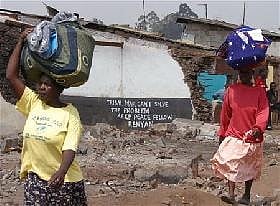
Kenya opposition stronghold devastated by unrest
Niva Ndubi cries as she recalls the moment a stray bullet tore through her shack made of iron sheets, killing her mother. "I was in the neighbour's house when mummy was shot," the nine-year old told Reuters, sobbing. "I could not face seeing her die. I last saw her in the morning after breakfast. I went to play and left her arranging our clothes. I miss her so much," she said.
bdnews24.com News Service
bdnews24.com
Published :
21 Jan 2008, 10:08 AM
Updated :
24 Apr 2022, 08:06 PM
KISUMU, Kenya, Jan 21 (bdnews24.com/Reuters) - Niva Ndubi cries as she recalls the moment a stray bullet tore through her shack made of iron sheets, killing her mother.
"I was in the neighbour's house when mummy was shot," the nine-year old told Reuters, sobbing.
"I could not face seeing her die. I last saw her in the morning after breakfast. I went to play and left her arranging our clothes. I miss her so much," she said.
Judith Naliaka died as youths clashed with police in Kenya's western city of Kisumu, the latest in weeks of bloody unrest which has seen homes and shops burned to the ground.
Her family blames the police.
"We accuse the government for Judy's death," Rose Chakra, one of her cousins, told Reuters. "The police just shot her as she sat in her house."
Her shack stands silent, a hole in its back wall where the bullet entered, clothes and cooking utensils strewn on the floor between two wooden beds exactly as they were when Naliaka was rushed to hospital.
She brought up her daughter alone, and the young girl is now living with neighbours in shacks which lie metres from the railway line running from Kenya to Uganda.
More than 650 people have died across Kenya and a quarter of a million been displaced since President Mwai Kibaki's disputed re-election on Dec. 27 triggered some of the country's worst unrest in living memory.
Kisumu -- Kenya's third largest city and the opposition stronghold -- has witnessed some of the heaviest violence.
"NOWHERE TO RUN TO"
The clashes have paralysed Kisumu. Piles of rubble litter streets where shopping malls once glittered.
Businesses and houses belonging to members of Kibaki's Kikuyu ethnic group -- Kenya's largest and most economically powerful -- or those perceived to support him were looted or razed after his swearing in on Dec. 29.
"My shop and two houses were burnt down. I lost everything that I made for the last 25 years in Kisumu. I just want to leave this city," said Joseph Kahuti at a Kisumu police station, where 65 victims are sheltering, awaiting transport out of town.
Joseph Kariuki, 35, a Kikuyu born and raised in Kisumu, says he will not leave the city where his father settled in 1934.
Unlike many others, Kariuki did not lose anything during the riots. He speaks Luo, the language of opposition leader Raila Odinga's ethnic group, and his linguistic skills saved him.
"I speak better Luo than Kikuyu. I've never left Kisumu and I don't even know where my father hails from in central Kenya. Kisumu is my home and I have nowhere to run to," he said.
The orphaned Ndubi, who is in primary school and has just received a sponsor willing to pay for her education, wants to continue with her studies.
"This is the only present my mum left me," she said, pointing at a tattered English grammar book in her school bag.
"I want to be a teacher when I grow up. English is my favourite subject in school," she said.
bdnews24.com/lq/1606hrs