


Published : 06 Jan 2020, 08:24 AM
Updated : 08 Apr 2022, 02:18 AM


Steeling for retaliation from Iran, a US-led coalition in Iraq and Syria suspended the campaign it has waged against the Islamic State for years as hundreds of thousands of Iranians took to the street to mourn the assassinated general, Qassem Soleimani.
“Iran’s nuclear program will have no limitations in production, including enrichment capacity,” the Iranian government said in an announcement that seemed to signal the de facto collapse of the 2015 agreement.
Warning Iran not to attack, President Donald Trump said the United States had pinpointed 52 targets in Iran — including cultural sites. The sites, he said, represented the 52 American hostages held at the US Embassy in Tehran, Iran, during the Islamic Revolution in 1979.
Amid outrage in Iran, Foreign Minister Mohammad Javad Zarif declared that “targeting cultural sites is a war crime” and predicted that the “end of US malign presence in West Asia has begun.”
Trump has said that the killing of Soleimani on Friday was aimed at preventing war. But so far, it has unleashed a host of unanticipated consequences that could dramatically alter where the United States operates. Increasingly, the killing appeared to be generating effects far beyond the US’ ability to control.
That may include Iran’s nuclear future.
On Sunday, the Iranian government said it was abandoning its “final limitations in the nuclear deal,” the international agreement intended to prevent the country from developing nuclear weapons. The decision leaves no restrictions on Iran’s nuclear program, the statement said, including on uranium enrichment, production, research and expansion.
Iran will, however, continue its cooperation with the International Atomic Energy Agency and return to the nuclear limits if the economic sanctions imposed on it are removed and Iran’s interests guaranteed, the government said. US sanctions have hit Iran’s oil-based economy particularly hard.
Soleimani was a towering figure both in Iran and across the Middle East, where he cultivated proxy militias in Iraq, Syria and Lebanon. Since he was killed in a US drone strike at the Baghdad airport Friday alongside a powerful Iraqi militia leader, Iran and its partners have stepped up calls for vengeance, although they have yet to follow through on the threats.
US allies have largely kept quiet and distanced themselves from the killing so as not to put themselves in the line of fire.
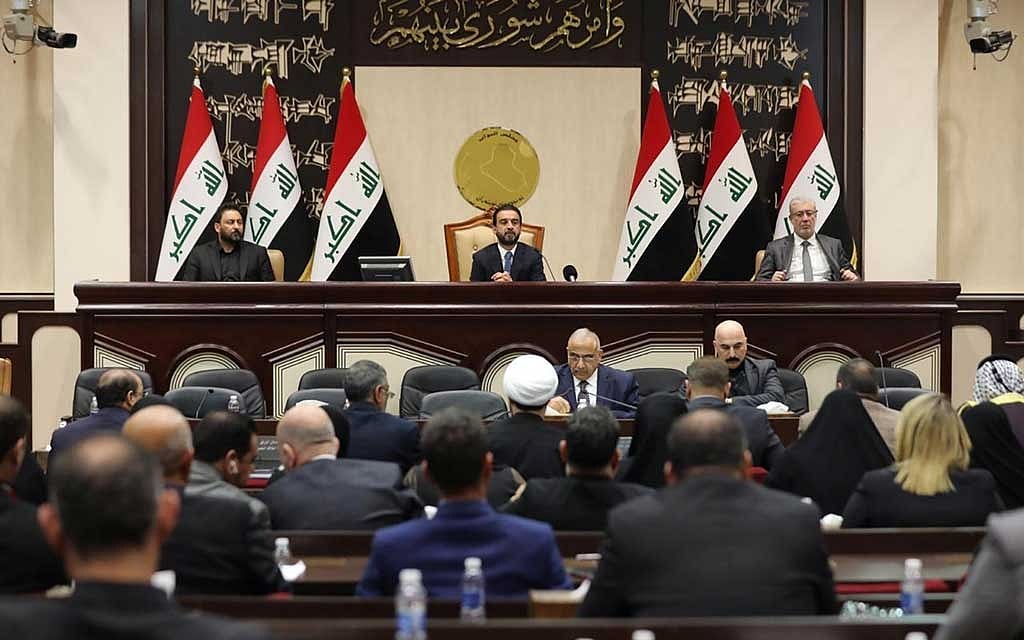
Lawmakers in Iraq voted Sunday to require the government to end the presence of US troops in the country after the United States ordered the assassination on Iraqi soil.
The vote will not be final until it is signed by the prime minister, and it was unclear whether Iraq’s current caretaker government had the authority to end the relationship with the US military.
Few doubted, however, that the country would take whatever legal actions were necessary to compel a US departure over the coming months. Prime Minister Adel Abdul Mahdi of Iraq drafted the language and submitted the bill approved by Parliament on Sunday, leaving little doubt about his support.
Although the vote in Parliament was 170-0, lawmakers were more divided on the issue of ousting US troops than that tally may suggest.
Many of the 328 members of Parliament, primarily those representing the country’s ethnic Kurdish and Sunni Muslim minorities, did not attend the session and did not vote. Iraq’s Shiite Muslim majority dominates the Iraqi government.
While groups that grew out of Shiite militia organisations have pushed hard for the expulsion, Sunni Muslim factions and the Kurds have wanted the United States to stay.
The legislation threads a fine needle: While using strong language demanding that the government “end any foreign presence on Iraqi soil and prevent the use of Iraqi airspace, soil and water for any reason” by foreign forces, it gives no timetable for doing so.
It would end the mission approved in 2014 that gave the United States the explicit task of helping Iraqi forces fight the Islamic State. That agreement gave the Americans substantial latitude to launch attacks and use Iraqi airspace.
But the measure would leave in place the Strategic Framework Agreement, which allows a US troop presence in Iraq in some form, although only “at the invitation of the Iraqi government.”
On Sunday, the US-led coalition in Iraq and Syria said that it would pause its yearslong mission of fighting the Islamic State and training local forces in both countries.
A pullout of the estimated 5,200 US troops in Iraq could cripple the fight against the Islamic State, or ISIS, possibly facilitating its resurgence. A smaller contingent of about 1,000 US troops are in eastern Syria.
The general’s killing unleashed calls for vengeance in both Iraq and Iran and reinforced solidarity among hard-liners and moderates in Iran against the United States. After the vote in Iraq calling on the government to expel US troops, Iranian officials reacted with congratulatory messages.
Hesameddin Ashena, a top adviser to Iranian President Hassan Rouhani, wrote on Twitter, “Expanding friendship with our neighbours and domestic unity are the best gifts for protecting our national security.”
In Iraq, the attack was seen as a violation of the nation’s sovereignty. On Sunday, Iraq’s Foreign Ministry said it had summoned the US ambassador in Baghdad. In Iran, it was viewed as tantamount to an act of war. Hossein Dehghan, a military adviser to Iran’s supreme leader, Ayatollah Ali Khamenei, told CNN that Iran’s response would include an attack on “US military targets.”
As the Middle East braced for Iranian retaliation, which analysts said was all but inevitable and US officials said they expected within weeks, Iran and Washington ratcheted up the rhetoric.
Members of Iran’s Parliament chanted, “Death to America!” en masse in the chamber Sunday in protest over Soleimani’s killing, television footage showed.
The chants came as Trump fired off a series of Twitter ripostes to the growing anger, saying that the United States had already chosen 52 targets in Iran.
Iran summoned the Swiss envoy representing US interests in Tehran on Sunday to protest Trump’s threat that Washington would target Iranian sites. And Trump’s tweet became a rallying cry among Iranians, many of whom shared it widely on social media with the message, “Attend the funeral for our cultural heritage.”
Iran’s information and telecommunications minister, Mohammad Javad Azari-Jahromi, denounced Trump as “a terrorist in a suit.”
“Like ISIS, Like Hitler, Like Genghis!” Jahromi said on Twitter. “They all hate cultures. Trump is a terrorist in a suit. He will learn history very soon that NOBODY can defeat ‘the Great Iranian Nation & Culture.’”
The attack on the Iranian general left the US’ European allies scrambling to address the safety of their troops in the Middle East and complaining that they had been given no warning about the strike. European leaders called for a de-escalation of the tensions between Iran and the United States.
The European Union’s foreign policy chief, Josep Borrell, invited Zarif, the Iranian foreign minister, to Brussels for talks. Borrell said that he had spoken with Zarif, urging “Iran to exercise restraint and carefully consider any reaction to avoid further escalation, which harms the entire region and its people.”
Germany’s foreign minister, Heiko Maas, said he would seek direct talks with Iran. Europe wants to continue the fight against the Islamic State, Maas said, and Germany is anxious about the safety of its troops training Iraqi forces.
Germany’s defence minister, Annegret Kramp-Karrenbauer, said in a statement: “Iraq cannot be allowed to sink into chaos, and certainly not under the control of extremists. Therefore, it is important not to let up now in the fight against Islamic State.”
In general, the Europeans did not specifically criticize Trump for his decision and share the US’ view that Iran has been a destabilising force in the Middle East and a supporter of terrorism. At the same time, no European government praised the killing of Soleimani, emphasising instead the increased risks to their citizens, troops and interests.
Prime Minister Boris Johnson of Britain was reported to be angry with Trump for not informing him or other allies with troops in Iraq about the decision to kill Soleimani. While carried out by Americans, the killing is seen as having put all European citizens and troops in Iraq and the wider region at heightened risk.
Johnson, who was said to be returning early from a vacation in the Caribbean, is expected to discuss the issues with Chancellor Angela Merkel of Germany, President Emmanuel Macron of France and Trump in the next few days, a Downing Street spokeswoman said.
Secretary of State Mike Pompeo complained that the response by European allies had not been “helpful.” He told Fox News in an interview, “The Brits, the French, the Germans all need to understand that what we did, what the Americans did, saved lives in Europe as well.”
Dominic Raab, Britain’s foreign minister, who is scheduled to travel to Washington this week to meet Pompeo, said all countries had a right to defend themselves.
Asked in an interview with the BBC whether the killing was legal, Raab said, “There is a right of self-defence.” He said he did not agree that the killing was an act of war and described Soleimani to Sky News, another British broadcaster, as a “regional menace.”
But Raab also said that he had spoken to Iraq’s prime minister and president to urge a de-escalation of tensions in the region and that he planned to speak to Iran’s foreign minister.
In particular, the Europeans have tried to persuade Iran to keep to the terms of the 2015 nuclear deal, known as the Joint Comprehensive Plan of Action; Trump pulled the United States out of it in May 2018, reimposing harsh economic sanctions on Iran. Iran had slowly abandoned its adherence to parts of the deal before its announcement Sunday.
The Europeans are also working to keep the Strait of Hormuz open to shipping. About one-third of the world’s oil tankers use the waterway, which Iran has intermittently threatened to close. Last July, Iranian forces seized a British-flagged tanker in the strait, trying to pressure the world to allow its oil exports despite US sanctions.
On Saturday, Britain’s defence minister, Ben Wallace, said he had ordered the country’s navy to accompany all British-flagged ships through the Strait of Hormuz.
France has also stepped up diplomatic initiatives to ease tensions. Macron spoke with President Barham Salih of Iraq and the de facto ruler of the United Arab Emirates, Crown Prince Mohammed bin Zayed of Abu Dhabi.
On Sunday, Kataib Hezbollah, an Iraqi armed group close to Iran, warned Iraqi troops on bases that also house US forces that they should stay at least 3,000 feet from their US counterparts starting Sunday evening and not allow themselves to be used as human shields.
In Lebanon, Hassan Nasrallah, head of Hezbollah, another armed group backed by Iran, also called for revenge, telling his followers that US bases, ships and soldiers in the region were “fair targets,” while American civilians were not.
c.2020 The New York Times Company










