


Published : 10 Dec 2019, 08:52 AM
Updated : 17 Oct 2022, 11:50 AM


Investigators uncovered “no documentary or testimonial evidence” that political bias affected how officials conducted the investigation, said the report, which totaled more than 400 pages. The FBI had sufficient evidence in July 2016 to lawfully open the investigation, known as Crossfire Hurricane, and officials followed procedures in using informants to approach campaign aides, the inspector general, Michael E Horowitz, determined.
But Horowitz also uncovered substantial dysfunction, carelessness and serious errors in one part of the sprawling inquiry: the FBI’s applications for court orders approving a wiretap targeting Carter Page, a former Trump campaign adviser with ties to Russia. He found that one low-ranking FBI lawyer altered a related document and referred the lawyer for possible prosecution.
By puncturing conspiracy theories promoted by Trump and his allies, yet sharply criticising law enforcement actions that have not been the subject of public debate, Horowitz’s mixed findings may offer vindication for both critics and allies of Trump. The exhaustive report by an independent official is likely to stand as a definitive accounting of the FBI’s actions in the early stages of the Russia investigation.
Attorney General William Barr, who was said to be sceptical of Horowitz’s conclusion that officials had a proper basis to open the Russia investigation, praised the inspector general but reiterated his long-standing complaints about the FBI inquiry, saying the bureau’s “malfeasance and misfeasance” detailed in the report reflected a “clear abuse” of the wiretap application process.
“The inspector general’s report now makes clear that the FBI launched an intrusive investigation of a US presidential campaign on the thinnest of suspicions that, in my view, were insufficient to justify the steps taken,” Barr said in a statement that echoed his willingness to act as Trump’s defender at the end of the special counsel investigation that grew out of the Russia inquiry.
Horowitz’s findings on the wiretap application showed that when it mattered most — with the stakes the greatest and no room for error — FBI officials on various teams still made numerous and serious mistakes in wielding a powerful surveillance tool. The discovery calls into question the bureau’s surveillance practices in routine cases without such high-stakes political implications.
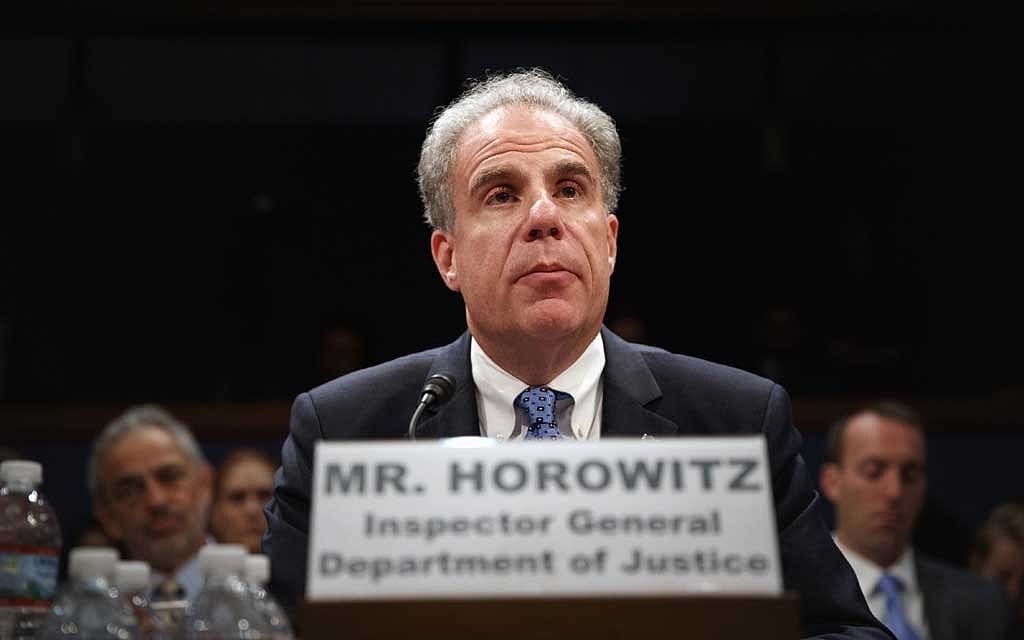
Justice Department Inspector General Michael Horowitz testifies on Capitol Hill on June 18, 2018. The New York Times
The report came on the same day that House Democrats moved forward with their impeachment inquiry into Trump, with a lawyer for the Judiciary Committee telling its members during a hearing that the president’s dealings with Ukraine were “so brazen” that there was no question that he had abused his power to advance his own political interests over the country’s.
The report, as well as Barr’s criticism, is certain to extend the debate over the legitimacy of the FBI’s inquiry. Barr has publicly said he thinks the Trump campaign was subjected to “spying” and tapped John H. Durham, the US attorney in Connecticut, to lead yet another investigation into the Russia investigation.
Though the report largely exonerated FBI officials of the president’s most inflammatory accusations, Trump’s persistent attacks have nonetheless already damaged the bureau’s reputation. Top officials were fired, while others left the bureau.
Much of the report focused on the paperwork associated with the wiretapping of Page, who was first approved for targeting in October 2016, about a month after he had stepped down from the Trump campaign. The Justice Department obtained three renewals of court permission to eavesdrop on Page — two under the Trump administration.
The four applications contained dozens of significant inaccuracies, material omissions or assertions that were not backed in supporting documents, according to the report, which grouped them in a chart. The applications for the wiretap relied on historical information about Page’s contacts before 2016, and claims about his 2016 interactions with Russians came from a notorious dossier of opposition research collected by Christopher Steele, a former British intelligence agent paid by Democrats.
For example, the FBI never told the main Justice Department, which in turn never told the court, that Page had for years been providing information to the CIA about his prior contacts with Russian intelligence officials, including an encounter cited in the application as a reason to be suspicious of him. That made his history less suspicious, Horowitz suggested.
The FBI’s omission of Page’s contacts with the CIA relates to the criminal referral that Horowitz made about an FBI lawyer assigned to assist the Russia investigation team. He found that the lawyer, Kevin Clinesmith, altered an email from the CIA to a colleague during a renewal application.
An FBI official who had to sign an affidavit attesting to the accuracy and completeness of a court filing had specifically asked about any relationship with the CIA. Clinesmith altered the email so that it stated that Page was “not a source,” contributing to the Justice Department’s failure to discuss his relationship with the CIA in a renewal application.
Horowitz has referred his findings about Clinesmith to prosecutors for a potential criminal investigation for making a false statement. Clinesmith left the Russia investigation in February 2018 after the inspector general identified him as one of a handful of FBI officials who expressed animus toward Trump’s election as president in internal texts. He resigned from the bureau in September.
In addition to the other issues with the wiretap application, the FBI in January 2017 interviewed a primary source for important claims about Page in Steele’s dossier. In the interview, the source contradicted some of what Steele had written. But FBI officials said only that they found the source “truthful and cooperative,” leaving the false impression in renewal applications that his account had confirmed rather than raised doubts about the dossier’s reporting.
Indeed, as recently as July 2018, when the Justice Department sent a letter to the court discussing certain errors or omissions in its Page wiretap applications, the report said, it continued to defend the reliability of Steele’s reporting and the court filings by portraying Steele’s source as having corroborated his dossier.
The report placed primary blame for the significant errors and omissions on sloppiness by FBI case agents, including one unnamed investigator who mischaracterized information and failed to advise the Justice Department officials working on court filings of several important facts.
The inspector general found that this pattern was not intentional, but that explanations offered in defense of the agents — such as that they were busy with the Russia investigation at the time and “the Carter Page FISA was a narrow aspect of their overall responsibilities” — were unsatisfactory.
Horowitz took no position on whether the outcome would have been different — and the intelligence court would not have approved wiretapping Page or extending the surveillance for additional periods — without the misstatements and omissions.
Still, notwithstanding now-famous text messages sent by several other FBI officials that indicated a dislike for Trump, the bureau’s top counterintelligence official, Bill Priestap, made the decisions to open the investigation and scrutinise four Trump campaign figures with links to Russia, and Horowitz found that he had a sufficient and lawful basis to do so.
“Priestap’s exercise of discretion in opening the investigation was in compliance with department and FBI policies, and we did not find documentary or testimonial evidence that political bias or improper motivation influenced his decision,” the report said.
Trump’s frequent FBI targets participated in Horowitz’s investigation, sitting for hours of interviews. That list includes James Comey, the former director; Andrew McCabe, the former deputy and acting director; James A Baker, the former general counsel; Lisa Page, a former senior counsel to McCabe; and Peter Strzok, a former senior counterintelligence agent.
Horowitz had previously uncovered text messages that Lisa Page and Strzok had exchanged on their work phones expressing hostility toward Trump, but his report found no evidence that any investigative steps were influenced by their personal political opinions. He made a similar finding about the Hillary Clinton email investigation, which involved many of the same law enforcement officials.
A footnote cited other FBI officials who supported Trump’s campaign and expressed hostility toward Clinton. It quoted text messages celebrating his surprise electoral win, including one by an agent who later explained to the inspector general that he was glad Clinton lost because “I didn’t want a criminal in the White House.” The report similarly does not accuse these officials of taking official actions based on their personal political opinions.
Trump’s allies have argued that law enforcement officials abused their powers by using opposition research to get a wiretap and that the Justice Department should have done more to alert the court that Trump’s political opponents had funded Steele’s efforts.
A lengthy footnote in the application told the court that the information was most likely opposition research but did not specifically name the funders: the Democratic National Committee and the Clinton campaign. Horowitz observed that is standard practice not to explicitly name Americans or American organisations in such sensitive documents; Trump, for example, is referred to as “Candidate #1.”
“The Carter Page FISA application did not identify by name Steele’s clients or the presidential candidates, which is consistent with the department’s general practice of not disclosing the true identities of US persons who are not the surveillance targets in FISA applications,” Horowitz wrote.
Despite the particular attention it has received, the wiretap of Carter Page was but a very small piece of a much larger, sprawling FBI investigation into Russian interference. Investigators obtained nearly 500 search warrants and interviewed hundreds of witnesses, according to the special counsel’s report.
The report found that Steele’s information was not used in the opening of the Russia investigation, as Trump’s allies have frequently but falsely suggested as part of their claim that the FBI spied on the Trump campaign as part of a politicised plot.
But the inspector general also determined that the FBI did not place informants or undercover agents in the campaign, and it did not ask them to “report on the Trump campaign.” Nor did the inspector general find evidence that undercover agents or informants were told to meet with Trump campaign officials before the opening of Crossfire Hurricane. Members told the inspector general that no investigative steps were taken before the actual opening of the investigation in late July 2016.
Instead, it confirms that the FBI opened the inquiry after WikiLeaks began publicly releasing hacked Democratic emails and officials learned that a Trump campaign aide had previously bragged to a pair of Australian diplomats of knowing that Russia had dirt on Clinton in the form of hacked emails it was willing to release anonymously to help Trump.
That campaign aide, George Papadopoulos, has subsequently accused the person who told him about Russia’s possession of those emails, a Maltese professor named Joseph Mifsud, of being an FBI and CIA asset engaged in a conspiracy to entrap the Trump campaign. But Horowitz is said to have found no evidence to corroborate that he worked for the FBI.
The inspector general also noted that the FBI apparently requested information from another agency but that portion remains blacked out. It was previously reported that Mifsud did not work for the CIA, either.
Papadopoulos was later convicted of lying to the FBI about his interactions with Mifsud. Trump has also raised the specter of a “deep state” conspiracy involving Mifsud.
In addition, the inspector general looked at the role of a Justice Department official named Bruce G. Ohr, who has been vilified by Trump and his allies because he was in contact with Steele and because his wife worked for the political research firm that employed Steele.
The inspector general criticized Ohr for failing to keep his supervisors informed of his actions, but does not accuse him of being part of a conspiracy. The inspector general described Ohr as making “consequential errors in judgment,” requesting meetings with senior law enforcement officials outside his area of responsibility, by making himself “a witness” in the investigation.
c.2019 The New York Times Company













