


Published : 24 Jun 2020, 10:46 AM
Updated : 08 Apr 2022, 02:35 AM


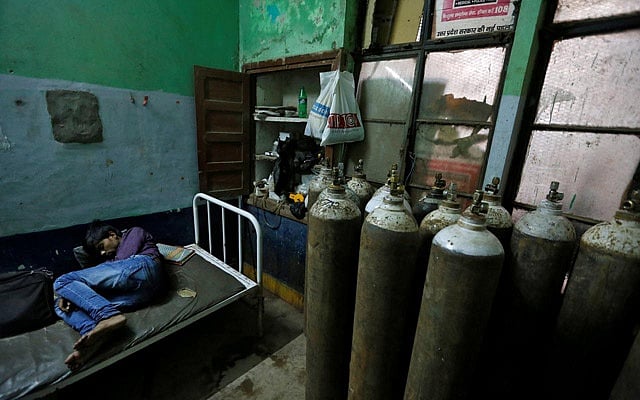
Many patients severely ill with COVID-19, the illness caused by the coronavirus, require help with breathing at some point. But now the epidemic is spreading rapidly in South Asia, Latin America and parts of Africa, regions where many hospitals are poorly equipped and lack the ventilators, tanks and other equipment necessary to save patients whose lungs are failing.
The World Health Organization is hoping to raise $250 million to increase oxygen delivery to those regions. The World Bank and the African Union are contributing to the effort, and some medical charities are seeking donations for the cause.
By a stroke of luck, the WHO, UNICEF and the Bill & Melinda Gates Foundation in 2017 began searching for ways to increase oxygen delivery in poor and middle-income countries — not in anticipation of a pandemic but because oxygen can save the lives of premature infants and children with pneumonia.
The organisations began ordering equipment in January, but within weeks suppliers were swamped by the sudden surge in demand created by the pandemic.
Although the machinery needed to generate oxygen is relatively simple, it must be sturdy enough to withstand the dust, humidity and other hazards common in rural hospitals in poor countries. Some companies produce relatively rugged equipment, but prices are rising and restrictions on international flights are complicating deliveries.
The machines cannot come too soon, doctors working in the field said.
In May, the Alliance for International Medical Action, or ALIMA, treated 123 COVID-19 patients in the Democratic Republic of Congo, said Dr Baweye Mayoum Barka, the charity’s representative in Kinshasa, the country’s capital. Fifty-six of them needed oxygen, but not enough equipment was available.
“So, unfortunately, there were 26 deaths, 70% of them in less than 24 hours,” Barka said. “I can’t say they were all from a lack of oxygen, but it played a role.”
ALIMA needs 40 oxygen concentrators, which filter oxygen from the air, but the agency has just eight, he said. Because it is hard to move patients from one hospital to another, some die waiting, gasping for air.
In Congo, many COVID-19 patients arrive at hospitals with critically low blood oxygen levels — sometimes as low as 60%, a level at which patients must normally be put on a ventilator to survive. (Normal oxygen saturation levels are 95% or more.)
Nigeria is also grappling with an oxygen shortage, said Dr Sanjana Bhardwaj, UNICEF’s chief of health there. Since May, hospitals in Lagos and Kano have seen a steady stream of older patients with COVID-19 symptoms who need oxygen.
In nearly every country the virus has hit, rich or poor, about 15% of all symptomatic patients develop pneumonia severe enough to require extra oxygen, the WHO estimates, but not so dire that they must be put on a ventilator.
Ventilators are rare in poor countries. They can cost up to $50,000, and patients must be heavily sedated the whole time the breathing tube is lodged deep in their airways. Also, the pressure must be constantly monitored to prevent lung damage. That requires anesthesiologists and trained respiratory technicians, positions that many hospitals lack.
Oxygen can be delivered in two ways. Tanks contain nearly pure oxygen. For patients who need large volumes and help keeping the air sacs in their lungs open, tanks can deliver oxygen at high pressure through a mask strapped tightly over the nose and mouth.
But tanks are heavy, must be refilled at central stations and delivered by truck, and pose some risk of explosion and fire. While many poor countries have plants making industrial-grade oxygen for construction jobs like welding, it cannot be used on patients because the tanks often contain rust or oily water that could lodge in the lungs, said Paul Molinaro, chief of operations support and logistics at the WHO.
An alternative is an oxygen concentrator, which is usually the size of a suitcase or even a briefcase. Concentrators pull oxygen out of ambient air by forcing it under pressure through a “molecular sieve” filled with the mineral zeolite, which adsorbs nitrogen.
Most concentrators cost only $1,000 to $2,000. They need electricity but can run on a generator or batteries, using about as much power as a small refrigerator.
ALIMA has started a campaign, “Oxygen for Africa,” to raise money to send about 500 concentrators to six poor countries, Jennifer Lazuta, a spokesperson, said.
UNICEF has ordered about 16,000 concentrators for about 90 countries, but thus far has been able to deliver only about 700, said Jonathan Howard-Brand, an innovation specialist at UNICEF’s procurement centre in Copenhagen.
The WHO has ordered another 14,000, of which 2,000 have been delivered and 2,000 are in transit, Molinaro said.
He and Howard-Brand described severe delivery problems created by the epidemic, including delays of up to five weeks. When possible, the aid agencies ship through the World Food Program, which has dozens of planes. But the concentrators must compete for space with shipments of food, personal protective gear and other lifesaving goods.
Also, some countries are far from cargo hub cities, while others restrict all flights, even those containing aid, for fear of the virus being introduced.
“We need more planes in the air,” Howard-Brand said.
c.2020 The New York Times Company







