


Published : 24 Sep 2019, 08:15 PM
Updated : 08 Apr 2022, 02:24 PM


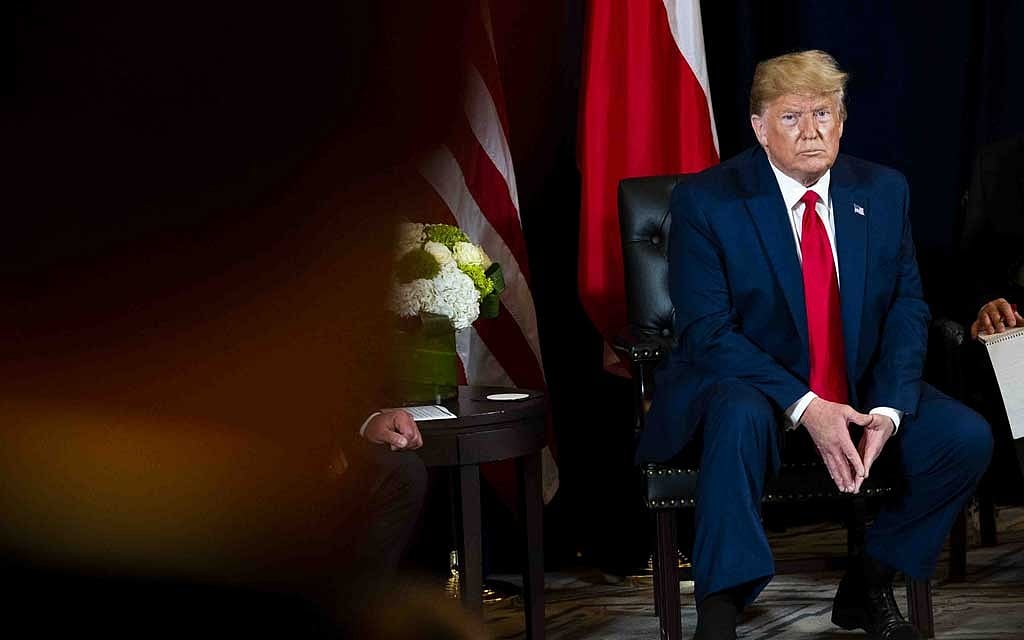
After Trump comes President Abdel-Fattah el-Sissi of Egypt, the former general who has come to symbolise the repression of the Arab Spring revolutions — although his appearance was thrown into doubt last weekend as protests erupted at home. Then comes President Recep Tayyip Erdogan of Turkey, an autocrat who has bullied critics and whose government is a leading jailer of journalists.
Twenty-one leaders are speaking Tuesday alone, and the final one scheduled is Boris Johnson, making his United Nations debut as Britain’s prime minister. His visit came as the country’s top court delivered a stinging rebuke to Johnson, ruling he had acted unconstitutionally in suspending Parliament, an action taken as he tries to take his country of the European Union by Oct. 31.
Iran finds itself isolated as attacks on Saudi Arabia draw US and Europe closer.
On the eve of the speeches, the leaders of Britain, Germany and France took the US side in blaming Iran for the Sept. 14 attacks on Saudi Arabia. The move was a setback for Iran, which has denied any role in the attacks, and was a stark contrast to the sympathy Iran had engendered a year ago after Trump abandoned the 2015 nuclear agreement.
The Europeans, who have been seeking to salvage that agreement, issued a joint statement on Monday that not only accused Iran of responsibility for the attacks on Saudi Arabia, but called on Iran to begin negotiating on broader issues than its nuclear program.
The statement aligned with Washington’s position on both the Saudi attacks and the demand for a stronger nuclear deal, and represented a major shift in Europe’s position of tolerance with Iran.
“The time has come for Iran to accept a long term negotiation framework for its nuclear program, as well as regional security issues, which include its missile programs,” the statement said.
— Farnaz Fassihi
Climate Summit: Auspicious optics but few promises, and one angry young activist.
A day before the speeches, Secretary-General António Guterres convened the UN Climate Action Summit, intended to punctuate and increase promises by presidents, prime ministers and corporate executives to wean the global economy from fossil fuels to avoid the worst effects of global warming.
But China made no new pledges to take stronger climate action. The United States, having vowed to withdraw from the Paris Agreement, the pact among nations to jointly fight climate change, said nothing.
A host of countries made only incremental commitments. The contrast between the slow pace of action and the urgency of the problem was underscored by the Swedish climate activist Greta Thunberg, 16, who castigated what she called the “business as usual” approach of world leaders. “The eyes of all future generations are upon you,” she said, her voice quavering with rage. “If you choose to fail us, I say we will never forgive you.”
— Somini Sengupta and Lisa Friedman
In the hallways, on guard for awkward encounters.
While Trump will not be seeing the presidents of China, Russia and Venezuela, who are skipping the General Assembly this year, the potential is large for awkwardness between leaders who may inadvertently see each other in the halls and conference rooms.
Diplomats who just a few weeks ago had foreseen a meeting between Trump and President Hassan Rouhani of Iran say that it is now unlikely, given the rising tensions between the two countries. Nor is a meeting predicted between Secretary of State Mike Pompeo and his Iranian counterpart, Mohammad Javad Zarif, who are not known to even talk to each other.
Other potential unpleasantness may loom should Bolsonaro of Brazil encounter President Emmanuel Macron of France, who exchanged mutual insults last month via social media over Bolsonaro’s handling of fires and deforestation in the Amazon rainforest.
Deteriorating relations between Prime Minister Shinzo Abe of Japan and President Moon Jae-in of South Korea have lowered expectations for any warming at the United Nations, even if Trump seeks to bring them together. And the prime minister of Pakistan, Imran Khan, is still furious with Prime Minister Narendra Modi of India over the Indian crackdown last month in the disputed territory of Kashmir.
c.2019 The New York Times Company










