Published : 14 Feb 2022, 08:40 PM
Updated : 03 Aug 2022, 11:31 AM


Health advocates have said that the legislation, which was approved in a referendum, was a significant step toward tightening the country’s loose tobacco regulations.
“Many organisations have stepped up to the plate and advocated for a solution that prioritises youth protection,” said Flavia Wasserfallen, a member of the Swiss National Council and a proponent of the initiative.
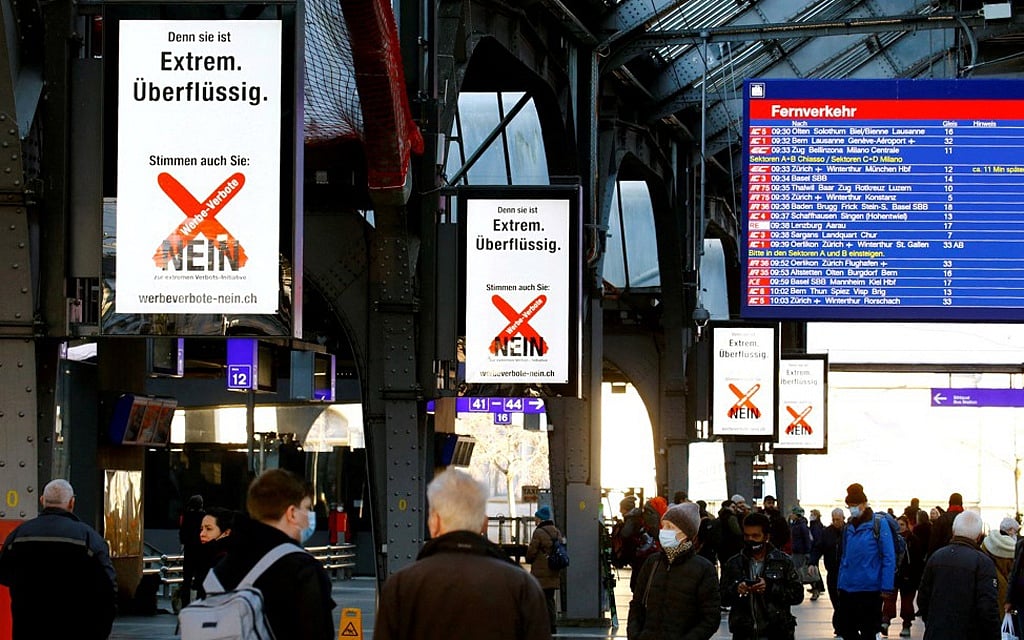
Across much of the West, tobacco advertisements long ago fell out of favour, but they have lived on in this Alpine nation, with displays for cigarettes and e-cigarettes showing up on billboards, in movie theatres and at events like music festivals.
But voters made it clear Sunday that they were no longer interested in seeing them, and despite strong opposition from the tobacco industry and the government, the tougher regulations were approved by 56.6% of voters and received strong support from the country’s French- and Italian-speaking regions, despite having the country’s highest smoking rates.
Steps have been taken in recent years to try to introduce tougher regulations on tobacco-related products in Switzerland. In 2015, the Federal Council, the country’s executive branch, proposed a Tobacco Products Act that would ban the sale of tobacco and related goods to minors as well as restrict advertising.
Parliament eventually approved a weakened version of the bill, which forbade the sale of tobacco to those under 18 but let advertising continue mostly unimpeded.
The most recent initiative was started by a group of more than 40 health organisations that formed in response to the weakening of the tobacco legislation. The revamped Tobacco Products Act, which includes the advertising-related provisions that voters approved Sunday, is expected to come into effect in 2023.
“The majority of our country has decided to correct parliament’s decision on the Tobacco Products Act,” Hans Stöckli, president of the committee behind the initiative, said Sunday. Stöckli described the result as “a historic milestone” and as “a necessary step” toward improved tobacco regulation.
Opponents of the measure called the tighter restrictions extreme. And while they agreed that tobacco should be age-restricted, they said the new rules amounted to a de facto ban on a legal product because children could potentially be exposed to advertisements anywhere.
Switzerland has long had a close relationship with the tobacco industry. Philip Morris and Japan Tobacco International have their international headquarters in the country, and British American Tobacco also has a strong presence.
The industry employs about 4,500 people in Switzerland, according to the government, including in the production of high-tar cigarettes that are illegal to produce or sell in the European Union. Cigarettes rank with chocolate and cheese as some of the country’s leading exports.
Even after the new rules take effect, Switzerland will continue to have more liberal tobacco regulations than many other countries. And it will also still not fulfil all the requirements needed to ratify the World Health Organization’s Framework Convention on Tobacco Control, an international response to combating the tobacco epidemic, despite signing it in 2004. The United States has also not ratified the convention.
Alain Berset, Switzerland’s vice president, who also serves as the country’s health minister, had opposed the initiative before the vote. But at a news conference Sunday, he acknowledged that Swiss voters had spoken, and said the government would move forward with the new regulations.
“The Federal Council will now tackle the implementation of the initiative,” Berset said.
The Tobacco Products Act was not the only issue on the ballot Sunday. In a move that people feared could have cut off Switzerland from global medical progress, voters shot down a proposed ban on all human and animal experiments in the country.
Voters also decided against providing Swiss media outlets with increased financial support by rejecting a government proposal to extend subsidies to online media as well as to regional radio and television stations.
A government-approved amendment to the federal stamp duties act that would have made it cheaper for companies to raise new capital was also rejected, with opponents saying it would have mainly benefited large companies.
© 2022 The New York Times Company