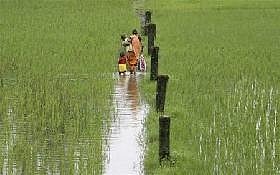
Drought-hit India may have to import food
India may have to import food to make up for shortages, finance minister Pranab Mukherjee has said, as drought is reportedly affecting 700 million people in the country after poor monsoon rains. India's monsoon rains have been 26 percent below normal since the start of the June-September season, hurting crops like cane, paddy, soyabean and triggering a sharp rise in food prices.
bdnews24.com News Service
bdnews24.com
Published :
22 Aug 2009, 05:06 AM
Updated :
12 Aug 2022, 01:39 PM
JUNNAR, India, Aug 22 (bdnews24.com/Reuters) – India may have to import food to make up for shortages, finance minister Pranab Mukherjee has said, as drought is reportedly affecting 700 million people in the country after poor monsoon rains.
India's monsoon rains have been 26 percent below normal since the start of the June-September season, hurting crops like cane, paddy, soyabean and triggering a sharp rise in food prices.
Indian finance minister Pranab Mukherjee was quoted by BBC News on Saturday, saying India would import food to make up for any shortages, but did not specify what would be imported and when, saying he wanted to avoid speculation on prices.
Mukherjee said any commodity that was in short supply would be imported to boost domestic stocks.
He said details of the imports were not being revealed, though reports said lentils, edible oils and other staples might be among the foods to be brought in.
The drought is affecting almost half of Indian districts with food prices reportedly escalating by 10 percent.
The monsoon is crucial to the health of Asia's third-largest economy, although an increasingly diversified economy means a deficient monsoon has less of an impact on the overall economy than in past dry years, and strength in manufacturing and urban demand could offset disappointing crop output.
Jitters about the economic impact from weak monsoon rains have weighed on investor confidence and the benchmark has fallen 4.2 percent this month, hurt by worries about the weak monsoon and looming inflation.
For farmers in India, the monsoon is vital for summer-sown crops because most of them do not have access to irrigation facilities.
The farm minister said on Friday that failed monsoon rains in India have created a critical situation for rural livelihood, drinking water and crops.
Nilesh Wahardi's sugarcane field in western India is normally abuzz with activity this time of year, with workers planting stubs of cane in the moist ground.
But this year one of the worst monsoons in a decade has spoiled Wahardi's chances of taking advantage of sugar prices that are at historic highs, highlighting the fragile nature of India's farm-dependent economy.
"We cannot let the crop fail. It is our life," said Wahardi, whose family will have to give up buying new clothes and things for the house and dig a borewell instead because of the poor monsoon.
Like Wahardi, millions of Indians from rice-dependent families in the poverty-stricken plains of Bihar to the sugarcane farmers of western India, are struggling for survival as India stares at a drought.
In Maharashtra, hundreds of villagers are selling their cattle as once green pastures have become barren.
"Six months ago, I bought a pair of bulls for 40,000 rupees ($821.4), now I don't have enough fodder and water to feed them," said Nanasaheb Ugale, whose fields of onion plants have burned in the heat without any rain.
DASHED HOPES
The drought has dashed the hopes of millions of farmers in India, where almost half the 100 million farming families are in debt, according to the National Sample Survey Organisation.
Farmers often pay high interest rates to private lenders, leaving them in a never-ending cycle of debt.
Sunil Mahajan, a farmer in Loni village of Madhya Pradesh, is struggling to pay a 100,000 rupee ($2,050) loan he took to cultivate maize and cotton.
"I do not know how I will be able to afford my daughter and son's education this year," Mahajan said.
In Gujarat, soyabean farmers have been forced to seek jobs as labourers at construction sites.
"The soyabean crop has been badly damaged due to low rainfall. I will have to work as a labourer to feed my family of six," said Nitin Sawai, a farmer.
Food prices in India have risen over 10 percent annually, although the overall wholesale price index has seen a year-on-year decline for several weeks in a row.
To tackle the situation, the government has called for judicious use of ground water and reservoirs for irrigation, as India's main reservoirs stood at 38 percent of total capacity, down from 58 percent a year ago.
"My entire crop of cotton has been badly damaged due to non-availability of canal water and poor rains have added to my and my family's misery," said Atma Ram, a villager in northern Punjab state's Kahira Khurd village.
($1 = 48.7 rupees)
bdnews24.com/mi/rah/1110h