


Published : 04 Jul 2014, 06:23 PM
Updated : 08 Aug 2022, 06:57 PM


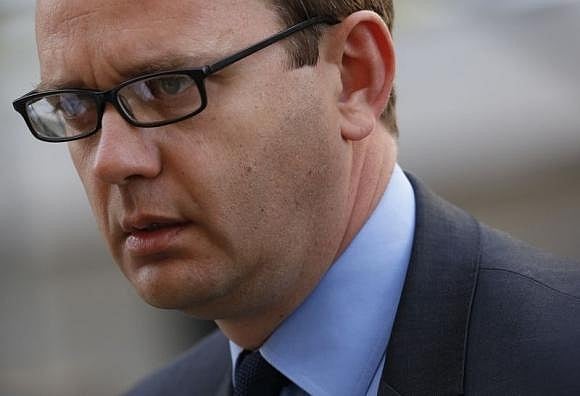
Coulson, editor of the now defunct News of the World newspaper from 2003-2007, was convicted last week of conspiracy to intercept voicemails on mobile phones following a high-profile eight-month trial at London's Old Bailey court.
The prime minister, who has apologised for having hired Coulson, said of the sentence: "What this says is that it's right that justice should be done and that no one is above the law."
Opposition leader Ed Miliband has criticised Cameron for bringing a "criminal into the heart of Downing Street".
The maximum sentence the 46-year-old could have faced was two years but the judge said he had taken into account Coulson's good character. He showed no reaction as the sentence was read out in a packed Court 12 at the Old Bailey.
"Mr Coulson on the jury's verdict has to take the major blame for the phone hacking at the News of the World," judge John Saunders said. "He knew about it and encouraged it when he should have stopped it."
The sentenced was passed exactly three years to the day that the Guardian newspaper published revelations that staff on the paper had hacked into the voicemails of murdered schoolgirl Milly Dowler.
That sparked widespread outrage across the country which forced Murdoch to close the 168-year-old tabloid just days later. It emerged that the newspaper had listened into messages of countless targets - from movie stars to crime victims to government ministers - to obtain information for scoops.
Coulson was the only one of seven defendants to be convicted following the long-running trial.
He was found guilty of conspiracy to illegally intercept voicemails on mobile phones. The jury failed to reach a verdict on charges he authorised illegal payments to public officials and he is to be re-tried at a later unknown date.
Three other senior journalists from the paper - Greg Miskiw, Neville Thurlbeck and James Weatherup - had pleaded guilty before the trial began and were also sentenced on Friday. Miskiw and Thurlbeck were sentenced to six months in jail while Weatherup was given a 4 month suspended sentence.
Glenn Mulcaire, the former private investigator who conducted much of the hacking and who has already gone to jail for an earlier hacking offence, was given a six month suspended sentence.
Coulson's one time lover Rebekah Brooks, his predecessor as News of the World editor who later ran News Corp.'s British newspaper arm, was found not guilty of phone-hacking and other allegations last week by the jury.
Phone-hacking became public knowledge in 2006 when the News of the World's former royal editor Clive Goodman and Mulcaire admitted they had hacked the phones of royal aides. The paper said at the time that Goodman was a rogue reporter acting alone to hire Mulcaire.
Coulson quit the paper after they were jailed, denying that he had knowledge of their illegal activity. Within months he began working for Cameron in opposition as his communications chief. Cameron brought him to Downing Street after the 2010 election.
Coulson quit after revelations in 2011 that the hacking at his former newspaper had been much more expensive than the paper had previously admitted.
Murdoch's British newspaper arm has said it has changed the way it operates and apologised to hacking victims.
Many Kurds have long wanted to declare independence and now sense a golden opportunity, with Baghdad weak and Sunni armed groups in control of northern cities such as Mosul and Tikrit.
Top US defence officials, who have deployed advisers to the region to assess the state of the Iraqi military, said the security forces were able to defend Baghdad but would have difficulty going on the offensive to recapture lost territory, mainly because of logistical weaknesses.
"If you're asking me will the Iraqis at some point be able to go back on the offensive to recapture the part of Iraq that they've lost, I think that's a really broad campaign quality question," General Martin Dempsey, chairman of the US Joint Chiefs of Staff, told reporters at the Pentagon. "Probably not by themselves."
Dempsey said "the future is pretty bleak" for Iraqis unless they can bridge the sectarian differences within their government. The absence of an inclusive government, he said, was a factor in the security forces' failure to stand up to ISIL.
"They didn't collapse in the face of a fight. They collapsed in the face of a future that didn't hold out any hope for them," Dempsey said.
Unless the Iraqi government bridges internal sectarian differences and "gets the message out that it really does intend to allow participation by all groups, everything we're talking about (doing to help) makes no difference," he said.
Many see the Shia prime minister, Nuri al-Maliki, as the main obstacle to resolving the crisis and hope he will step aside.
"POLITICAL STABILITY NEEDED"
Maliki himself said a political solution went hand-in-hand with the campaign to recapture areas held by insurgents.
“There is no security without complete political stability,” he said in a televised address on Wednesday. “We will proceed with our political projects but we will be on high alert and ready for the momentum of the battle."
Security forces are battling fighters led by the Islamic State, which shortened its name from the Islamic State in Iraq and the Levant this week and named its leader "caliph," the historical title of successors of the Prophet Mohammad who ruled the Muslim world.
Rising concern and pressure from the United States, Iran, the United Nations and Iraq's own Shia clerics has done little to end the paralysing divisions between Iraq's main ethnic and sectarian blocs.
Mithal al-Alusi, a prominent Sunni politician, said he did not think Maliki was prepared to step aside. “Mr. Maliki wants to continue and he believes ... that without him nothing can be done in Iraq,” he said.
In the system put in place after the United States toppled Saddam Hussein in 2003, the premiership is traditionally given to a Shia, while the speaker of the house has been a Sunni and the president, a largely ceremonial role, has been a Kurd.
In his weekly televised address, Maliki said he hoped parliament could get past its "state of weakness" and reach consensus in its next session, planned for Tuesday. But it is far from clear when leaders in Baghdad might do so.
All the main blocs are beset by internal divisions, and none has yet decided who to put forward for its designated position.
Dia al-Asadi, secretary general of the Al-Ahrar bloc, a Shia faction loyal to powerful cleric Moqtada al-Sadr and opposed to Maliki, told Reuters that only Maliki’s own State of Law coalition would support his staying on as prime minister.
“There is objection by almost all of the other groups - the Kurds, the Sunnis, and the other Shias," he said.
Each of the blocs has said it wants to know who the others will choose for their posts before naming its own - meaning the nominations will have to be done as a package.
FIGHTING IN DIYALA
Maliki's government, bolstered by civilian volunteers and Shi'ite militias, has managed to stop the militant advance short of the capital, but has been unable to take back the cities that government forces abandoned.
The army failed last week to take back Tikrit, 160 km (100 miles) north of Baghdad, and remained on the outskirts of the city on Thursday, according to the prime minister's military spokesman Lieutenant General Qassim Atta.
In the northeasterly province of Diyala, 14 militants were killed in fighting with security forces, local police said.
The head of the region's police, Jamil Al-Shimmeri, said security forces had taken back control of the village of Showhani near the town of Muqdadiya, 80 km northeast of Baghdad.
Insurgents have been present in Diyala for the past several weeks, following their rapid seizure of Mosul, one of Iraq's largest cities, to the north.
US Defence Secretary Chuck Hagel said the US military had six assessment teams on the ground evaluating the state of Iraqi forces and had established Iraqi-US joint operations centres in Baghdad and Arbil to coordinate activities. (Full Story)
Saudi-owned al-Arabiya television said Saudi Arabia had deployed 30,000 soldiers to its border with Iraq after Iraqi soldiers withdrew from the area, but Iraq denied the report.
Al-Arabiya broadcast footage of what it said were Iraqi soldiers in the desert area east of the city of Karbala after pulling back from the border. But the army spokesman said the border was still under the full control of Iraqi forces.













