


Published : 11 Feb 2020, 01:38 AM
Updated : 17 Oct 2022, 11:01 AM


The team was led by Bruce Aylward, a Canadian doctor and epidemiologist who has overseen international campaigns to fight Ebola and polio.
Since WHO’s director general, Tedros Adhanom Ghebreyesus, visited Beijing in January, the organization has tried to send a team, but the Chinese government had balked. The delay raised questions about China’s sensitivity to international assistance in combating the epidemic.
In a series of posts on Twitter, Tedros expressed concern that countries that have seen only a few cases with no direct connection to China could yet see a jump in new infections.
“We may only be seeing the tip of the iceberg,” he wrote.
He called on all countries to share information about the coronavirus “in real time” with the organization.
CHINA RECORDS MOST DEATHS FROM THE VIRUS IN A SINGLE DAY
Ninety-seven people died from the coronavirus Sunday, a new daily record since it was first detected in December, China’s National Health Commission said Monday. The death toll is now 908 people, which surpasses the toll from the SARS epidemic of 2002-03, according to official data. The number of confirmed infections in the country rose to 40,171, and 3,062 new cases were recorded in the preceding 24 hours, most of them in Hubei province. The SARS epidemic, which also began in China, killed 774 people worldwide. There have been only two confirmed deaths from the new coronavirus outside mainland China: one in Hong Kong and one in the Philippines. Many doctors believe that deaths and infections from the current epidemic are undercounted in China because testing facilities are under severe strain.AFTER A LONG BREAK, CHINA SLOWLY RETURNS TO WORK
Some factories and offices across China resumed work Monday, the end of an extended Lunar New Year holiday intended to slow the spread of the virus.
The resumption of business was slow as many workers were reluctant to return to large cities from their hometowns, and as managers tried to respond to a slew of new health regulations issued by local governments across the country.
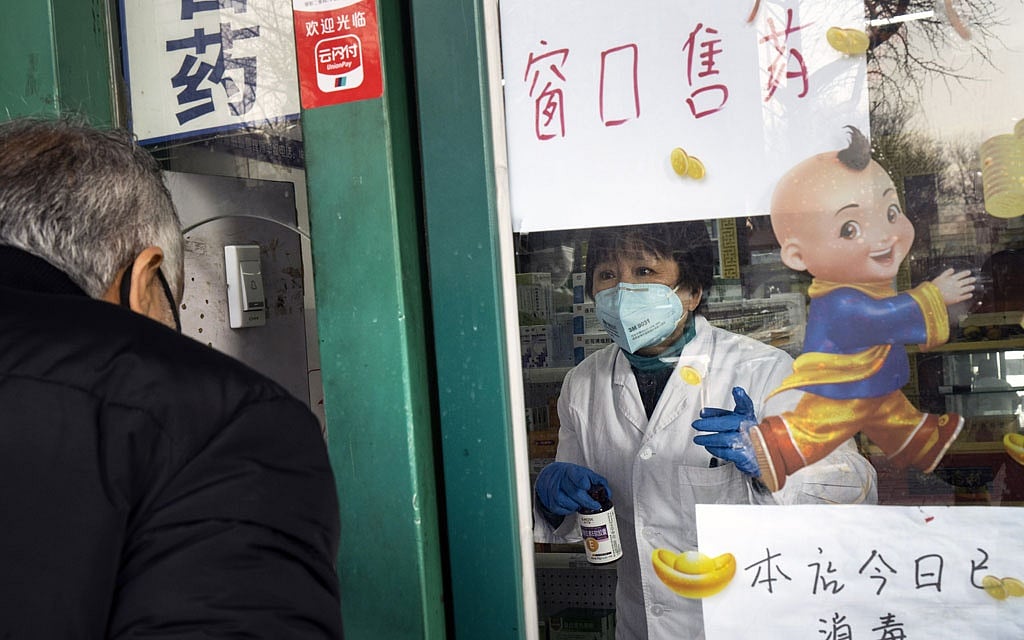
A man buys medicine at a Beijing pharmacy through a window, a precaution taken to combat the coronavirus, on Sunday, Feb 9, 2020. The coronavirus death toll in China has risen to 811, surpassing the toll from the SARS epidemic of 2002-3, according to official data released on Sunday. (Giulia Marchi/The New York Times)
CORONAVIRUS STYMIES GLOBAL TRADE AND GLOBAL BUSINESSES
The China Development Forum, an annual economic policy conference that China has used to project an image as an economically open country, has been postponed indefinitely.
In past years, members of the Communist Party’s Politburo Standing Committee and the governor of China’s central bank have used the event to seek more foreign investment for the country.
But this year, global companies are instead grappling with the results of having a supply chain deeply embedded in China as the coronavirus spreads across the nation.
On Monday, Nissan of Japan said it would shut down its plant in Kyushu, Japan, for four days beginning later this week, “due to supply shortages of parts from China.” Other carmakers, like Fiat Chrysler in Italy and Hyundai in South Korea, have already warned that a lack of parts from China could force them to curtail production in their home markets.
Even trade shows further afield are taking a hit, with companies like Amazon and Sony choosing to stay away from this month’s Mobile World Congress technology conference in Barcelona, Spain, one of the world’s most important mobile technology trade fairs. Nvidia, LG and Ericsson also pulled out of the meeting.
More than 100,000 people from more than 200 countries had been expected to attend the event, but some big firms are dropping out. The organizers said new safety measures would be implemented, including prohibiting any visitors from Hubei province in China from attending. Security officials will also take visitors’ body temperatures and check passports stamps in order to keep out anybody who visited China in the previous 14 days. The event begins Feb. 24.
PRICES JUMP IN CHINA AS THE VIRUS DISRUPTS SUPPLIES
The coronavirus has helped push inflation to an eight-year high, the Chinese government said Monday, adding to Beijing’s problems.
Consumer price inflation rose to 5.4% year on year in January, compared with a 4.5% rise in December. That signified the highest level since November 2011, according to China’s statistics bureau. The outbreak has disrupted China’s supply chains, making it difficult in many places to get products to market.
While nonfood-related prices, including energy, rose slightly, it was food prices that pushed inflation up. The price of pork, which has surged for months, has now more than doubled over the past year after an outbreak of African swine fever led to a shortage of pigs.
The latest inflation figures mark a new challenge for China’s central bank. The People’s Bank of China has opened the spigots to provide money to local governments that are trying to contain the outbreak. Last week it announced it had pumped $175 billion into the financial system.
The government has told banks to extend favorable terms to companies that have been closed by efforts to contain the outbreak, which include means to keep people at home. In many cases, employers have been responsible for employee wages after closing factories or other operations.
But printing money to inject into the economy also helps push prices up, creating a double-edged sword for China’s authorities.
Inflation typically rises slightly during the holiday, when families buy presents and food to feed large family gatherings. Economists say they rose faster than usual and stayed higher for a longer period of time.
LOCAL OFFICIALS PREVENT MASK AND PROTECTIVE GEAR FACTORIES FROM STARTING UP AGAIN
Chinese efforts to stop the coronavirus outbreak have hit even those companies that make essential equipment for medical and emergency workers — gear that is in short supply in many parts of the country.
On Tuesday, officials in the city of Xiantao in Hubei province notified companies making protective clothing and medical masks that they needed to produce the proper paperwork before they could reopen. Unless they could prove their products had been cleared for sale within China, the notice said, the factories could not open until Feb. 14.
The notice caused an uproar online. Xiantao is a major industrial hub for what are known as nonwoven products. That includes the suits and gloves used by emergency workers to protect themselves during outbreaks. The area is especially important for making protective masks. The vast majority of its production is exported, according to 2016 government figures.
The notice said local officials made the move to ensure quality standards were upheld and to root out counterfeit gear makers. But officials relented after a public outcry. On Monday, the government said it approved 73 protective product manufacturers to resume operations, while others are being certified. It was not clear Monday how many had resumed production.
c.2020 The New York Times Company







