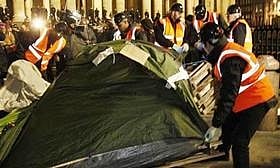
British anti-capitalist camp cleared from St Paul's
Bailiffs, backed by riot police, evicted British anti-capitalism activists from a protest camp outside St Paul's Cathedral in London in the early hours of Tuesday morning.
bdnews24.com News Service
bdnews24.com
Published :
28 Feb 2012, 04:13 AM
Updated :
09 Aug 2022, 03:29 PM
LONDON, Feb 28 (bdnews24.com/Reuters) - Bailiffs, backed by riot police, evicted British anti-capitalism activists from a protest camp outside St Paul's Cathedral in London in the early hours of Tuesday morning.
There was no violent resistance from the activists as bailiffs employed by the City of London Corporation, which owns the land on which they were camped, removed around 50 tents within an hour shortly after midnight.
Around a dozen activists remained on a barricade made of wooden crates, chanting "Occupy Everywhere", surrounded by a ring of riot police. Bailiffs later removed that too.
Other activists watched from the steps of the cathedral shouting "We are the 99 percent" and holding banners reading: "This is just the beginning." They were shunted across the steps by a line of riot police and some later began to drift away.
It was not clear whether there had been any arrests or injuries. Police said it was too early to comment.
The urban camp was set up four months ago, part of an international movement inspired by Occupy Wall Street against what the activists see as corporate greed and economic inequality.
Around 100 tents had already been taken down voluntarily after protesters last week lost their legal battle to stay.
Authorities in some North American cities have used violence to forcibly remove similar camps. In London, Christian Wallace, 35, who had lived in the camp for the past four months, was concerned the heavy police presence could lead to clashes.
"I just want to leave peacefully but some don't want to go quietly as this is their only home," he told Reuters.
ACTIVISTS RESIGNED
Most of the activists were resigned to the eviction.
"It is a sad evening, but it has been coming, " Dan Ashman, 27, said as the bailiffs moved in to remove the site. "The saddest day was when the courts didn't recognise reality, but the reality that the authorities put before them," he said.
George Barda, 36, who went to court to fight the eviction, said it was important that activists left peacefully.
"I am sure we could have put up more of a show by chaining ourselves to railings, but it is not a question of matching the power of the authorities," he said.
London Occupy has a smaller site on the edge of the City, London's financial district, and others dotted around the country.
The St Paul's site attracted most attention because the 300-year-old baroque cathedral is one of central London's most recognisable landmarks.
It is a favourite with tourists and likely to be thronged by Olympic visitors this summer. It was also where Prince Charles married Princess Diana in 1981.
The protesters chose to pitch their tents at the bottom of the cathedral steps in October after they were blocked from their intended target, the nearby square at the London Stock Exchange.
Their cause resonated with many Britons still angry that banks, some of which took billions of pounds of taxpayers' money in a government bailout, continue to pay out large bonuses despite being largely blamed for the 2008 financial crisis.
It also generated unintended publicity when the cathedral appeared divided on how to handle the sit-in, resulting in the resignation of two senior Anglican clerics.
A debate about the role of ethics in finance and the relationship between the Church and City followed.
The activists, who were joined by homeless people at the camp, received support from some celebrities including designer Vivienne Westwood and playwright Alan Bennett, who dropped in for tea and left signed copies of his work at its library tent.
But it was also accused of being too diverse in its cause.
The Corporation won its right to remove the camp after arguing in court that it hindered planning control, attracted crime, and interfered with a public right of way and the rights of those who wished to worship in the cathedral.
It won a case in the High Court last month for the tents to be taken away. The protesters went to the Court of Appeal arguing that their case had "unique and global" significance but the appeal was rejected.
The protesters could still apply to the European Court of Human Rights.
bdnews24.com/cr/1013 h.