


Published : 19 Mar 2022, 10:17 AM
Updated : 03 Aug 2022, 11:39 AM


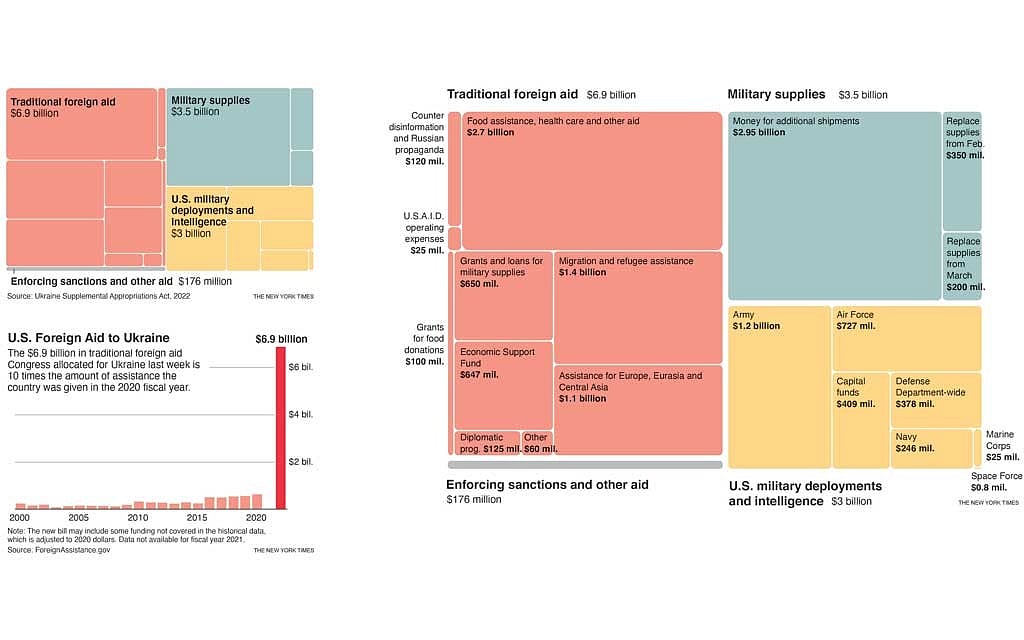
1. Traditional Foreign Aid, $6.9 billion
The bill allocates $6.9 billion through traditional foreign aid channels. That includes money to strengthen the security and economy of Ukraine, and to provide food, health care and urgent support to both Ukrainians living in the country and those who fled. It also includes financial support for weapons purchases.
That is more than the amount given to Ukraine in any year since 1994, when the US Agency for International Development began tracking such figures. The $6.9 billion may include some funding that wouldn’t be counted in the agency’s data, which is calculated differently. Nonetheless, it is 10 times the amount given to Ukraine in fiscal year 2020, the period of the latest published data.
In the 2020 fiscal year, Ukraine received 6% of total US foreign assistance tracked in the agency’s data, making it the 17th-largest recipient. It received almost 60 times as much as its neighbour Belarus but only a sixth of the money that went to Afghanistan, the highest recipient of US aid that year.
This portion of the newly authorised package will cover a wide variety of programs, including:
— $2.65 billion to provide food assistance and health care to Ukrainians and neighbouring countries affected by the war.
— $1.4 billion for humanitarian support and resettlement of Ukrainian refugees. Around 3.2 million people have fled Ukraine since the invasion, according to the United Nations Refugee Agency.
— $1.12 billion to support Ukraine’s government, provide economic assistance and help neighbouring countries through the Assistance for Europe, Eurasia and Central Asia program.
— $650 million for a financing program to provide additional military support for Ukraine and other countries affected by the war. The program largely provides loans and grants to purchase US weapons, equipment and training.
— $647 million to the Economic Support Fund that provides direct financial support and other economic assistance to Ukraine and other countries affected by the invasion.
— $125 million for diplomatic programs to help maintain US citizen services in the area; invest in cybersecurity; enhance the State Department’s capacity to identify the assets of Russian and other oligarchs; and coordinate with the Treasury Department in seizing or freezing those assets.
— $120 million to counter disinformation and Russian propaganda, and to support independent media and activists.
— $100 million for Food for Peace grants to support commodity donations of food assistance to Ukraine and Ukrainian refugees.
— $30 million to continue integrating Ukraine’s electricity grid into Europe’s. In late February, Ukraine started a 72-hour test to unhook its power grid from those of Belarus and Russia. During the trial, Russia invaded. Ukraine’s electric grid had been operating in isolation until Wednesday, when the European Commission for Energy announced that technical experts had successfully connected it to Europe’s.
— $30 million to fight international narcotics trafficking and human trafficking in Ukraine.
— $25 million for operations at USAID, the agency leading the US humanitarian response in Ukraine.
2. Military Supplies, $3.5 billion
Another $3.5 billion will be used to replace military supplies the Biden administration already sent to Ukraine this year and to keep dispatching additional shipments.
In times of “unforeseen emergency,” the president can authorise the transfer of US-owned weapons, ammunition and defence supplies without congressional approval.
The $3.5 billion includes $550 million to replace supplies President Joe Biden authorised sending in February and the first week of March. Those so-called “drawdown” packages included “Javelins and other anti-armour systems, small arms, various calibres of ammunition, and other essential nonlethal equipment,” according to a Congressional Research Service report published this week.
The bill also allows Biden to keep sending more supplies. On Wednesday, shortly after Ukraine’s president, Volodymyr Zelenskyy, delivered a virtual address to Congress, Biden announced a third package, worth $800 million, that will be replaced using funds approved in this bill.
3. US Deployments and Intelligence Programs, $3 billion
The US also allocated $3 billion to help pay for the deployment of its own military units to allied countries in Europe. The funding will be used to transport personnel and equipment, pay deployed troops, and provide medical and intelligence support in the region.
4. Enforcing Sanctions and Other Aid, $175.5 million
Finally, Congress allocated more than $175.5 million to enforce the sanctions and export control measures imposed by the US to isolate Russia’s economy from the international financial system.
The newly authorised package will fund the following programs:
— $43.6 million to the FBI to investigate cyberthreats, perform counterintelligence, monitor cryptocurrency activities and establish an additional team to focus on violations of Russian sanctions.
— $25 million for the Treasury Department to target sanctions and analyse Russian economic vulnerabilities.
— $25 million to combat disinformation and support independent journalism.
— $22.1 million to analyse Russian economic and trade vulnerabilities and the effect possible retaliations may have on the US supply chain. Part of the money will also be used to enhance US technological infrastructure and information-sharing platforms with allies.
— $19 million for the Financial Crimes Enforcement Network.
— $17 million for Departmental Offices to support policy offices involved in coordinated responses for Ukraine task forces.
— $9.7 million for the Department of Justice’s Ukraine task force to address cybercrime threats and ransomware cases.
— $4 million for oversight of emergency funds and operations of USAID.
— $4 million for oversight of emergency funds and operations of the State Department.
— $5 million for US attorneys to prosecute sanctions violators and develop data analytics to address complex sanctions cases.
— $1.1 million for the National Security Division to support the Department of Justice task force work on export control, sanctions and cyber cases related to the conflict.
Sources: Department of State, Foreign Operations Appropriations: A Guide to Component Accounts; Congressional Research Service, US Security Assistance to Ukraine; ForeignAssistance.gov; White House request to Congress; Ukraine supplemental appropriations act, 2022; House summary of the bill
© 2022 The New York Times Company







