


Published : 08 Oct 2021, 05:20 PM
Updated : 08 Apr 2022, 01:15 PM


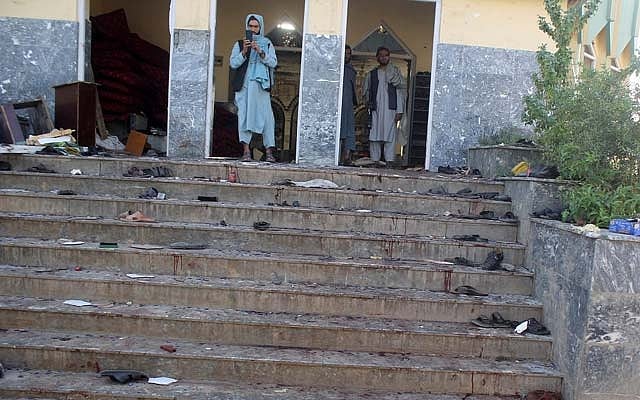
The massacre, while the mosque was crowded for Friday Prayer, was the group’s second attack against a mosque in just a few days. And it was the realisation of Afghan Hazaras’ fears that the Islamic State’s predation would go unchecked under the rule of the Taliban, which itself preyed on the Hazara in the past.
Witness accounts described a powerful explosion with many casualties. Matullah Rohani, a Taliban official in Kunduz, told local media that at least 43 people were killed by the attack and more than 140 were injured.
A local Shia community leader put the death toll much higher. Sayed Ahmad Shah Hashemi, who represents Kunduz province’s Shia population, told The New York Times that more than 70 people were killed in the attack.
“This deadly incident has caused trauma among Shias and other sectors of the society,” Hashemi said.
Hours after the bombing, it was claimed by the Islamic State Khorasan, also known as ISIS-K. It was the group’s deadliest strike since the suicide bombing at the international airport in Kabul on Aug. 26 that killed about 170 civilians and 13 US troops.
Islamic State Khorasan is a Sunni extremist group that has long targeted Shia Muslims in Afghanistan, focusing heavily on the Hazara ethnic minority, which is predominantly Shia.
The group also staged an attack several days ago outside a mosque in Kabul, the capital, which killed several people.
In the months before US forces withdrew from Afghanistan, some 8,000 to 10,000 jihadi fighters from Central Asia, the North Caucasus region of Russia, Pakistan and the Xinjiang region in western China poured into Afghanistan, a United Nations report concluded in June. Most were said to be associated with the Taliban or al-Qaida, which are closely linked, but others were allied with the Islamic State.
In claiming the attack in Kunduz on Friday, the Islamic State Khorasan statement said that the attacker was ethnic Uyghur — an oppressed Muslim minority in western China. China has long been concerned that Afghanistan could become a haven for Uyghur militants who might seek to attack Chinese government interests in revenge for its abuses against the Muslim population in Xinjiang province.
The newly installed Taliban government, having overthrown the country’s Western-backed administration in August, is struggling to contain an invigorated Islamic State. The group has grown increasingly antagonistic in recent weeks, conducting guerrilla-style attacks and bombings that have included Taliban fighters among the dead. The new government is also struggling with a collapsing economy as foreign funding remains largely frozen.
As Taliban officials shift from leading an insurgency to forming a functioning state, providing security to a population ravaged by more than 40 years of war has been their benchmark. But Islamic State attacks have undercut the Taliban’s promises.
The Taliban’s chief spokesman, Zabihullah Mujahid, condemned the attack Friday and vowed retribution.
For Afghanistan’s Shia minority, the new Taliban era has seen a continuation of the predation and violence that has stalked members for decades.
The Hazara grew increasingly bitter toward the US-backed government of President Ashraf Ghani in recent years, accusing it of doing little to protect them against sectarian massacre. And they looked at the Taliban’s return to power with dread: During the 1990s civil war era and first Taliban government in Afghanistan, the group made a point of targeting Hazara Shias.
©2021 The New York Times Company










