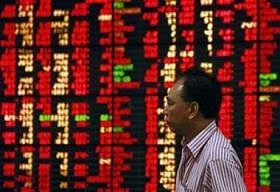
Asian shares nosedive but pare losses
Asian shares tumbled on Tuesday as investors scrambled to adjust to a rapid downgrade in the outlook for US and global economic growth, but later staged a sharp rebound from early lows, helping cushion expected losses in Europe.
bdnews24.com News Service
bdnews24.com
Published :
09 Aug 2011, 07:21 AM
Updated :
10 Aug 2022, 05:15 PM
Singapore, Aug 9 (bdnews24.com/Reuters) - Asian shares tumbled on Tuesday as investors scrambled to adjust to a rapid downgrade in the outlook for US and global economic growth, but later staged a sharp rebound from early lows, helping cushion expected losses in Europe.
US S&P 500 index futures pulled back sharply from earlier lows and crept into positive territory, while European index futures .STXEc1 also pared early losses and were trading down around 0.5 percent.
Major indexes in Asia slumped in early trade following a drop of more than 6 percent on Wall Street on Monday in the first trading session since the historic downgrade of the United States' AAA credit rating by Standard & Poor's.
Many market watchers fear the move will exacerbate the US economic slowdown by further undermining business and consumer confidence, possibly tipping the country back into recession.
Tokyo's Nikkei .N225 closed down 1.7 percent, having been down more than 4 percent at one stage, and MSCI's broadest index of Asia Pacific shares outside Japan was down 1.9 percent, after tumbling more than 6 percent earlier.
Australia's benchmark .AXJO staged the most dramatic comeback and was up 1.2 percent after being more than 5 percent in the red. Elsewhere, buying by state pension funds helped pare heavy initial losses in South Korea .KS11 and Taiwan .TWII.
"Not even in the global financial crisis did we see this extraordinary volatility," said RBS Australia's head of Sydney sales trading, Justin Gallagher.
The market turmoil of recent days puts significant pressure on the US Federal Reserve at its regular policy meeting on Tuesday to announce some fresh measures of support for a damaged US economy, though its options are limited.
Market players cited short-covering ahead of the Fed meeting as one factor for the rebound in Asia, while bargain hunting and the fading of early margin selling were also cited.
Traders said a rumor had been circulating in markets that the Federal Reserve might make an emergency statement before Wall Street opened, but most analysts dismissed the prospect as highly unlikely.
World stocks had touched 11-month lows on Tuesday, while gold struck a new record as investors dumped riskier assets amid fears that political leaders are failing to tackle debt crises in Europe and the United States.
MSCI's All-Country World Index has fallen about 14 percent so far this month, wiping around $3.8 trillion off company values, to its lowest levels since last August.
FLIGHT-TO-SAFETY
The flight-to-safety lifted gold to the latest in a string of record highs and boosted the Swiss franc and the yen.
"The breadth and the discipline of the selling is the most troubling factor," said Keith Ducker, chief investment officer at "dark pool operator Tora.
"Panic selling is generally followed by quick recoveries however the past two days have been driven more from thoughtful risk aversion ... indicating that this downturn may be more cyclical and potentially long-term in nature."
While the US downgrade late on Friday was the most obvious blow to confidence, investors have also been spooked by data suggesting the US economy was stalling and Europe's ever-worsening sovereign debt crisis.
There are also concerns about China's inflation rate, which analysts fear could curb Beijing's ability to stimulate demand to offset a global slowdown.
"The macroeconomic picture outside of Asia is bleak and Asia's ability to remain immune is doubtful in the extreme," said Alex Hill, co-founder of Singapore-based hedge fund Tantallon Capital, which manages more than $300 million.
Chinese data on Tuesday failed to offer respite, showing consumer price inflation hugging three-year highs in July.
"This is the type of data that should have prompted the PBoC to hike interest rates, but given the current turmoil in financial markets, we expect them to delay it," said Wei Yao, an economist with Societe Generale in Hong Kong.
The main index in South Korea .KS11, an economy particularly vulnerable to global capital outflows that was hard hit in 2008, was down almost 10 percent at one stage, but was supported by state pension fund buying and ended down 3.6 percent.
Hong Kong's Hang Seng .HSI was down 2.8 percent, pulling back from initial losses of more than 7 percent.
"It's very emotive trading," said Simon Burge, chief investment officer at ATI Asset Management in Australia. "Fundamentals would have to deteriorate quite significantly to catch up with where share prices are."
The dollar traded around 0.7545 Swiss franc, edging higher after coming close to an all-time low around 0.7483 reached the previous day.
The euro plunged to a record low on trading platform EBS of 1.0605 francs, then traded flat at 1.0700.
"The yen and the Swiss franc are drawing extremely strong demand as plunges in global shares are having a major psychological impact, forcing investors to refrain from holding risk assets," said Teppei Ino, a currency analyst at Bank of Tokyo-Mitsubishi UFJ.
Gold, a traditional refuge from financial storms, hit a record above $1,770 an ounce, and was later trading around $1,748.
JP Morgan (JPM.N) said on Monday it expected spot gold to climb to $2,500 an ounce or higher by year-end, following the downgrade of US debt. The US bank said its previous estimate of $1,800 was "too conservative."
US crude oil futures fell around $1.50 by mid-afternoon, or about 1.8 percent, to below $80 a barrel, but were well off session lows.
TIME OF OPPORTUNITY?
Whilst traders in Asian markets such as South Korea and Japan reported foreign money bailing out of local stocks, many asset managers maintained that the region still offers the best prospects.
"From a macro, top-down perspective, we expect the relative strength of the region's fundamentals to continue to attract incremental foreign capital," said RBS Asia Pacific equity strategists in a note.
"From a sector standpoint, it still appears that the one sector standing above any other for the delicate trade-off between risk and reward is telecoms. Valuations or expectations cannot be said to be anywhere near excessive levels."
While the steepling falls in equities reminded many of the shockwaves that swept through markets in the wake of Lehman Brother's collapse, money and corporate credit markets are not yet seeing a repeat of the strains witnessed three years ago.
"We are not seeing a replica of Lehman in terms of a systemic failure of the global banking system, most of the bank markets are still functioning reasonably, in terms of funding markets, commercial paper markets," said Warren Hogan, chief economist at ANZ Banking Corporation
And as many traders hit the sell button, Anthony Bolton, one of Britain's best known equity fund managers who now runs the firm's China Special Situations Fund (FCSS.L), saw a buying opportunity.
"History shows that normally extreme equity market volatility as we are now experiencing should be seen as a time of opportunity rather than a time to become more defensive," he said in a statement.
bdnews24.com/jr/1308h