Published : 30 Apr 2020, 10:00 PM
Updated : 17 Oct 2022, 11:06 AM



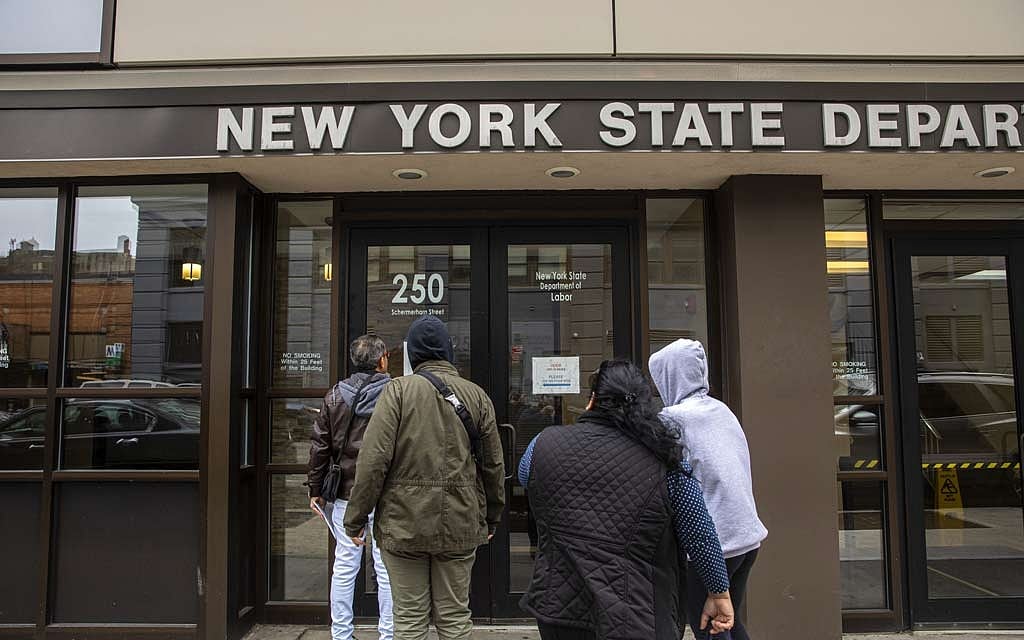
The figures announced Thursday by the Labor Department bring the number of workers joining the official jobless ranks in the past six weeks to more than 30 million and underscore just how dire economic conditions remain.
Many state agencies still find themselves overwhelmed by the flood of claims, leaving perhaps millions with dwindling resources to pay the rent or put food on the table.
If anything, according to many economists, the job losses may be far worse than government figures indicate. A study by the Economic Policy Institute found that roughly 50% more people than counted as filing claims in a recent four-week period may have qualified for benefits but were stymied in applying or didn’t even try because they found the process too formidable.
“The problem is even bigger than the data suggest,” said Elise Gould, a senior economist with the institute, a left-leaning research group. “We’re undercounting the economic pain.”
The depth of the economic chill was also highlighted by a Commerce Department report that showed consumer spending in March declined by a stunning 7.5% from February’s level.
Stocks dip as jobless claims rack up.
US stocks followed European markets lower Thursday as investors considered data revealing a sharp contraction in the eurozone economy and another surge of jobless claims in the United States.
The S&P 500 was down less than 1% in early trading. European markets fell about 2% after a rally in Asia.
On Wednesday, the S&P 500 had gained nearly 3%, lifted by news that drugmaker Gilead Science had seen early results that its experimental drug remdesivir could speed recovery in patients infected with the coronavirus. A steady climb has lifted the S&P 500 by more than 31% since its March 23 low.
This news was also a boon to Chinese drugmakers that make some of the ingredients in Gilead’s drug.
Broader positive sentiment was on display in commodities markets, too, as the price of oil continued a rally after Norway, a major oil producer, said that it would limit production, something that will lift sagging prices. The price of the US benchmark, West Texas Intermediate, jumped 16% to $17.53, while Brent crude, the international benchmark, rose more than 12% to $25.31 a barrel.
Europe will pay banks to lend money amid a deep downturn.
To counter a deep economic decline, the European Central Bank said Thursday it will effectively pay banks to lend money as it vowed to do whatever is necessary to counteract the economic impact of the coronavirus.
FILE -- A New York State Department of Labor office in Brooklyn, March 19, 2020. Millions of Americans have lost their jobs due to business closures in the wake of the coronavirus. (Hiroko Masuike/The New York Times)
Christine Lagarde, the president of the ECB, said at a news conference Thursday that the eurozone economy could decline by as much as 12% this year. The downturn is “unprecedented in peacetime,” she said.
In a statement Thursday, the central bank also said that it was prepared to further increase its purchases of government and corporate bonds, a form of money printing intended to keep market interest rates low and make it easier for businesses and consumers to get credit.
The central bank had previously earmarked more than 1 trillion euros, or $1.1 trillion, for asset purchases. But the bank said Thursday it is prepared to raise that sum “as much as necessary and for as long as needed.”
Mark Zuckerberg is worried about a second outbreak. Elon Musk says lockdowns are “fascist.”
As big companies report their latest quarterly earnings, CEOs are revealing radically different attitudes toward the lockdowns and social-distancing measures imposed during the pandemic. It has made for lively conference calls with analysts, which are normally focused on far more prosaic matters.
After the market closed Wednesday, Facebook reported better-than-expected earnings for the first quarter and also “signs of stability” in the second. Mark Zuckerberg, Facebook’s chief executive, warned that the effects of the pandemic would be significant and long lasting, with “massive societal costs” stemming from stay-at-home orders. But he said that reopening too quickly “will almost guarantee future outbreaks and worse longer-term health and economic outcomes.”
Around the same time, Tesla announced that it eked out an unexpected first-quarter profit. What made headlines, though, was Elon Musk’s profanity-laced rant about stay-at-home orders. The electric carmaker’s chief, who has clashed with officials in California over the closure of Tesla’s factory there, likened lockdowns to “forcibly imprisoning people in their homes against all their constitutional rights.” Then, in response to a question about infrastructure spending, he really let rip.
“If somebody wants to stay in their house, that’s great. They should be allowed to stay in their house, and they should not be compelled to leave,” he said. “But to say that they cannot leave their house, and they will be arrested if they do, this is fascist. This is not democratic. This is not freedom.”
©2020 The New York Times Company