


Published : 19 Aug 2020, 11:37 AM
Updated : 08 Apr 2022, 02:40 AM


The Tuesday night speaking lineup for the Democratic convention was always intended as a muscular contrast on foreign policy and diplomatic integrity, presented to viewers under the evening’s unsubtle theme: “Leadership Matters.”
There were two former commanders-in-chief, Bill Clinton and Jimmy Carter, and a former chairman of the Joint Chiefs turned chief diplomat: Colin Powell. There was Sally Q Yates, the former deputy attorney general who famously warned the White House in early 2017 that Michael Flynn, President Donald Trump’s first national security adviser, had lied about his Russian contacts.
“When this president goes overseas, it isn’t a goodwill mission — it’s a blooper reel,” Kerry said. “He breaks up with our allies and writes love letters to dictators.”
Earlier in the day, Kerry sent a fundraising email that made even clearer that Biden was the person who could “begin the hard work of putting back together the pieces of what Donald Trump has smashed apart.”
But putting back the pieces is probably not a feasible option, with global affairs straying a great distance from the status quo Biden might recall from the last time he stepped out of the Situation Room.
The relationship with China has turned poisonous. Biden’s party, still reeling from Russia’s election interference in 2016, has become more hawkish on dealing with Moscow than Republicans who once cast themselves as the party of national security. North Korea has turned a project to build a few bombs into an arsenal that rivals India’s and Pakistan’s, and reconstituting the Iran deal, if that is even possible, is unlikely to change the fundamental tensions dividing the Middle East.
Biden has offered few detailed policy plans to address how he would tackle this very changed world. Instead, the broad message of the virtual convention came down to this: Trust a man who ran the Foreign Relations Committee, who participated in the decisions to take out Osama bin Laden with a commando strike and Iran’s nuclear centrifuges with a cyber strike, and who would arrive at the White House with an experienced team.
To Trump and his supporters, that is Biden’s vulnerability. They say he stands for the establishment foreign policy that the current administration took office to destroy.
Biden, in turn, is arguing that Trump has allowed adversaries to undercut American interests, coddling strongmen, heartening the Russians and cutting deals for his friends.
By day’s end, the gravity of this split — and Biden’s long-running campaign theme of country-over-party leadership at home and abroad — had been reinforced by the latest turn in the seemingly ceaseless drama of Russia and the Trump 2016 campaign.
A Republican-controlled Senate panel released an extensive report detailing the web of connections between the Trump operation and Russian government officials and others with ties to the country’s intelligence services.
With the proceedings on Tuesday night, Democrats supplied a compelling counterpoint to a nation still getting its head around a disquieting truth: A foreign power tried to sabotage the last American presidential election, and some in Trump’s circle were open to the help.
The roster of allies who spoke Tuesday evening hinted at the kind of president Biden would like to be — a model that Democrats believe will resonate more powerfully with each revelation of Trumpian hostility to diplomatic norms.
Rep Lisa Blunt Rochester, D-Del, a co-chair of Biden’s presidential campaign, described a sharp divide between Biden and Trump on matters of “experienced leadership, compassionate leadership, qualified leadership.”
This view is in many ways a culmination of the pitch Biden and his allies have been pressing since the start of his campaign last spring: that he, a former vice president who spent decades steeped in foreign policy as a senator, was uniquely equipped to repair tattered relationships abroad and to assume the commander-in-chief role at home after four years of uncertain and destabilizing leadership under Trump.
Biden has surrounded himself by trusted veterans of the Democratic foreign policy establishment including Antony J Blinken and Jake Sullivan, two of his former national security advisers in the White House. His team is stacked with Obama-era foreign policy hands who are not promising radical departures from that administration. Instead they are betting that a renewed emphasis on multilateral engagement, a clear message about America’s role in the world and the empowering of foreign policy experts — along with scientists — will help to steady a rocky international landscape.
Doing much of this work, Biden has long believed, will require the cooperation of Republicans, a perspective that seemed to inform the itinerary Tuesday night. In elevating Powell as the spokesman for the Republican national security establishment that has fled Trump, the Democratic nominee was turning to a Biden-esque internationalist, who as chairman of the Joint Chiefs and then as secretary of state, argued that America is most powerful when it works with allies.
But Powell was also the man who made the case for invading Iraq, as President George W Bush’s most credible salesman — in a speech to the United Nations on Feb 5, 2003, that he has said he deeply regrets, just as Biden regrets his initial support for the war. Still, as Trump struggles to define Biden, seeking to cast the Democratic ticket as radical and unpatriotic, Powell’s appearance seemed intended to reassure moderate Republicans about Biden’s judgment.
Other faces were more familiar to the watchful Biden supporter.
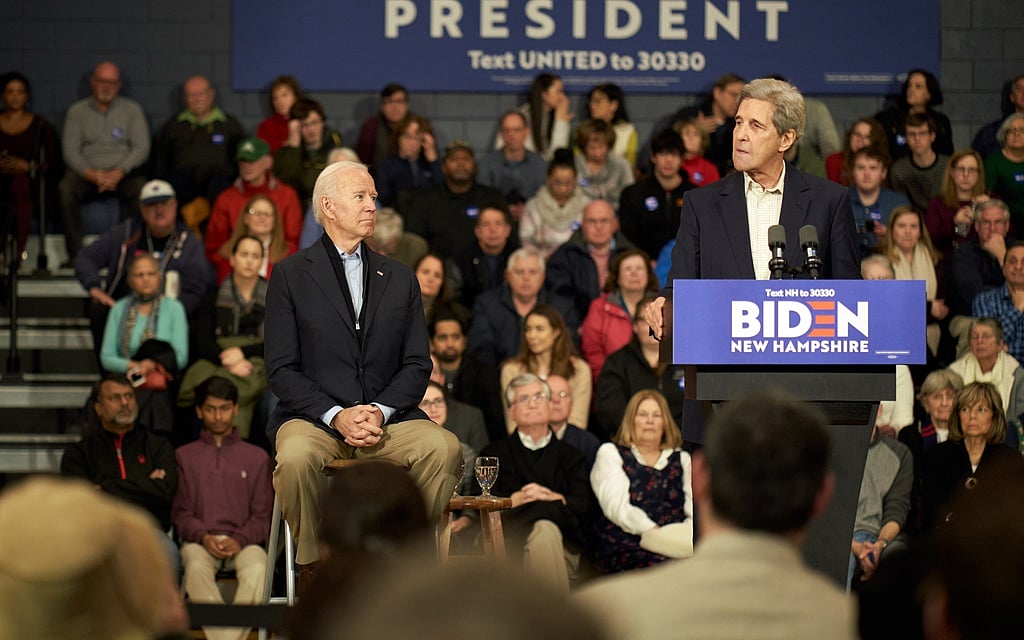
On the road early this year, as he stumped for his former Senate colleague in school gyms and at house parties, Kerry constantly made the case for Biden’s foreign policy credentials. It is a case that Democrats and even a number of Republicans have cited in explaining their comfort with Biden, describing him as a man steeped in what was once a tradition of bipartisan consensus when it comes to America’s role as a leader on the global stage. Those standards, they argue, have been shredded by Trump.
“I’ve never before seen the world more in need of someone who on day one can begin the incredibly hard work of putting back together the world Donald Trump has smashed apart,” Kerry said in his endorsement last December.
Chuck Hagel, the former defense secretary who was a Republican senator from Nebraska before joining the Obama administration, described Biden as notably receptive to hearing out colleagues from the other side of the aisle.
“Biden made an effort always to communicate with and talk to and deal with and ask opinions of his Republican colleagues,” Hagel said in an interview earlier in the campaign.
Certainly, Biden’s deep experience in foreign affairs — “I was one of those folks they call a ‘chairman of the Foreign Relations Committee,’” he once said grandly, at a veterans-focused event in 2012 — has not always translated into electoral success and has sometimes amounted to significant political liability.
In 2008, his White House run was hamstrung by his vote authorizing the Iraq War, a decision he struggled to accurately explain as recently as this year. Early in the 2020 Democratic primary, Biden often strained to connect with audiences when discussing the finer points of his foreign policy history, his throwback references to long-ago global endeavors rarely landing in Iowa and New Hampshire.
And the fact remains that in some arenas Trump simply took Obama initiatives to wild extremes. Biden urged Obama to draw down troops in Afghanistan, and warned of “endless wars.” Biden himself promised to reinvigorate America’s nuclear laboratories, which Trump seized upon to renew an arms race with Russia.
Biden conceives of himself as pragmatic and nonideological, a maker of deals and a shaker of hands, eager to collaborate with Republicans and convinced that he is particularly capable of doing so effectively. Of course, some Democrats have questioned the wisdom of such compromises historically, lamenting his deference to Republicans most significantly in Iraq.
But Biden has made outreach to independents and moderate Republicans a central piece of his campaign strategy from the start. And his Tuesday program put his relationship with one Republican on prominent display: Biden’s friendship with Sen. John McCain, R-Ariz., whom Biden eulogized.
In a video about their relationship that included the voice of McCain’s widow, Cindy, the men were described as having, at times, opposing views, but uniting around their belief in bipartisan cooperation where possible.
If the evening’s thesis was often that Biden could be counted on with the nation’s most sensitive national security predicaments, the headliner on Tuesday moved to expand the point closer to home.
For the evening’s marquee speech, Jill Biden, the candidate’s wife, resolved to address the convention from Room 232 at Brandywine High School, where she once taught, drawing on her long career in education and her rolling side gig as a public advocate for her husband.
The implication, against the backdrop of a mismanaged pandemic that threatens the upcoming school year, was unmistakable: The Bidens know how to take care of families, and Trump has failed them.
“I know if we entrust this nation to Joe, he will do for your family what he did for ours,” Jill Biden said. “Bring us together and make us whole.”
c.2020 The New York Times Company













