


Published : 16 Dec 2020, 12:06 PM
Updated : 08 Apr 2022, 02:52 AM


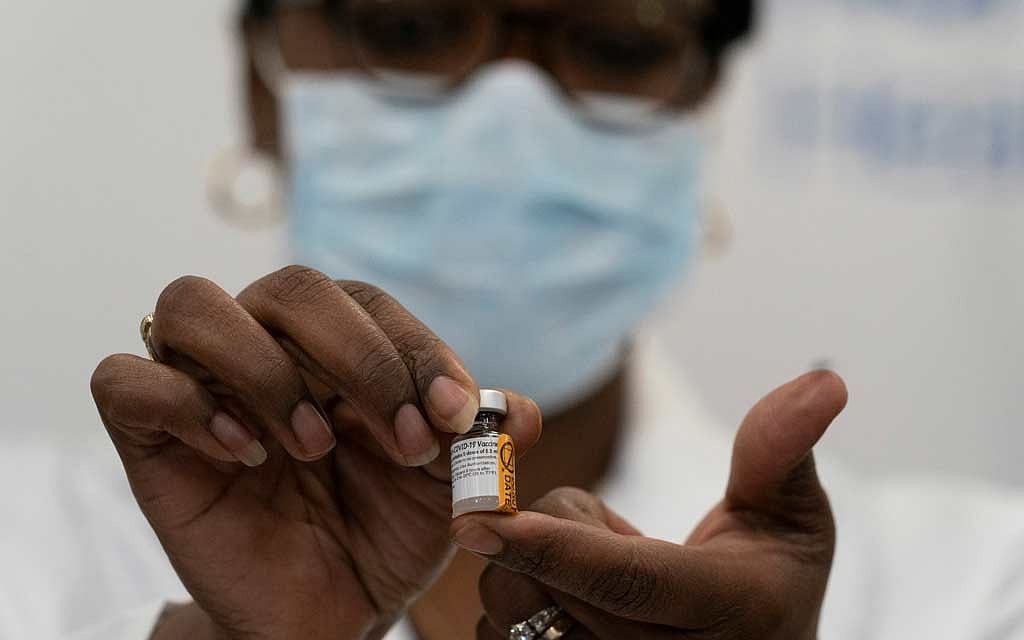
From that vial would come five doses.
After preparing the vial, staff members put it in a cooler and drove it 25 minutes east to Long Island Jewish Medical Center, where a news conference had been hastily moved up. A nurse, Sandra Lindsay, was waiting to get the first shot.
Gov Andrew Cuomo’s office teleconferenced in. But it was not until just after 9 am, right before the broadcast began, that someone on the governor’s team said that it appeared they were about to administer not only the first dose in the state but the first in the country.
“The silence in that room was deafening,” said Joe Kemp, communications officer for Northwell. “Hospital workers, Cuomo’s people. Every one of us realised at that minute just how profound that was going to be. We were putting a woman on the moon. It was a lunar landing.”
Similar scenes played out around the country, as hospitals, which have been waiting months for the first doses, scrambled to put together events after unknowns about the vaccine and its distribution made it difficult to perfectly plan for its arrival.
Some hospitals deliberately worked to spotlight the moment, picking a person — a Black or Latino nurse or doctor, a housekeeper — who would be among the first to receive the shot as a way to send a message to diverse communities about trusting the vaccine.
Others — like a hospital in Iowa that first vaccinated a health care worker who had a few days off coming, or a hospital in Pittsburgh that let staff members vote on who would get the honour — left the specifics of who would go first more to chance.
That health workers in high-risk positions would go first was a common point of agreement through much of the country. An advisory committee to the Centres for Disease Control and Prevention last week recommended that health care workers should be among the first to receive the vaccine, along with nursing home residents and workers.
Hospitals, with their ability to store vials at subzero temperatures, were prioritised to get the first doses of the vaccine from Pfizer.
But even with that, there were choices.
On Tuesday, Dr Marina Del Rios, an emergency department physician at University of Illinois Health, was the first person vaccinated in Chicago. “I think that the city was being strategic over who they selected,” she said in an interview. “They probably understood that it was important to have someone who was Latino in that first group, given that such a huge proportion of the Latino community has been affected by COVID, and so many of us have lost loved ones.”
At Tampa General Hospital in Florida, the first vaccine went to a 31-year-old nurse, Vanessa Arroyo. “We’ve been in the front lines through this whole pandemic and cared for the first COVID-positive patient at Tampa General,” she said. “So I felt like it was right for one of our own to be the first to receive this vaccine.”
In Pittsburgh, the initial shots were administered Monday at UPMC Children’s Hospital. The first went to Charmaine Pykosh, a 67-year-old advanced nurse practitioner. She was chosen for the honour by her colleagues. “For the first shot, we all weighed in,” she said. “We kind of had a text vote.”
Doctors and nurses were well-represented, but at several hospitals housekeepers and hospital support staff members also were at the front of the line. At VA Bedford Healthcare System in Massachusetts, Andrew Miller, a housekeeper in the Environmental Management Service, was the first employee to receive the vaccine Monday afternoon, the hospital announced in a tweet.
Some systems and states used the moment specifically to reach out to communities disproportionately affected in the virus’ first wave. In New Jersey, the first person to be vaccinated was Maritza Beniquez, an emergency room nurse at University Hospital in Newark, the state’s hardest-hit city. Beniquez described herself as a “proud Latina American” whose family is originally from Puerto Rico. “It was just wave after wave of critically ill patients that were coming in with no end in sight,” she said of her experience in the emergency room.
That New York ended up being first was unexpected. The Pfizer vaccine was coming in three waves this week from Kalamazoo, Michigan, where the drugmaker has its largest manufacturing site. But even with Northwell, which planned for weeks on having a news conference featuring vaccinations on camera shortly after receiving its first doses, there was some last-minute scramble.
Stephanie Cal, a critical care nurse at Long Island Jewish Medical Center, got a call Sunday night to see if she wanted to be among the first five employees to get a shot. Lindsay, 53, the director of critical care nursing at the hospital, was chosen as the very first recipient after Northwell got word Sunday that its first doses would be arriving in the borough.
About 15 minutes before the livestream began, Gareth Rhodes, a top aide to Cuomo, got on the phone with Lindsay to say that it was looking as if she might be the first person vaccinated in the nation and that she should expect media attention. “And she said, I remember very distinctly, ‘It’s my duty. I’ve seen too much pain and suffering,’” Rhodes said.
© 2020 New York Times News Service










