


Published : 01 Feb 2021, 06:20 PM
Updated : 14 Oct 2022, 06:27 PM


Trump did not, could not, win the election, not by “a lot” or even a little. His presidency would soon be over.
Allegations of Democratic malfeasance had disintegrated in embarrassing fashion. A supposed suitcase of illegal ballots in Detroit proved to be a box of camera equipment. “Dead voters” were turning up alive in television and newspaper interviews.
The week was coming to a particularly demoralizing close: In Arizona, the Trump lawyers were preparing to withdraw their main lawsuit as the state tally showed Joe Biden leading by more than 10,000 votes, against the 191 ballots they had identified for challenge.
As he met with colleagues to discuss strategy, the president’s deputy campaign manager, Justin Clark, was urgently summoned to the Oval Office. Trump’s personal lawyer, Rudy Giuliani, was on speakerphone, pressing the president to file a federal suit in Georgia and sharing a conspiracy theory gaining traction in conservative media — that Dominion Systems voting machines had transformed thousands of Trump votes into Biden votes.
Clark warned that the suit Giuliani had in mind would be dismissed on procedural grounds. And a state audit was barreling toward a conclusion that the Dominion machines had operated without interference or foul play.
Giuliani called Clark a liar, according to people with direct knowledge of the exchange. Clark called Giuliani something much worse. And with that, the election-law experts were sidelined in favour of the former New York City mayor, the man who once again was telling the president what he wanted to hear.
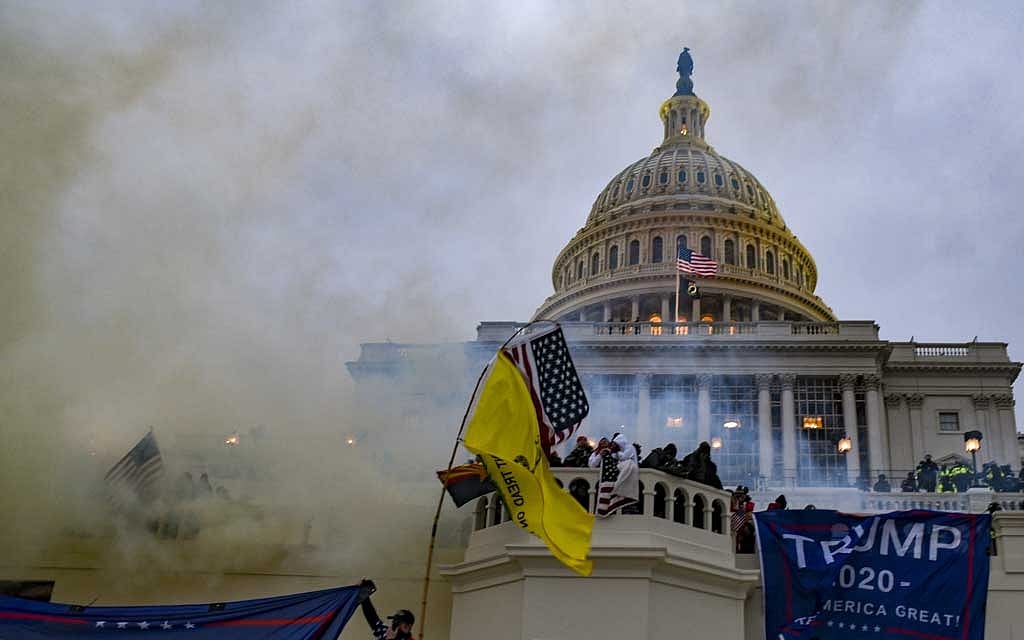
Thursday the 12th was the day Trump’s flimsy, long-shot legal effort to reverse his loss turned into something else entirely — an extralegal campaign to subvert the election, rooted in a lie so convincing to some of his most devoted followers that it made the deadly Jan. 6 assault on the Capitol almost inevitable.
Weeks later, Trump is the former President Trump. In coming days, a presidential transition like no other will be dissected when he stands trial in the Senate on an impeachment charge of “incitement of insurrection.” Yet his lie of an election stolen by corrupt and evil forces lives on in a divided America.
A New York Times examination of the 77 democracy-bending days between election and inauguration shows how, with conspiratorial belief rife in a country ravaged by pandemic, a lie that Trump had been grooming for years finally overwhelmed the Republican Party and, as brake after brake fell away, was propelled forward by new and more radical lawyers, political organizers, financiers and the surround-sound right-wing media.
In the aftermath of that broken afternoon at the Capitol, a picture has emerged of entropic forces coming together on Trump’s behalf in an ad hoc, yet calamitous, crash of rage and denial.
But interviews with central players, and documents including previously unreported emails, videos and social media posts scattered across the web, tell a more encompassing story of a more coordinated campaign.
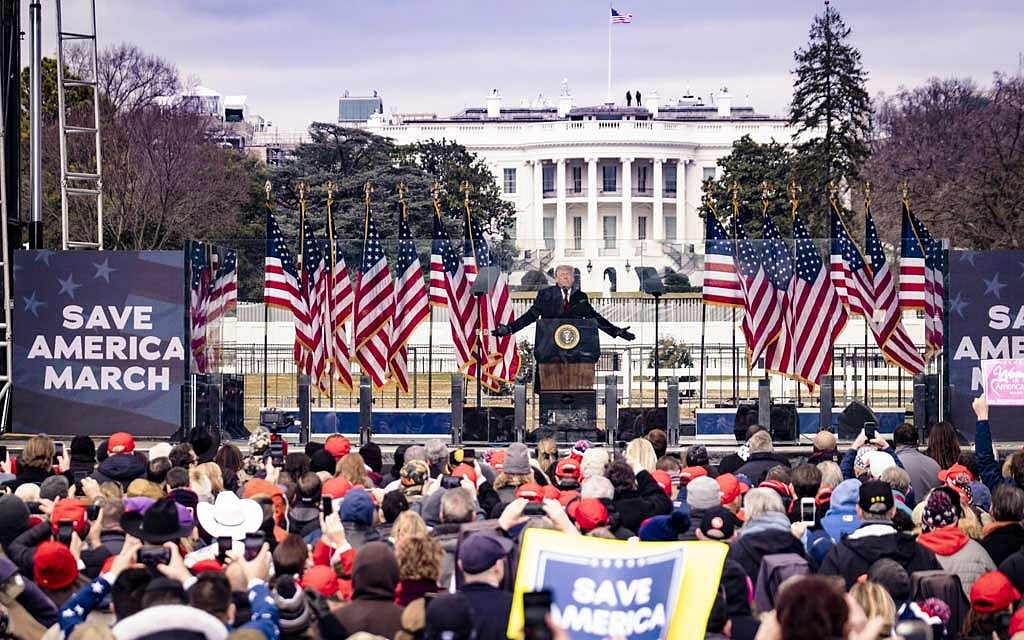
With the White House behind him, then President Donald Trump speaks at a rally on the day that some his supporters rioted and stormed the Capitol building, in Washington, Jan. 6, 2021. (Pete Marovich/The New York Times)
Throughout, he was enabled by influential Republicans motivated by ambition, fear or a misplaced belief that he would not go too far.
In the Senate, he got early room to manoeuvre from the majority leader, Mitch McConnell. As he sought the president’s help in Georgia runoffs that could cost him his own grip on power, McConnell heeded misplaced assurances from White House aides like Jared Kushner that Trump would eventually accede to reality, people close to the senator told the Times. McConnell’s later recognition of Biden’s victory would not be enough to dissuade 14 Republican senators from joining the president’s last-ditch bid to nullify millions of Americans’ votes.
Likewise, during the campaign, Attorney General William Barr had echoed some of Trump’s complaints of voter fraud. But privately the president was chafing at Barr’s resistance to his more authoritarian impulses — including his idea to end birthright citizenship in a legally dubious preelection executive order. And when Barr informed Trump in a tense Oval Office session that the Justice Department’s fraud investigations had run dry, the president dismissed the department as derelict before finding other officials there who would view things his way.
For every lawyer on Trump’s team who quietly pulled back, there was one ready to push forward with propagandistic suits that skated the lines of legal ethics and reason. That included not only Giuliani and lawyers like Sidney Powell and Lin Wood, but also the vast majority of Republican attorneys general, whose dead-on-arrival Supreme Court lawsuit seeking to discount 20 million votes was secretly drafted by lawyers close to the White House, the Times found.
As traditional Republican donors withdrew, a new class of Trump-era benefactors rose to finance data analysts and sleuths to come up with fodder for the stolen-election narrative. Their ranks included the founder of MyPillow, Mike Lindell, and former Overstock.com CEO Patrick Byrne, who warned of “fake ballots” and voting machine manipulation from China on One America News Network and Newsmax, which were finding ratings in their willingness to go further than Fox in embracing the fiction that Trump had won.
As Trump’s official election campaign wound down, a new, highly organized campaign stepped into the breach to turn his demagogic fury into a movement of its own, reminding key lawmakers at key times of the cost of denying the will of the president and his followers. Called Women for America First, it had ties to Trump and former White House aides then seeking presidential pardons, among them Steve Bannon and Michael Flynn.
As it crossed the country spreading the new gospel of a stolen election in Trump-red buses, the group helped build an acutely Trumpian coalition that included sitting and incoming members of Congress, rank-and-file voters and the “de-platformed” extremists and conspiracy theorists promoted on its homepage — including white nationalist Jared Taylor, prominent QAnon proponents and Proud Boys leader Enrique Tarrio.
With each passing day the lie grew, finally managing to do what the political process and the courts would not: upend the peaceful transfer of power that for 224 years had been the bedrock of American democracy.
As lawsuits failed in court after court across the country, leaving Trump without credible options to reverse his loss before the Electoral College vote on Dec. 14, Giuliani and his allies were developing a new legal theory — that in crucial swing states, there was enough fraud, and there were enough inappropriate election-rule changes, to render their entire popular votes invalid.
As a result, the theory went, those states’ Republican-controlled legislatures would be within their constitutional rights to send slates of their choosing to the Electoral College.
Before Thanksgiving, a team of lawyers with close ties to the Trump campaign began planning a sweeping new lawsuit to carry that argument.
According to lawyers involved in the conversations, the group determined that the fast-approaching Electoral College vote did not leave time for a series of lawsuits to work their way through the courts. They would need to go directly to the Supreme Court.
The lawsuit was audacious in its scope. It claimed that, without their legislatures’ approval, Georgia, Michigan, Pennsylvania and Wisconsin had made unconstitutional last-minute election-law changes, helping create the conditions for widespread fraud. Citing a litany of convoluted and speculative allegations — including one involving Dominion voting machines — it asked the court to shift the selection of their Electoral College delegates to their legislatures, effectively nullifying 20 million votes.
On Dec. 11, the court declined to hear the case.
If the highest court in the land couldn’t do it, there had to be some other way.
And so they came the next day, by the thousands, to a long-planned rally in Washington, filling Freedom Plaza with red MAGA caps and Trump and QAnon flags, vowing to carry on.
“The justice system has a purpose in our country, but the courts do not decide who the next president of the United States of America will be,” the freshly pardoned former national security adviser, Flynn, told the crowd. “We the people decide.”
The rally had been planned by Women for America First, which was quietly becoming the closest thing Trump had to a political organizing force, gathering his aggrieved supporters behind the lie of a stolen election.
The group’s founder, Amy Kremer, had been one of the original Tea Party organizers, building the movement through cross-country bus tours. She had been among the earliest Trump supporters, forming a group called Women Vote Trump along with Ann Stone, ex-wife of the longtime Trump adviser Roger Stone.
With donors including the Trump-affiliated America First Policies, Women for America First had rallied support for the Supreme Court nomination of Amy Coney Barrett and defended Trump during his first impeachment.
The group’s executive director was Kremer’s daughter, Kylie Jane Kremer, who recently worked on Hannity’s radio show. Two organizers helping the effort, Jennifer Lawrence and Dustin Stockton, were close to Bannon.
For the Kremers, Lawrence and Stockton, the instrument of that fight would be a reprise of the Tea Party Express, a bus tour to enlist state and federal lawmakers in Trump’s effort to keep states from certifying results before the Electoral College vote.
But after the 12th, the group found itself in limbo — leading a restive movement without a clear destination.
At the White House, Trump was still searching for ways to nullify the results, soliciting advice from allies like Flynn, Giuliani and Powell.
Ultimately Trump agreed, at least for the moment, to focus on blocking congressional certification of the results on Jan. 6.
If one senator and one House member object to a state’s results, the two chambers must convene separately to debate, then reconvene to vote. Rejection of the results requires majority votes in both chambers.
Now, Women for America First had a purpose, too. Objectors were already lining up in the House. So the group planned a new bus tour, this one to travel from state to state helping to sway persuadable senators — 11 by their count.
On Saturday, Jan. 2, Kylie Kremer posted a promotional video for Wednesday’s rally on Twitter, along with a message: “BE A PART OF HISTORY.”
The president shared her post and wrote: “I’ll be there! Historic day.”
It was coming down to a contest of wills within the Republican Party, and tens of thousands of Trump supporters were converging on Washington to send a message to those who might defy the president.
Trump took the stage at the Ellipse on Jan. 6 shortly before 1 p.m., calling on the tens of thousands before him to carry his message to Republicans in the Capitol: “You’ll never take back our country with weakness.”
As he spoke, some protesters, with Proud Boys helping take the lead, were already breaching the outer security perimeter around the Capitol. Inside, when Rep. Paul Gosar, R-Ariz., stood to raise the first objection, to results in his home state, several Republican lawmakers gave him a standing ovation.
Less than an hour later, the lawmakers would flee to a secure location as the mob streamed into the building.
On Jan. 15, Trump acquiesced to an Oval Office meeting with Lindell, who arrived with two sets of documents. One, provided by a lawyer he would not name, included a series of steps Trump could take, including “martial law if necessary.” The other, Lindell claimed in an interview the next day, was computer code indicating that China and other state actors had altered the election results — vetted by his own investigators after he found it online.
A couple of minutes later, Trump directed his national security adviser, Robert O’Brien, to escort Lindell upstairs, to White House counsel Pat A. Cipollone’s office. He told the MyPillow founder to come back afterwards.
After a perfunctory discussion, aides directed Lindell to the exit. “I say it loud, ‘I’m not leaving,’” he recalled telling them. He eventually left when an aide made it clear there would be no Oval Office follow-up. The president was done.
© 2021 The New York Times Company







