Published : 22 Oct 2026, 07:50 PM
Updated : 22 Oct 2026, 07:50 PM


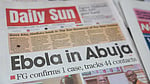
Nigeria's first Ebola patient in over a decade was not tested for the disease until 13 days after falling ill, officials said, a delay that raises questions about authorities' ability to contain an outbreak already spanning four African nations.
The epidemic, first detected 3,000km away in Democratic Republic of Congo in May, is the second-largest on record and had already hit Uganda and Kenya before the Nigerian case was confirmed on Tuesday -- the widest known spread on the continent.
The patient, the Ugandan-born wife of a Swiss diplomat, arrived in Nigeria's capital Abuja, a major travel hub, on Oct 3 after a two-week holiday in Uganda, Dr Jean Kaseya, the head of Africa's top public health body, told Reuters.
'NO-ONE IS SAFE TODAY'
She fell ill three days later, Kaseya said, citing the account given by Nigerian authorities. Initially suspecting malaria, she sought treatment at several facilities before being tested for Ebola on Oct 19.
"When we identified at-risk countries, Nigeria was not part of this list. It is now," said Kaseya, director-general of the Africa Centres for Disease Control and Prevention.
That list would have to be redrawn, and North and Southern Africa could also be at risk, he added. "We need to consider that no one is safe today."
The late detection would complicate efforts to trace people the woman may have infected, he said. Ebola spreads through direct contact with the bodily fluids of someone showing symptoms.
"We need to identify all the contacts... this one is a little bit tough for someone who went almost two weeks without being tested, coming into contact with health workers, family members, friends," Kaseya said.
Nigeria has identified 44 contacts so far, a number Kaseya and other Ebola experts said was bound to rise.
The outbreak is caused by the Bundibugyo species of Ebola, for which there is no vaccine or treatment. It has infected more than 9,500 people and killed more than 4,600 in Congo alone.
'THIS IS FAR FROM OVER'
Uganda reported 20 cases in May and June, mostly imported from Congo, but the World Health Organization declared the country Ebola-free in August.
Ugandan authorities have said the woman who fell ill in Nigeria had travelled to eastern Congo before transiting through Uganda.
Nigerian officials said they have not confirmed that.
"Our case did not have confirmed travel to DRC. So we presume it was likely picked in Uganda," Nigeria's Health Minister Muhammad Ali Pate told state television on Tuesday.
Kaseya said the Africa CDC was seeking clarification from both countries and from the woman herself.
Whether she was in Congo is an important question, said Marion Koopmans, a Dutch virologist who sits on the World Health Organization's Ebola emergency committee.
If she was, it would reinforce worries about the efficacy of screening at borders and in airports, she said. If not, it would raise the possibility that she somehow got infected in Uganda.
"Either way, it confirms that this is far from over," she said.
Nigerian officials have pointed to the country's handling of a case during the West African outbreak in 2014-2016, saying the country is fully prepared to deal with the disease.
But Dr Ayoade Alakija, a Nigerian physician and co-chair of a G7 committee for investment in global health, noted that the first case to reach Nigeria in that outbreak involved a patient who flew from Liberia and was immediately hospitalised.
"It's a very different scenario," she said.