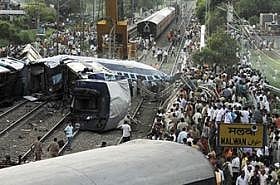
43 killed, 300 hurt in India train accident
Fifteen coaches of the Kalka Mail train go off the rails near the town of Fatehpur in Uttar Pradesh. Updates 2
bdnews24.com News Service
bdnews24.com
Published :
10 Jul 2011, 03:17 PM
Updated :
10 Aug 2022, 05:05 PM
Dhaka, July 11 (bdnews24.com) — At least 43 people have been killed and over 300 injured in a train derailment near Fatehpur city in northern India.
Fifteen coaches of the Kalka Mail passenger train left the rails near the town of Fatehpur in Uttar Pradesh on Sunday, Indian media reports said.
The train, travelling from Howrah near Calcutta to Kalka in Haryana state, was running at 108 km an hour—the highest permissible speed for superfast trains—when it went off the rails.
The derailment took place at 12.20pm when the packed train from Howrah reached near Malwa station, nearly 120 kms from Lucknow – the capital of Uttar Pradesh.
Rescue workers and locals arrived to try to free trapped passengers from the badly damaged carriages.
Railway officials feared the death toll would go up, as two badly damaged coaches of the ill-fated train were yet to be broken into until early Monday morning, according to an Indian daily Hindustan Times.
Joining the rescue operations, Army despatched two columns, one each from Kanpur and Allahabad, with relief assistance troops, medical teams and equipment to the Kalka Mail accident site.
An Army official, teams of engineers with plant cutting devices and other equipment have moved to the site to help rescue people trapped in bogies, 10 of which are in bad shape, reported The Times of India.
Minister of state for Railways K H Muniappa has also rushed to the site to oversee the rescue relief operations, a railway spokesperson said.
HC Joshi, North Central Railway General Manager, said, "The exact cause of the derailment has not been ascertained as we are busy in rescue operations."
He added a probe has been ordered into the accident.
The Indian Railways carries around 30 million people every day, but has a patchy safety record because of ageing infrastructure.
bdnews24.com/corr/ost/nir/0246h