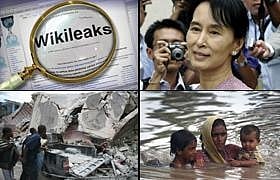
2010 in ReviewWikiLeaks, Suu Kyi hog headlines
A look back on a hair-raising happening year around the world.
bdnews24.com News Service
bdnews24.com
Published :
31 Dec 2010, 04:30 PM
Updated :
24 Apr 2022, 05:52 PM
Dhaka, Dec 31 (bdnews24.com)—A look back on a hair-raising happening year around the world
1) Haiti Earthquake
A devastating earthquake, botched relief efforts and a million people homeless. Riots and social unrest. Floods, a deadly cholera outbreak and a contested presidential election.
For Haitians, it has been a catastrophic year.
It all began on January 12 this year, when a 7.0 magnitude earthquake leveled most of Haiti's capital Port-au-Prince and severely affected some of its neighbouring towns.
The natural disaster crippled the country leaving over 200,000 dead. But worse was yet to follow.
The earthquake left more than a million people homeless. Port-au-Prince's infrastructure was in tatters and efforts to reduce the rubble and rebuild the capital lagged.
Then in October, a cholera outbreak brought more tragedy. More than 2000 people have already lost their lives, while 91 000 others have been treated for the disease.
2. Pakistan floods
Battling an insurgency at home, while lurching from one economic or political crisis to another, Pakistan's stability was balanced on a knife-edge in July 2010, when the first drops of the monsoon rains began to fall. The rains did not cease until September; by the time the record flooding was over, the Pakistani government said that over 20 million people (11 per cent of the population) had been directly affected.
Seventeen million acres (69,000 square-km) of crop land submerged. Over 200,000 cattle and livestock drowned. Agricultural damage to an estimated $2.9bn, with overall damage estimated at $43bn, more than 25% of Pakistan's gross domestic product.
Whole villages were simply wiped off the map.
It was a disaster that UN Secretary-General Ban Ki-Moon said was the worst he had ever seen.
3) End of Thai 'red shirt' movement
Thailand's government agreed on Dec 21 to lift an eight-month state of emergency in Bangkok, citing an improved political climate and a less confrontational approach by anti-government "red shirt" protesters.
The state of emergency was declared in Bangkok and surrounding provinces on April 7 after demonstrators occupying Bangkok's commercial heart broke into the grounds of parliament extending to other provinces.
In all, 91 died and more than 1,800 were wounded in the country's worst political violence in modern times.
The Centre for the Resolution of the Emergency Situation, an ad hoc body set up to manage the state of emergency, granted security forces broad powers and allowed arrest, searches and surveillance without warrants, media censorship and detention without charge for up to 30 days.
The resurgence of the anti-government "red shirts," most of whom back ousted former premier Thaksin Shinawatra, is one of the biggest political risks to Southeast Asia's second-biggest economy, which is projected to grow 7.5 percent this year before slowing in 2011.
4. Chile miners' miraculous rescue
Chileans were just beginning to pick themselves up from one of the strongest earthquakes ever registered when, on August 5, the country was again struck by disaster.
In the desolate, mineral-rich Atacama desert region, a copper-gold mine had collapsed, leaving 33 miners trapped inside.
On day 17 of the rescue operation, a handwritten note attached to one of the perforating drills read: "We are all 33 alive in the shelter".
The miners' families, who had been camped outside since day one, cried for joy along with all of Chile as news spread across the globe.
The world watched with bated breath as the stories of each and every one of the miners, including their families, their infidelities, strengths, courage, health problems and traumas, became household gossip.
The rescue operation itself was a feat of engineering magic, down to the red, white and blue Phoenix capsule that lifted the miners to the surface 70 days after the accident.
5. Middle East and Flotilla
The world awoke on May 31 to news that the Israeli army had conducted an early morning raid on the Gaza Freedom Flotilla.
The flotilla's aim was to break the Israeli imposed blockade on Gaza in place since June 2007 by delivering six ships laiden with over 10 000 tonnes of humanitarian aid to the Hamas-controlled Gaza strip. The journey turned disastrous when the Israeli army opened fire on activists on board one of the boats, the Mavi Marmara, killing nine people, including 8 Turks and one US citizen.
The raids took place in international waters and this, combined with the fact that the violence had been waged on activists from over 40 countries, brought renewed global outrage towards Israel.
An international fact-finding mission conducted by the UNHCR on the incident concluded the IDF's raid "betrayed an unacceptable level of brutality" and violated international law "including international humanitarian and human rights law".
Israel rejected the findings of the report, calling it "biased" and "one sided", launching its own internal investigation into the incident. The investigation, headed by former Israeli supreme court judge Yaakov Tirkel, concluded that "some mistakes were made" but fails to reprimand the misconduct of IDF soldiers involved in the incident.
6. Cambodia festival stampede
At least 345 people were killed, on Nov 22, in a stampede during festival celebrations in the Cambodian capital, Phnom Penh.
Huge crowds had gathered on a small island for the final day of the Water Festival, one of the main events of the year in Cambodia.
The stampede took place on a bridge, which eyewitnesses said had become overcrowded.
Most of the deaths were as a result of suffocation and internal injuries.
Hundreds more people were injured in the crush.
Panic broke out after a concert on Diamond Island, which followed a boat race on the Tonle Sap river regarded as a highlight of the festivities.
Prime minister Hun Sen described the stampede as the "biggest tragedy" to hit Cambodia since the mass killings carried out by the Khmer Rouge regime in the 1970s.
7. Myanmar election, Suu Kyi's release
On November 7, people of Myanmar voted in the country's first national elections for 20 years, but the main opposition party boycotted the poll.
Ruling generals said the polls mark a transition to democratic civilian rule but critics say they are a sham.
The National League for Democracy, the main opposition party led by Nobel laureate Aung San Suu Kyi, boycotted the vote.
The Myanmar military authorities, on Nov 13, released the pro-democracy leader, Aung San Suu Kyi, from house arrest.
The Nobel Peace Prize winner had been detained for 15 of the past 21 years.
Appearing outside her home in Rangoon, Ms Suu Kyi told thousands of jubilant supporters they had to "work in unison" to achieve their goals.
8. Nobel Peace Prize to China's Liu
Jailed Chinese dissident Liu Xiaobo was awarded the winner of the 2010 Nobel Peace Prize.
Making the announcement in Oslo, Nobel Committee president Thorbjoern Jagland said Mr Liu was "the foremost symbol of the wide-ranging struggle for human rights in China".
China said the award was contrary to Nobel principles and could damage relations with Norway.
The Beijing government summoned the Norwegian ambassador in protest. It called Mr Liu a "criminal", saying the award violated Nobel principles and could damage relations with Norway.
Mr Liu, 54, was a key leader in the Tiananmen Square protests in 1989.
In 2009 he received an 11-year sentence for "inciting subversion" after drafting Charter 08 - which called for multi-party democracy and respect for human rights in China.
9. Gulf oil spill
In late April, a surprise explosion on the Deepwater Horizon mobile drilling rig in the Gulf of Mexico caused arguably the worst environmental disaster that the US has ever faced.
While the initial death toll was 11 platform workers, British Petroleum and US government officials did not notice the oil leak for days.
The Coast Guard and other agencies had rushed to contain the spill - around 75km from the shore - but the amount of oil leaked exceeded many worst-case scenarios.
Sea turtles, pelicans and hermit crabs were killed by crude oil as it washed its way into the Louisiana bayou and vulnerable wetlands. The oil created a kill zone around the leak, and toxic dispersants used to push back the spilled oil have caused further damage to wildlife and human habitats along the Gulf coast.
The total cost of the disaster has been estimated at between $29bn and $63bn, and the environmental cleanup is ongoing.
10. Assange's WikiLeaks
It has been a whirlwind of a year for WikiLeaks, the whistleblower website and its director Julian Assange.
Little was known of WikiLeaks when it first opened operations in 2006, but the organisation captured international attention in April this year when it released a 2007 video that showcased US brutality towards civilians and journalists in Iraq.
Later in July, WikiLeaks released 76,900 classified military documents about the US invasion of Afghanistan.
But not to be undone, in October the website released a package of almost 400,000 secret field reports from Iraq in conjunction with major media organisations across the globe.
Factor in revelations of multiple rape charges issued against Assange in Sweden, a warrant sanctioned by Interpol for his arrest, and talk of imminent extradition of a man involved in the publication of the most sensitive of government documents, and the WikiLeaks story turns into the stuff of a high-speed espionage thriller.
bdnews24.com/adk/shk/mr/bd/1940h