


Published : 19 May 2014, 08:57 PM
Updated : 08 Aug 2022, 06:46 PM


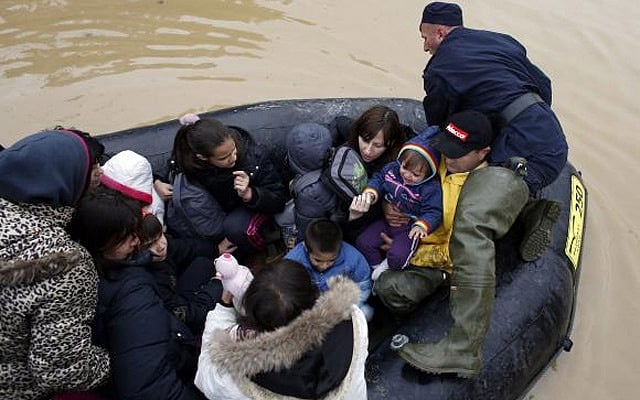
The floods extended across Serbia and Bosnia, where receding waters in some of the worst-hit areas are now revealing the extent of the devastation. Homes have been toppled or submerged in mud, trees felled and villages strewn with the rotting corpses of livestock.
"The consequences of the floods are terrifying," Bosnian Foreign Minister Zlatko Lagumdzija told a news conference. "The physical destruction is not less than the destruction caused by the war." He said more than 100,000 houses and other buildings were no longer usable. "During the war, many people lost everything," he said. "Today, again they have nothing."
More than a million people in Bosnia were been cut off from clean water supplies, Lagumdzija said, after torrential rains caused rivers to burst their banks and triggered more than 2,000 landslides.
The discovery of a body in northern Bosnia on Monday raised the regional death toll to at least 38, but the figure was likely to rise further.
Even as the crisis eased in some areas, a new flood wave from the swollen River Sava threatened others, notably Serbia's largest power plant, the Nikola Tesla complex, 30 km (18 miles) southwest of the capital, Belgrade.
In Bosnia, one official said as many as 500,000 people had been evacuated or left their homes, the kind of human displacement not seen since more than a million were driven out by ethnic cleansing in the Bosnian war two decades ago. At least 25,000 people have been evacuated in Serbia.
"We have some indications that a half a million Bosnians have either been evacuated or have left their homes because of flooding or landslides," said Fahrudin Solak, the acting head of the civil defence service in Bosnia's autonomous Federation.
Communities in both countries continued to stack sandbags and dig trenches to protect towns from flooding triggered by the heaviest rainfall in the Balkans since records began 120 years ago.
OUT OF THEIR HANDS
Soldiers and energy workers worked through the night to build barriers of sandbags to keep the water back from Serbia's Nikola Tesla energy complex and from a second site, the Kostolac coal-fired plant, east of Belgrade.
Hundreds of volunteers in the capital filled sandbags and stacked them along the banks of Sava. Police issued an appeal for more bags.
Djina Trisovic, a union spokeswoman at Serbia's EPS power utility, said some workers at the Nikola Tesla plant had worked three days with barely a break because their relief teams could not reach the plant.
"The plant should be safe now," she told Reuters. "We've done all we could. Now it's in the hands of God."
The plant provides roughly half of Serbia's electricity. Parts were already shut down as a precaution, and it would have to be powered down completely if the waters breached the defences.
Other EPS officials also said they believed the plant was out of danger, but there was concern for the Kolubara coal mine that supplies it. Power utilities in Bosnia and Macedonia said they had jointly provided 260 megawatts (MW) of power to Serbia to help it cope with shortages. [ID:NL6N0O51PY] [ID:nL6N0O529I]
Authorities in Bosnia issued a fresh warning about the danger of landmines left over from the war and now dislodged by the flooding. The Centre for the Removal of Landmines appealed for international help in securing equipment and satellite screening to monitor minefields.
In the north Bosnian town of Maglaj, barely a single house was left untouched by the waters, which receded to leave a trail of mud and debris. "It was totally submerged for two days," said its mayor, Mehmet Mustabasic. "It will take years, even decades, for Maglaj to get back to how it was."
In Krupanj in western Serbia, a woman wept on the remains of her destroyed house. Several other homes had tilted into the swollen river, mud and tree branches driven through walls and windows by the force of a landslide.
The authorities have jailed thousands of Mursi supporters since the army deposed the Brotherhood politician last July following mass protests against his rule.
Earlier this year, a judge issued preliminary death sentences against 1,200 Brotherhood supporters and members in two separate cases, triggering heavy condemnation from Western governments and human rights groups. The convicted included the group's leader, Mohamed Badie.
Rights groups criticised the trials for deep procedural flaws, and despite the acquittals, other courts are continuing with convictions.
A judge in Alexandria on Monday convicted 62 people and sentenced them to jail terms of up to 25 years in relation to political violence last July. The judge also upheld the death penalty against one of those charged in the case.
This came a day after more than 160 Brotherhood supporters were handed sentences of up to 15 years in prison.
Mursi's overthrow triggered the worst bout of internal strife in Egypt's modern history, with many hundreds of his supporters killed.
Several hundred policemen and soldiers have also died in a campaign of bombings and shootings since last year.
Gunmen killed two policemen in southern Egypt and a bomb wounded three students outside a university in Cairo on Monday, security sources said, a week before a presidential election former army chief Abddel Fattah al-Sisi is expected to win.







