


Published : 04 Oct 2016, 04:12 PM
Updated : 19 Oct 2022, 05:30 PM


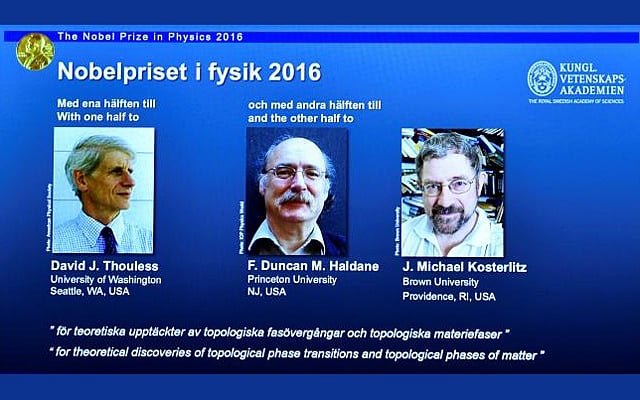


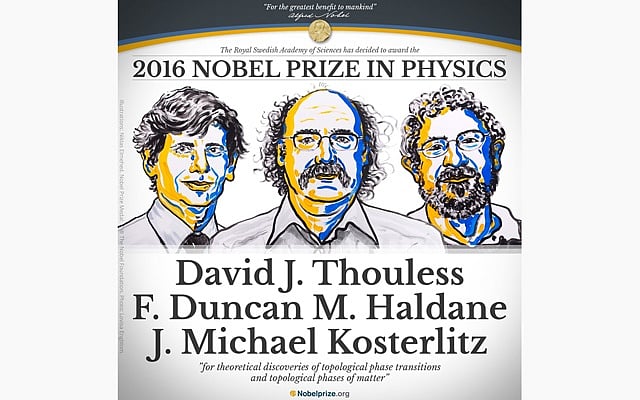
Their discoveries, using advanced mathematics, had boosted research in condensed matter physics and raised hopes for uses in new generations of electronics and superconductors or future quantum computers, the Royal Swedish Academy of Sciences said.
"Thanks to their pioneering work, the hunt is now on for new and exotic phases of matter," the academy said in a statement awarding the 8 million Swedish crown ($937,000) prize.
"Many people are hopeful of future applications in both materials science and electronics."
Thouless was awarded half the prize with the other half divided between Haldane and Kosterlitz.
Members of the Royal Academy of Sciences, Nils Martensson (L-R), Goran K Hansson and Thomas Hans Hansson, sit under a screen showing pictures of the winners of the 2016 Nobel Prize for Physics during a news conference in Stockholm, Sweden October 4, 2016. Top from left: David Thouless, Duncan Haldane and Michael Kosterlitz. Reuters
Thomas Hans Hansson (R), one of the members of the Royal Academy of Sciences, speaks as fellow member Goran K Hansson watches during a news conference announcing the winners of the 2016 Nobel Prize for Physics in Stockholm, Sweden October 4, 2016. Reuters
"This has paved the way for designing new materials with novel properties and there is great hope that this will be important for many future technologies," he said.
Physics is the second of this year's crop of Nobels and comes after Japan's Yoshinori Ohsumi was awarded the prize for medicine on Monday.
As Nobel physics laureates, the trio of researchers join the ranks of some of the greatest names in science, including Albert Einstein, Niels Bohr and Marie Curie.
The prizes were first awarded in 1901 to honour achievements in science, literature and peace in accordance with the will of the Swedish dynamite inventor and business tycoon Alfred Nobel, who left much of his wealth to establish the award.
($1 = 8.5364 Swedish crowns)







