Published : 07 Oct 2026, 11:50 PM
Updated : 07 Oct 2026, 11:50 PM


A giant cloud on Mars that has puzzled scientists for years turns out to be even stranger than previously thought -- and explaining it required invoking physics once considered too exotic to occur in nature.
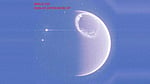
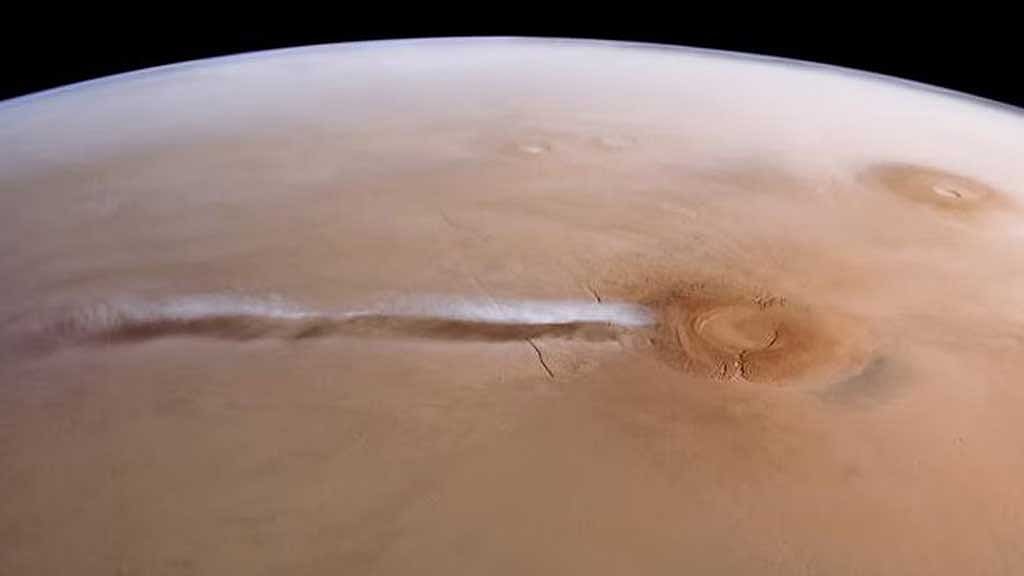
The Arsia Mons Elongated Cloud, or AMEC, was first spotted in 2018 by the European Space Agency's Mars Express spacecraft. Stretching more than 1,800km, it appears each morning over a volcanic region of Mars, grows throughout the day, then fades -- a cycle that repeats over several months each year, reports The Independent.
Scientists had long suspected it was an orographic cloud, the kind that forms when wind flows over a mountain or volcano, as seen on Earth. But attempts to model its formation kept falling short.
No simulation could replicate what the spacecraft images actually showed.
Now, a new study says researchers have finally cracked it -- but only by incorporating a phenomenon that, while described in textbooks, had never been observed in a real planetary atmosphere.
On Earth, clouds form when water vapour condenses around particles such as dust or pollen. The AMEC does none of that. Instead, water vapour skips any intermediate stage and turns directly into icy cloud particles in open air.
"It's akin to droplets of condensation appearing in the middle of a room, rather than on a window," said lead author Jorge Hernández-Bernal of LMD/CNRS/Sorbonne Université in Paris. "We call this homogeneous nucleation, and we've never seen it before in a planetary atmosphere. It's wholly unexpected."
The process requires humidity levels more than 100,000 times those typically found on Earth, reports The Independent.
Theoretically, it could occur in the upper atmospheres of Earth and Venus -- but it has never been directly observed anywhere until now.
Beyond Mars, researchers say the finding has broader implications. When modelling the atmospheres of distant planets -- including those outside our solar system -- scientists may need to account for processes previously considered too unlikely to matter.
"While clouds on Earth and Mars seem to be governed by the same rules, understanding this exotic Martian cloud required exotic physics -- and this may be true elsewhere in the cosmos," said ESA Mars Express Project Scientist Colin Wilson told The Independent.
The findings were published in the journal Nature Geoscience.