


Published : 27 Aug 2013, 12:13 PM
Updated : 20 Oct 2022, 03:38 PM


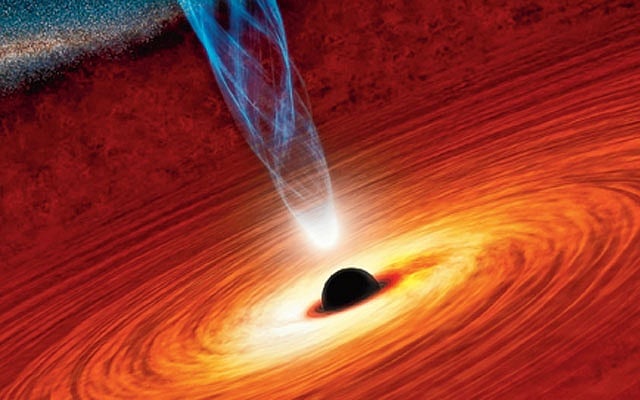

Banerjee, a research scholar at the Indian Institute of Science (IISc), Bangalore, and her supervisor Banibrata Mukhopadhyay have found a way to reliably predict the spin of black holes, a measure of their rotational speeds, and a tool to explore these exotic and mysterious objects.
The two astrophysicists have discovered an association between the mass and the spin of black holes — the larger the mass, the faster the rotational speed and higher the spin. The numerical values of both — mass and spin — are critical in efforts to understand the neighbourhood of black holes and the life history of their progenitor stars.
Black holes are the remnants of massive stars that have burnt all their nuclear fuel and collapsed under their own gravity into objects with such strong gravitational fields that they gobble up any nearby matter — not even light can escape from them.
While astronomers can easily determine the masses of black holes through observations, efforts to determine their spins have generated ambiguous results.
Now Mukhopadhyay and Banerjee have shown that the mass and the spin are interdependent — given the mass, the spin can be computed. Their research work has appeared in the international journal Physical Review Letters.
“The intense gravity of the black hole combined with its spin drags space and time in its immediate neighbourhood,” said Mukhopadhyay, associate professor at the IISc’s department of physics. “The spin can explain the powerful jets of electromagnetic radiation and matter spewed from the vicinity of black holes.”
Astrophysicists believe that as black holes emerge from progenitor stars that were rotating, they too would have some rotational speeds. But because black holes are not directly visible, their rotation cannot be determined through telescopic observations.
“The value of the spin and how fast the black hole is eating up matter around it can also give us information about its progenitor star,” said Banerjee, who graduated from Calcutta’s Presidency College before moving to the IISc for an integrated PhD programme.
Indrani Banerjee and Banibrata Mukhopadhyay at the Indian Institute of Science, Bangalore







