Published : 12 Jul 2022, 09:17 AM
Updated : 18 Jul 2022, 03:10 PM


The first full-colour, high-resolution pictures from the James Webb SpaceTelescope, designed to peer farther than before with greater clarity to thedawn of the universe, were hailed by NASA as a milestone marking a new era ofastronomical exploration.
Nearly twodecades in the making and built under contract for NASA by aerospace giantNorthrop Grumman Corp NOC.N, the $9 billion infrared telescope was launched onDec. 25, 2021. It reached its destination in solar orbit nearly 1 million milesfrom Earth a month later.
With Webbnow finely tuned after months spent remotely aligning its mirrors andcalibrating its instruments, scientists will embark on a competitively selectedagenda exploring the evolution of galaxies, life cycle of stars, atmospheres ofdistant exoplanets, and moons of our outer solar system.
Whoops andhollers from a sprightly "cheer team" welcomed some 300 scientists,telescope engineers, politicians and senior officials from NASA and itsinternational partners into a packed and lively auditorium at the agency'sGoddard Space Flight Center in Maryland for the big reveal.
"Ididn't know I was coming to a pep rally today," NASA Administrator JamesNelson said from the stage, enthusing that Webb's "every image is a discovery."
The eventwas simultaneously broadcast to watch parties of astronomy enthusiasts aroundthe world, from Bhopal, India, to Vancouver, British Columbia.
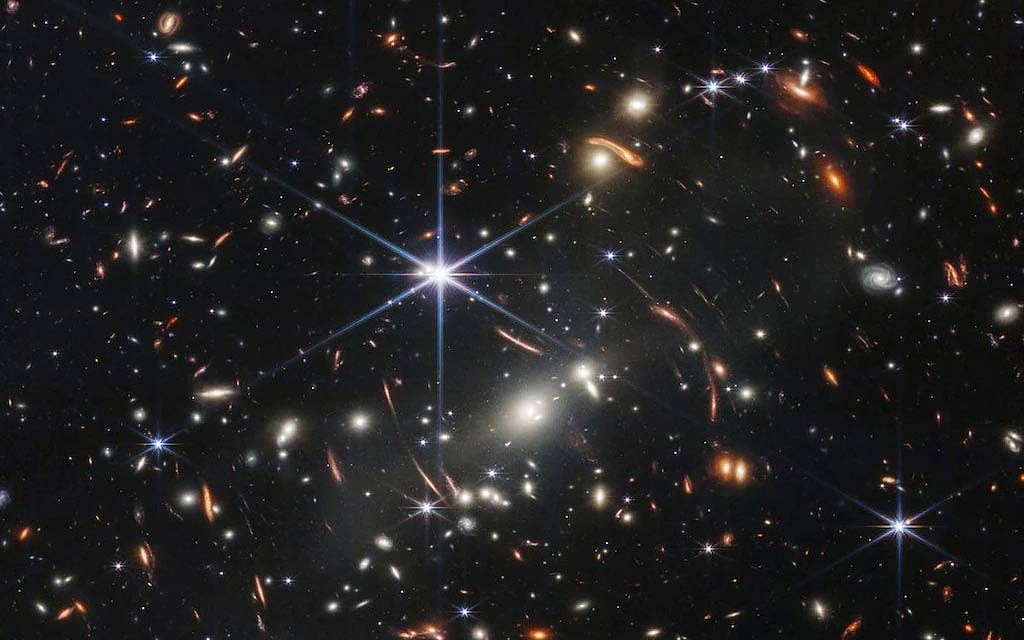
The first full-color image from NASA's James Webb Space Telescope, a revolutionary apparatus designed to peer through the cosmos to the dawn of the universe, shows the galaxy cluster SMACS 0723, known as Webb’s First Deep Field, in a composite made from images at different wavelengths taken with a Near-Infrared Camera and released July 11, 2022. NASA, ESA, CSA, STScI, Webb ERO Production Team/Handout via Reuters
Thecrowning debut image, previewed on Monday by US President Biden at the WhiteHouse but displayed with greater fanfare on Tuesday, was a "deepfield" photo of a distant galaxy cluster, SMACS 0723, revealing the mostdetailed glimpse of the early universe recorded to date.
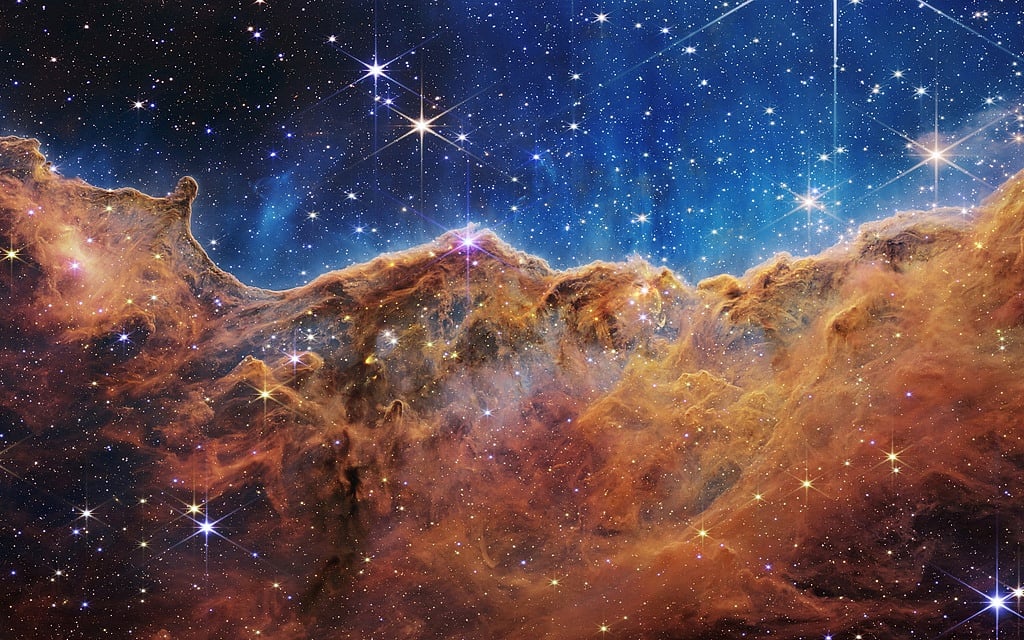
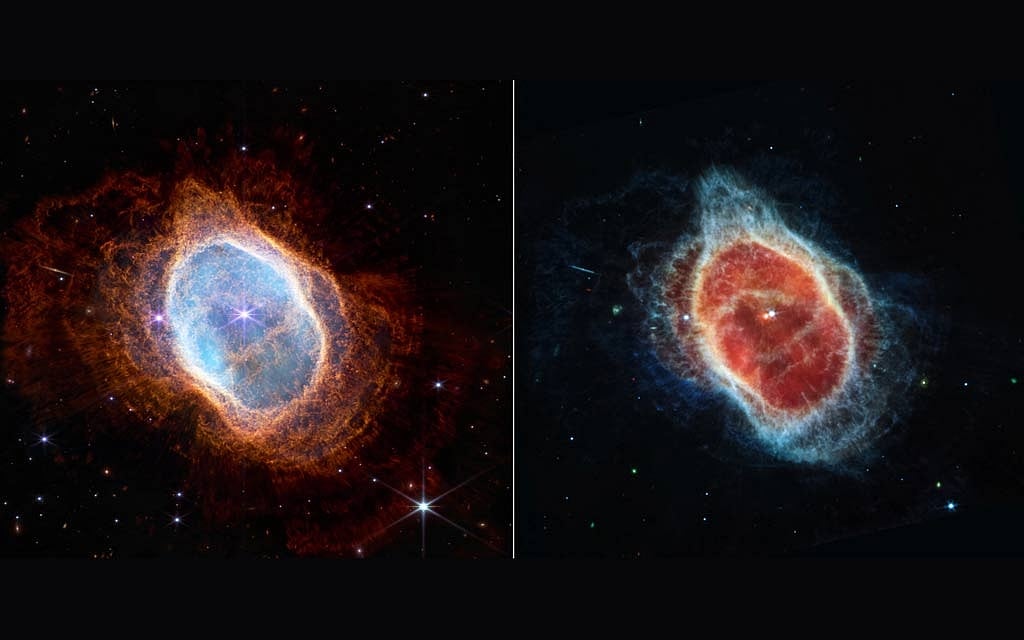
Among thefour other Webb subjects getting their closeups on Tuesday were two enormousclouds of gas and dust blasted into space by stellar explosions to formincubators for new stars - the Carina Nebula and the Southern Ring Nebula, eachthousands of light years away from Earth.
Thecollection also included fresh images of another galaxy cluster known asStephan's Quintet, first discovered in 1877, which encompasses several galaxiesNASA described as "locked in a cosmic dance of repeated closeencounters."
Apart fromthe imagery, NASA presented Webb's first spectrographic analysis of aJupiter-sized exoplanet more than 1,100 light years away - revealing themolecular signatures of filtered light passing through its atmosphere,including the presence of water vapour.
BIGGER,STRONGER THAN HUBBLE
Built toview its subjects chiefly in the infrared spectrum, Webb is about 100 timesmore sensitive than its 30-year-old predecessor, the Hubble Space Telescope,which operates mainly at optical and ultraviolet wavelengths.
The muchlarger light-collecting surface of Webb's primary mirror - an array of 18hexagonal segments of gold-coated beryllium metal - enables it to observeobjects at greater distances, thus further back in time, than any othertelescope. Its infrared optics allows Webb's observations to penetrate cloudsof dust and gas that obscure light in the visible spectrum.
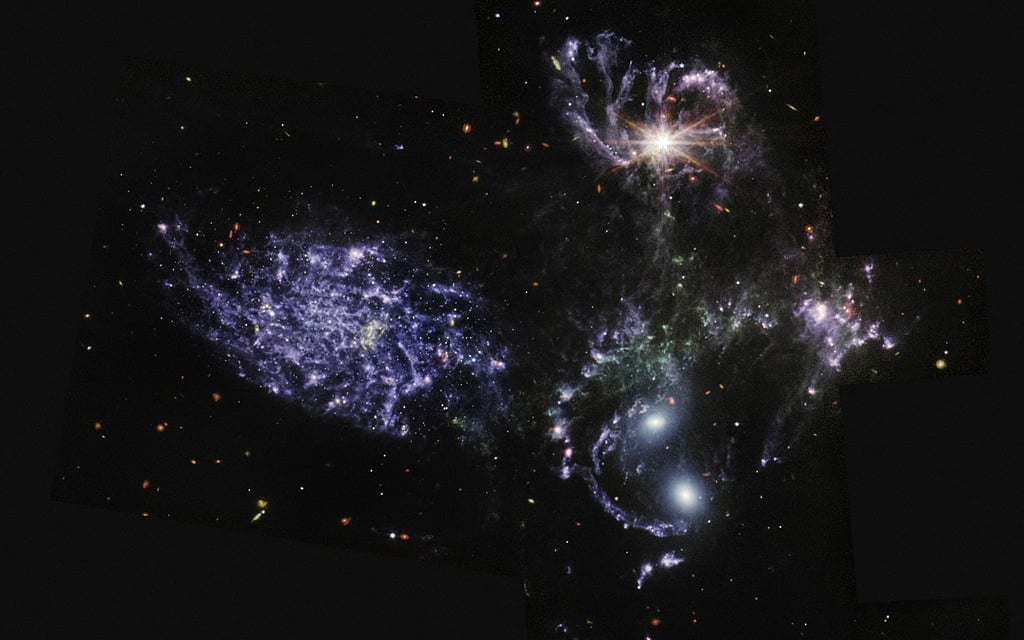
Stephan’s Quintet, a collection of five galaxies, as seen by MIRI from NASA's James Webb Space Telescope, a revolutionary apparatus designed to peer through the cosmos to the dawn of the universe and released Jul 12, 2022. NASA, ESA, CSA, STScI, Webb ERO Production Team/REUTERS
Themid-infrared image of Southern Ring Nebula, for instance, clearly showed thatthe dying stellar object at its centre was a binary system, or pair of starsclosely orbiting one another. The new photos of the Carina Nebula exposedcontours of its massive gas clouds that had never been seen before.
The SMACS0723 image Biden first released on Monday showed a 4.6 billion-year-old galaxycluster whose combined mass acts as a "gravitational lens,"distorting space to greatly magnify the light coming from more distant galaxiesbehind it.
At leastone of the faint, older galaxies appearing in the "background" of thephoto - a composite of images of different wavelengths of light - dates backabout 13.1 billion years.
That makesit less than 800 million years younger than the Big Bang, the theoreticalflashpoint that set the expansion of the known universe in motion some 13.8billion years ago.
Thebejewelled-like composite photo, according to NASA, offers the "mostdetailed view of the early universe" as well as the "deepest andsharpest infrared image of the distant cosmos" yet taken.
Underscoringthe vastness of the cosmos, the thousands of galaxies appearing in the SMACS0723 image were captured in a tiny patch of the sky roughly the size of a grainof sand held at arm's length by someone standing on Earth, NASA said.
The Webbtelescope is an international collaboration led by NASA in partnership with theEuropean and Canadian space agencies.