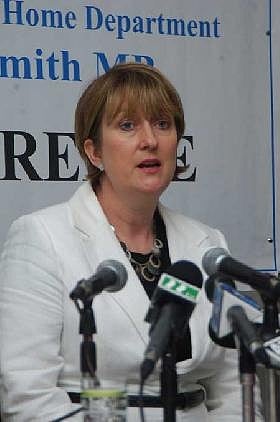
UK prefers 'democratically elected' govt: Smith
The UK is more comfortable working with a democratically elected government than a caretaker administration, British home secretary Jacqui Smith said Wednesday. Full Story
bdnews24.com News Service
bdnews24.com
Published :
09 Apr 2008, 03:37 PM
Updated :
24 Apr 2022, 08:24 PM
Dhaka, April 09 (bdnews24.com)—The UK is more comfortable working with a democratically elected government than a caretaker administration, British home secretary Jacqui Smith said Wednesday.
Full Story
Smith, ending her tightly-scheduled visit to Bangladesh, said there were links between "terrorist groups" in Bangladesh and the UK.
At a press conference at the British high commissioner's home, the UK minister said the chief adviser and the army chief had assured her that the next parliamentary elections would be held by Dec 31.
"The British government always feels more comfortable working with the democratically elected government," she said, when she was pressed for comment on the caretaker government, led by Fakhruddin Ahmed.
"That's why I have brought … my ministerial colleagues as well … a very strong message to Bangladesh and very strong support for the progress of the roadmap that may enable (Bangladesh) to deliver a free and fair election."
"I believe delivering a strong and sustainable democracy in Bangladesh … is actually the best way of ensuring and building partnership between our two countries," she said.
Smith said Bangladesh and her government would share information on suspected terrorist activities. Top officials of the two governments in June would meet at the joint working group to counter terrorism, she said.
Answering a question, she said: "There are—potentially or actually—links between the terror groups in Bangladesh and the UK. That's the reason why I think we have a shared interest in tackling terrorism."
The UK home secretary said the UK was in the same opinion with the US which branded the Harkat-ul Jihad Al-Islami as a "global terrorist organisation".
On holding the next general elections, the home secretary said: "I prefer to be optimistic. I had very strong reassurances from both the chief adviser and the chief of army staff and other advisers I met."
Smith said: "The voter registration and the other elements necessary to deliver free-fair elections are on track."
Smith said her government would consider allowing the Bangladeshis to continue their contribution to the hospitality industry in the UK.
She said she had talks with the army chief on sending the ill-gotten money, if detected, allegedly siphoned off by some influential people out of Bangladesh into the UK.
Smith arrived in Dhaka Tuesday night from Pakistan and will leave Dhaka Thursday.
Earlier at a meeting with Smith, interim leader Fakhruddin Ahmed said that some mandates of the emergency powers rules would fade in phases depending on ground reality to allow candidates to campaign in local government polls.
With the CA, Smith also discussed counterterrorism, climate change and preparations for year-end polls and voter registration, an official with the Chief Adviser's Office told bdnews24.com.
The official quoted Smith as telling the CA that she had seen voter-registration work for herself and was satisfied.
The issues of the administration's dialogue with political parties, its reforms agenda and bilateral cooperation also came up at the meeting.
The chief adviser was quoted to have told Smith that a team of advisers had already started informal talks with the political parties.
CA's press secretary Syed Fahim Munaim only confirmed to bdnews24.com by phone that Smith had met with Fakhruddin.
Earlier Bangladesh and the UK had discussed ways of future cooperation on counter-terrorism. A joint working group with officials from the two nations will be formed in June to deal with counterterrorism issues.
The matter came to the forefront as Smith met with her Bangladesh counterpart MA Matin in his office.
"She prioritised the issue of countering terrorism. I told her that we are trying," Matin told reporters after the meeting.
"I said that we have not been able to curb terrorism totally, but have controlled it to a great extent," Matin said.
"I told the home secretary that we have already convicted and hanged a number of terrorists, and the trial of other terrorists is on."
Smith, meanwhile, said she thought restoration of the democratic process in Bangladesh was important to curb terrorism.
She said the joint working group would be in place in June.
Smith, who arrived in Dhaka Tuesday night from Pakistan, told reporters: "The best way you do tackle terrorism in the long run is by building strong and stable democracy."
"I am very pleased to hear the adviser telling me about the progress that has been made in Bangladesh on anti-terrorism legislation, which I consider to be very important."
"The Bangladeshi people and the British people suffered in the recent past from indiscriminate terrorists' violence. It's something which as the home secretary has priority for me back in the UK," said Smith, who is the first woman to hold the portfolio of home affairs in the UK.
Also Wednesday, Smith made a courtesy call on army chief General Moeen U Ahmed, a military statement said.
The Inter-Service Public Relations Directorate in the statement said Smith discussed some bilateral issues with Moeen at the Army Headquarters.
Outgoing British High Commissioner to Bangladesh Anwar Choudhury accompanied her to the meeting with the general.
Smith also flew to Habiganj and laid a foundation stone to build Bahubal Model Police Station under a UNDP-managed Police Reform Programme, the UN's Dhaka office said in a statement.
At a ceremony there Smith said: "The British government is pleased to join with the EU and UNDP in support of this process of reform led by the inspector general and his senior management team."
"We are encouraged by the drafting of the Police Ordinance which will enable the police to better manage and control its own finances and destiny, reporting to the people through Parliament and we look forward to hearing of its promulgation.
"When the police service is attuned to the needs of the people and responsive to them, justice is served in that community," she said.
Anwar Choudhury, additional inspector general of police NBK Tripura, UNDP Bangladesh deputy country director Larry Maramis and the police reform programme's project director Hubert Staberhofer were present.
bdnews24.com/krc/my/ja/rah/jr/ad/2006 hours