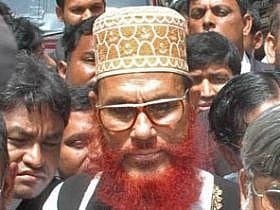
Tempers fray at war crimes tribunal
Deposition of the 17th prosecution witness in a case against Jamaat-e-Islami leader Delwar Hossain Sayedee at the war crimes tribunal got caught up in a debate over procedural issues.
bdnews24.com News Service
bdnews24.com
Published :
26 Jan 2012, 02:28 PM
Updated :
09 Aug 2022, 03:21 PM
Dhaka, Jan 26 (bdnews24.com) — Deposition of the 17th prosecution witness in a case against Jamaat-e-Islami leader Delwar Hossain Sayedee at the war crimes tribunal got caught up in a debate over procedural issues.
The International Crimes Tribunal, set up to try crimes against humanity during the 1971 Liberation War, has indicted Jamaat executive council member Sayedee on 20 counts of war crimes including murder, rape, arson and loot.
Prosecutor Syed Haider Ali began examining an employee of the Press Institute of Bangladesh, 44-year old Rabiul Anam Khan, who took the stand after lunch.
Rabiul Anam was listed as a seizure list witness and the session was destined to be a technical one with the witness identifying his signature and confirming that the investigation officer of the case had indeed seized those items, which were likely to be periodicals and newspaper articles.
But the defence erupted in strong objection when the prosecutor proceeded to have the newspaper reports marked as 'exhibits'.
This argument lasted until the closing of the day's session when even the generally tempered voice of defence counsellor Mizanul Islam took on an edge.
The defence had presumed that seizure list witnesses were being brought only to confirm that certain items had indeed been collected by the investigating officials.
However, when upon Rabiul Anam's confirmation newspaper reports and articles began to be marked as exhibits, the defence said there were specific rules regarding how documents could be marked as exhibits.
They cited paragraph 54 of the rules of procedure framed by the tribunal in 2010. It states, "The prosecution may prove a document by the person who was the author of such document or who knows the handwriting or signature of such author, and when any of such persons is dead or not available, the person from whom it was collected or who knows from whose possession it was collected."
Mizanul Islam said that it was clearly stated in the rules that the author had to be present at the court to have a certain document marked as exhibit.
The defence refused to accept the difference between a document or book and a report and insisted that he editor or the reporter be made available at the court.
Mizanul Islam told bdnews24.com later that they expected to be able to cross-examine any such author who the prosecution called for. "We had thought that the reporter or the writer or the author would be called before marking their work as exhibit."
Prosecutor Haider Ali said there was no such necessity to produce the reporter and that the court could indeed have the reports marked as exhibits.
He suggested reading section 19.1 of the 1973 Act and paragraph 54 of the rules together. That section of the act reads, "A Tribunal shall not be bound by technical rules of evidence; and it shall adopt and apply to the greatest possible extent expeditious and non-technical procedure, and may admit any evidence, including reports and photographs published in newspapers, periodicals and magazines, films and tape-recordings and other materials as may be tendered before it, which it deems to have probative value."
As such, Haider Ali insisted that the tribunal did not require the presence of the author, but the defence then went on to draw the court's attention to paragraph 55 of its rules of procedure, which states, "Once the document is marked as exhibit, the contents of a document shall be admissible."
Tribunal member, Judge A K M Zaheer Ahmed, then intervened, habitually saying that he only intended to appreciate the apprehensions of the defence.
He asked whether the defence was apprehensive that any exhibit, if admissible to the court, may have probative value and may be used as proof.
Mizanul Islam said that was indeed the case.
Another tribunal member, Justice A T M Fazle Kabir, however, pointed out that the tribunal could choose to consider anything as evidence or reject such document according to another provision of the rules of procedure.
Zaheer Ahmed went on to explain that paragraph 54 had been framed as a means of safeguard for the defence and only for handwritten documents.
He further tried to reassure the defence that although exhibits would become admissible to the court, their veracity as proof and their probative value would depend entirely on the tribunal's confidence in that document or report.
But Mizanul Islam persisted and said that it would differ from judge to judge. And it would depend on the individual how to interpret the authenticity of an exhibit.
Zaheer Ahmed agreed with the defence counsellor's apprehension.
Tribunal chairman Justice Nizamul Huq said, "Okay then leave the matter to us. We shall see to it."
Defence counsellor M Tajul Islam jumped and said, "But you are not above the law."
The tribunal chief said that he believed the matter needed reconsideration. "I have said that we will rethink the matter. We have framed the rules and we have full authority to change them."
He continued, in a way of explaining to Tajul Islam, "We can even quash all the evidence taken up until now if need be for fair trial. We can do that."
But Tajul Islam was not satisfied and he continued to argue to which, the tribunal chairman said, "Fine. The rules are omitted then. We will accept the evidence according to the act."
This obviously meant that the tribunal could exercise flexibility in accepting the documents and articles as evidence.
Tajul Islam still refused to sit down and continued, "Now you are omitting the rules? Just when it is inconvenient to the prosecution, you will proceed to omit the rules just like that?"
He said this would defeat the purpose the fair trial or ends of justice.
Justice Nizamul Huq said, "I can proudly say that all three of us are interested in a fair trial. And whatever rules we have framed were only aimed at reaching at a fair trial as well."
He continued, "But the defence does not seem to have confidence upon the tribunal that it is indeed fair trial we want to get at."
Justice Huq said that he had been assailed with objections saying that the rules of procedure were defence-friendly.
Tajul Islam cut in, "You cannot say it is defence-friendly."
Justice Huq replied, "I have read your opinion about the rules and have also taken that you were not entirely truthful in your writing."
Mizanul Islam, who was back to his tempered self by this time, intervened as the tension gave no sign of letting up. He suggested that instead of omitting the rules, the tribunal could perhaps modify the wording of the rules in question and the defence would have no problem then.
Justice Huq replied, "That is what I had said in the first place that we shall see to it. I had said that we would rethink the matter. But your colleague does not seem to have any confidence."
Tajul Islam stood up to say, "I am sorry it was a misunderstanding, my lord. I had thought that you meant to proceed with the witness examination and marking exhibits and only reconsider their probative value later."
He said it was only due to a misunderstanding that he had acted the way he did, and had not realised that the tribunal chairman was referring to a possible amendment of rules.
The matter of Jamaat guru Ghulam Azam's documents came up before the court adjourned for the weekend. One prosecutor said that one of the volumes given to the defence was bound wrongly and hence the pages were not in sequence.
Both the prosecution and the defence agreed that a correct version of that specific volume would be provided to the defence on Sunday, the next working day.
FIRST CASE TO TRIAL
Sayedee's is the first case to proceed to the trial stage at the tribunal. The prosecution on Sept 4 proposed framing of charges against him on 31 counts for crimes against humanity and genocide.
On Oct 3, the tribunal indicted Sayedee on 20 counts.
The tribunal also sent Jamaat's former chief Ghulam Azam to jail on Jan 11. His indictment hearing, as well as that of the present Jamaat chief Matiur Rahman Nizami, is scheduled for Feb 15.
Besides Sayedee, Jamaat chief Matiur Rahman Nizami, secretary general Ali Ahsan Mohammad Mojaheed and assistant secretaries general Mohammad Kamaruzzaman and Abdul Quader Molla, and Bangladesh Nationalist Party's standing committee member and MP Salauddin Quader Chowdhury have been detained, along with others, on war crimes charges.
The tribunal granted conditional bail to former BNP lawmaker and minister Abdul Alim on March 31 last year. The bail was extended further on Jan 16, ordering him to be present in the court on Mar 15 when the prosecution has been directed to submit formal charges against the BNP leader.
bdnews24.com/ta/bd/1832h