Tempers fly at tribunal
Cross-examination of Ghulam Azam's war crimes investigator sees heated debate
bdnews24.com News Service
bdnews24.com
Published :
11 Oct 2012, 04:29 PM
Updated :
09 Aug 2022, 04:21 PM
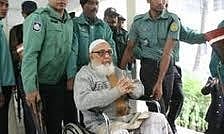
Dhaka, Oct 11 (bdnews24.com) — Cross-examination of former Jamaat-e-Islami chief Ghulam Azam's war crimes investigator saw tempers flare at the tribunal on Thursday.
Much of the day was spent in discussions with the defence counsel trying to justify his line of questioning.
However, faced with the prosecution's obstruction, defence counsel Mizanul Islam declined to continue cross-examining by the end of the day with almost an hour to go. Earlier, the tribunal had to stiffly ask Azam's conducting prosecutor and the chief prosecutor to take their seats.
Senior defence counsel Mizanul Islam began the day by cross-examining Matiur Rahman on a fortnightly magazine 'Ek Pokkho' — meaning one fortnight — which had set off an investigation on Aug 1, 2010, into the Jamaat guru's war crimes.
The three-Judge International Crimes Tribunal-1, set up to try crimes against humanity during the 1971 Liberation War, indicted the former Jamaat chief on war crimes charge on May 13.
The defence shifted to questioning the investigator about Azam's link with the killing of 38 people at Brahmanbaria that included one Siru Miah and his son Anwar Kamal.
The court heated up early in the morning barely an hour into the cross-examination when Islam was still dwelling on the Brahmanbaria incident.
Siru's wife had apparently secured a letter from Azam through her brother-in-law who used to be a private tutor of the ex-Jamaat chief's sons.
The defence was dwelling upon the letter when the conducting prosecutor Zead-Al-Malum stood up to raise an objection.
Tribunal member Justice Jahangir Hossain told him" "You cannot disturb him when he is putting a question to the witness."
Malum protested and continued to argue on his point and at one point said that he would rather leave the courtroom if the judges think him to be such a disturbing element.
Tribunal Chairman Justice Mohammad Nizamul Huq reacted disapprovingly saying: "No, no, no, you cannot say that."
But Malum still continued and Justice Hossain told the prosecutor that he should not dictate the tribunal what to do. "Sit down."
Malum attempted to speak further but the judge repeated himself several more times at which point the chief prosecutor Ghulam Arieff Tipoo stood up to say something.
The 82-year-old lawyer's voice was entirely drowned out by Justice Hossain repeatedly saying: "The tribunal is telling you to sit down."
The tribunal Chairman had taken matters in his hand and said: "Mr Chief Prosecutor, please take your seat."
Tipoo finally took his seat and Mizanul then resumed his questioning.
The tribunal intervened when the defence counsel asked the investigator to name the witness who had said having seen Azam at the Saudi King's court in 1975 and also in London, England.
Azam is alleged to have spoken against Bangladesh claiming that mosques were being turned into Hindu temples. He is alleged to have asked for funds to build mosques and buy Qurans for Muslims in Bangladesh from the Saudi King.
But the tribunal Chairman said that the counsel could not ask that question and continued that name of the witness could not be asked. He, however, allowed questions in other form that did require the witness' name.
The first prosecution witness against Jamaat chief Motiur Rahman Nizami, Misbahur Rahman Chowdhury, also a former member of Jamaat's student wing Islami Chhatra Sangha, had said in his testimony of having seen Azam at the Al Hamra Palace.
The tribunal again intervened a few questions later which was followed by another discussion about the probative value of materials that were not tendered either by the prosecution or the defence.
The tribunal Chairman said that no matter what the material would have to be accepted into evidence legally. He said if there were no documents or proof then allegations of the formal charge would be dismissed.
Prosecutor Malum said that the defence was still mixing up other criminal laws and evidence laws with the procedures of the act. "Furthermore, the Investigation Report is not the end of all proof or evidence. It is not the only source of all materials that might have probative value."
The defence resumed questioning but the prosecutor had another round of exchange with the tribunal at the end of which he only kept saying that since the court would not listen to him he would become 'mum and puppet'.
The defence counsel had hear several times after lunch from Malum that he was mixing up criminal and evidence laws with the tribunal's law and forgetting that they did not apply here.
The tribunal intervened when the defence counsel asked the investigator about certain facts. The Judges said that the facts were established through witnesses, not through the investigation officer.
The counsel was asking the Investigation Officer whether he had found any freedom fighter in Brahmanbaria Muktijoddha Sangsad who knew about people gone missing during 1971.
The question had come in relation to the death of 38 and after the Investigation Officer was asked how many others besides Siru Miah and his son had been identified.
Matiur said that there were several others including one Nazrul but could not give the specifics at the moment.
The defence counsel said that the investigator had begun his probe with just the complaint about Siru Miah and Anwar Kamal's killing that Ghulam Azam could have supposedly prevented by dint of his high office and influence during the war.
The prosecutor stood up to say: "This is the first time in my life that I see defence counsel putting forth his arguments in the middle of cross-examination."
Mizanul countered saying: "And this is also the first time that I see the cross-examination being disrupted repeatedly."
The defence counsel then said that he had to establish the number of confirmed deaths, whether it was 38, or 3 and was about to continue when the chief prosecutor cut in. "Or none, for that murder. Perhaps no one was murdered," he said.
The defence counsel said he could not proceed with such interruptions.
The tribunal chair chose to concentrate on the matter at hand and told the defence counsel that it did not matter whether there was one murder or 100. "The question is Ghulam Azam's involvement."
From this point on, prosecutor Malum made several attempts to address the tribunal but the Judges told him repeatedly that they would rather hear Mizanul.
Mizanul said that he needed to establish whether the investigation was done thoroughly and it was in his bid to show that the probe was not thorough that he needed to ask those questions.
Malum managed to put in that the technical rules of evidence were not applicable and the tribunal would do as much as possible to expedite the trials.
Justice Huq said: "This is a charge under crimes against humanity and as such the questions of concern are whether those executed were civilians, whether those people belonged to a certain group, whether this is a crime under the domestic laws of Bangladesh and so forth."
The defence counsel was in the middle of his reply when the prosecutor said referring to Mizanul's that he was using the language of criminal laws.
The tribunal continued its discussion with the defence counsel and at point the tribunal chair asked the defence lawyer to continue.
Even before he could ask two more questions, prosecutor Malum was up on his feet urging the tribunal to set a policy regarding cross-examination.
Once he was done, the lawyer wondered aloud: "I don't know why it is that I cannot proceed, whether it is due lack of intent or because continuous interruptions."
The tribunal urged him to continue but Mizanul said: "I have become devastated today."
He pleaded that he be allowed to leave the court an hour early so he could read up on the relevant laws and come better prepared on Sunday obviously indicating the numerous references to criminal and evidence laws in vogue.
Mizanul was rather reluctant to ask further questions and said" "I am not complaining against anyone but it is due my incompetence, failure and lack of knowledge about the laws that I cannot proceed."
But the tribunal kept urging him to ask the next question.
This went back and forth for a while longer and the tribunal finally rose around 4pm.
Six more witnesses against Nizami
The court allowed six witness statements to be included with the documents after lunch when it heard a bunch of applications and gave its orders.
There were two applications for Jamaat leader A T M Azharul Islam, one pleading for division in jail and another requesting privileged communication.
Regarding the division, the tribunal asked prosecutor Malum to report back on Sunday as to why the district magistrate had not complied with the court's order.
The court had earlier ordered that any such procedural matters would be dealt with by the local authorities in accordance with the jail code but the application for division had been referred back to the tribunal.
About privileged communication, the tribunal said that the defence had come way too early since the case had not even entered into the trial phase.
The defence would get ample time to consult the man once the case matures, he said and asked the defence lawyers to take back the application.
As regards another application of Mir Quasem Ali, a Jamaat stalwart and financier, for urgent treatment, the tribunal said that it would ask the jail authorities to ensure proper treatment at a suitable hospital.
Quasem's defence had said that he needed to have his teeth scaled on a regular basis and the jail did not have such facilities in the prisons.
bdnews24.com/ta/ssr/bd/2210h