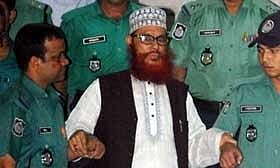
'Sayedee looted my house, set it on fire'
Village doctor Abdul Halim Babul puts the Jamaat-e-Islami leader at the scene of looting and arson on June 2, 1971.
bdnews24.com News Service
bdnews24.com
Published :
17 Jan 2012, 09:18 AM
Updated :
09 Aug 2022, 03:19 PM
Dhaka, Jan 17 (bdnews24.com)�Village doctor Abdul Halim Babul from Nalbunia, Indurkali of Pirojpur on Tuesday placed Jamaat-e-Islami leader Delwar Hossain Sayedee at the scene of looting and arson on June 2, 1971.
The 55-year old told the war crimes tribunal that the Jamaat executive council member had led a party of Razakars and Pakistani soldiers to his village.
The International Crimes Tribunal, set up to try crimes against humanity during the 1971 Liberation War, has indicted Sayedee on 20 counts of war crimes including murder, rape, arson and loot.
The 14th prosecution witness, Babul told the court that he was standing by the road in front of his house on the fateful day when he had heard from people that Razakars and Pakistani soldiers were advancing towards the village.
The Razakars, among other organisations like the Al-Shams, Al-Badr and infamous Peace Committees, were organised and mobilised by the Jamaat-e-Islami to thwart the resistance and liberation struggle in 1971.
Razkars have been notorious for their level of collaboration of the Pakistani occupation forces.
Babul said he had gone to his house and told the family about the news he had heard and they quickly left house to hide nearby from where the witness saw Sayedee lead a party to the village, loot his house and set it on fire.
After Babul's short deposition, Mizanul Islam took up the cross-examination as usual and went through a number of routine questions asking whether Babul had any previous communication with Mahbubul Alam Howladar and Manik Poshari, both of whom had filed complaints against Sayedee locally.
Tribunal judge A K M Zaheer Ahmed kept insisting from the very onset that the cross-examination should not take more than 10 minutes given the deposition was very short.
Mizanul Islam maintained that he would not veer off the course and would only ask relevant questions. "I will not ask anything that does not have relevance to the case."
Babul was visibly agitated when the defence counsel asked a few personal questions, especially one regarding a theft case filed by one Aklima Khatun of the same village.
Islam asked him whether it was true that had secured bail in a case that accused him, among other things, of theft. Babul said it was not true, at first.
Mizanul Islam then asked him whether it was true that there was such a case and cited the details with the particulars of the complainants dating back to 1982.
The witness then took the court's leave to have his say. Babul stood up and began in an agitated voice saying that he could reassure the court if he took his clothes off and made to pull up his shirt. The judges said that would not be necessary and told him that he only had to state what he had to say.
Babul said, "They had hacked me here (pointing to his left shoulder stretching diagonally across the back) and left."
"It was to counter that complaint that they had filed this false case. I was acquitted from that case."
Judge Zaheer Ahmed tried to calm him down saying that "merely having a case against you does not necessary reflect badly upon you".
Babul then continued in his angry manner to allege that the defence counsel had been to his house and intimidated him and his family. "It is as if the horrors of 1971 have returned."
Pointing at the counsel, Babul said that several hundred people (300-400 in the first instance and 500-700 in the second instance) had been to his village along with six or seven microbuses.
"Do you need so many people to collect evidence? You need a handful of people at most," he said.
The witness said that the large party had been to his house without any prior news and intimidated him.
That part of the statement, however, was not included in the court records.
Mizanul Islam's question was whether Babul knew of such a case, to which the court records showed that the witness had answered affirmatively followed by his explanation.
Manjur Ahmed Ansari's part, which followed Mizanul Islam, went smoothly and the cross-examination was wrapped up by noon.
Tribunal chairman Justice Nizamul Huq was visibly disappointed when prosecutor Syed Haider Ali told the tribunal that the prosecution did not have more witnesses ready for deposition. Huq shook his head disapprovingly, while judge Zaheer Ahmed told him, "It appears that prosecution is slowing us down."
When the tribunal asked if the next witness would be ready on Wednesday morning, the prosecutor said he was not certain.
Justice Huq said, "But that is not acceptable."
Haider Ali went on to explain that the witness was 80 years of age and he had not even met the witness to confirm whether the old man was physically fit enough to testify. But the prosecutor confirmed that the witness was already in Dhaka.
The prosecutor said he was still unable to confirm and would let the court know as soon as he could. The tribunal chairman remained adamant to skip a court session on Wednesday.
M Tajul Islam who only arrived at the tribunal premises after the court had adjourned for the day told the press that the tribunal should not have allowed the prosecutor to meet the witness in the first place.
"This only means that the prosecution is tutoring the witnesses to speak in a certain line and whenever they see that the witnesses are not saying what the prosecution wants them to say, they say the witness is physically unwell."
"This is a major hurdle to a fair trial."
Sayedee's is the first case to proceed to the trial at the tribunal. The prosecution on Sept 4 proposed the framing of charges against on 31 counts for crimes against humanity and genocide in the first case of the tribunal. The tribunal indicted Sayedee on 20 counts on Oct 3.
The tribunal also ordered alleged mastermind of war crimes and the former Jamaat chief, Ghulam Azam into jail on Jan 11. His indictment hearing, as well as that of the current Jamaat chief Matiur Rahman Nizami, has been scheduled for Feb 15.
Apart from Sayedee, Jamaat chief Matiur Rahman Nizami, secretary general Ali Ahsan Mohammad Mojaheed and assistant secretaries general Mohammad Kamaruzzaman and Abdul Quader Molla, and Bangladesh Nationalist Party's standing committee member Salauddin Quader Chowdhury, also a lawmaker, have been detained, along with others, on charges of committing war crimes.
The tribunal, however, on March 31 granted conditional bail to former BNP MP and minister Abdul Alim. The bail extended further on Jan 16 ordering him to be present in the court on Mar 15 when the prosecution has been directed to submit formal charges against the BNP man.
bdnews24.com/ta/bd/1434h