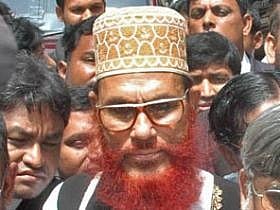
Sayedee counsels object to witness list
Defence says prosecution throwing up surprise witnesses on a day two witnesses recall seeing Jamaat leader in hiding at Jessore after '71 war Updates
bdnews24.com News Service
bdnews24.com
Published :
25 Jan 2012, 09:20 AM
Updated :
09 Aug 2022, 03:20 PM
Dhaka, Jan 25 (bdnews24.com) — Proceedings at the war crimes tribunal closed on Wednesday with the defence raising an objection to a list of 10 prosecution witnesses.
According to defence counsels, seven of the 10 names mentioned in a list of witnesses, which the prosecution gave to the defence on Tuesday, were not mentioned in a previous list of 68 witnesses provided.
The list of 10 witnesses was provided after the prosecution failed to produce a witness on Tuesday morning in a case against Jamaat leader Delwar Hossain Sayedee, who is facing 20 counts of war crimes charges, including murder, rape, arson and loot.
The International Crimes Tribunal, set up to try crimes against humanity during the Liberation War, on Wednesday held cross-examination of the 16th prosecution witness against Jamaat-e-Islami executive council member Sayedee.
Tribunal chairman Nizamul Huq told the defence counsels that they should be prepared to cross-examine any witness included in the two volumes of witness testimony that the prosecution has submitted to the court. At the same time, he asked the prosecution to ascertain the reason for a shortened list of 68 witnesses.
The defence further raised a point that the prosecution's documents did not even include testimonies of those seven witnesses.
Nizamul Huq told both sides, "We shall hear it tomorrow."
Both witnesses of the day said they had heard the accused, Sayedee, mention that he was in hiding at Dahakola of Bagharpara, in Jessore.
Cross-examination of both witnesses ended on Wednesday. The day's second witness cross-examination began with tribunal member A T M Fazle Kabir absent.
CROSS-EXAMINATION OF JULFIKAR ALI
Julfikar Ali, the 16th prosecution witness, became agitated when a defence lawyer brought to his attention that a book by Rokonuddoula, journalist and correspondent of the daily Sangbad, 'Jessore during Liberation War' (roughly translated from "Muktijuddhe Joshor") named Julfikar as a Razakar.
Julfikar protested, saying he had been in fact tortured by Razakars and that he even received allowances as a freedom fighter.
The Razakars, a Jamaat-backed group mobilised to thwart and oppose the liberation force, worked in collaboration with the Pakistani army during the 1971 war.
Julfikar also recalled hearing Sayedee mentioning that he had been hiding at Rowshan Ali's house in the area. But the freedom fighters, he said, failed to capture Sayedee when they surrounded the house -- the accused, he said, had fled by then.
The witness, who said he had seen Sayedee with Rowshan Ali together in the area when he was in hiding, replied that while he did not know for sure what Sayedee did for a living before the Liberation War, he had heard that he was a student leader.
Asked how many Razakars Julfikar and his fellow freedom fighters had caught in their initiative after the war, Julfikar replied they could not catch anyone. "All of them were in hiding," he said.
The prosecution had at one point raised a point with the tribunal about including certain statements of the witness that he was making of his own volition.
The cross-examination resumed after a brief argument between the defence and prosecution counsels.
'ROWSHAN ALI ALIVE'
Soon, defence lawyer Mizanul Islam asked Julfikar Ali whether Rowshan Ali was still alive. Replying that Ali was alive, Julfikar added, "He has performed 'hajj'. (He) never lies."
At this, both the defence counsel and tribunal member Judge A K M Zaheer Ahmed smiled at the irony of a prosecution witness vouching for Rowshan Ali, who is likely to appear as a defence witness.
Zaheer Ahmed asked the prosecution whether this part of Julfikar's statement, which the witness made of his own volition, would be included in the court records. The prosecution merely said it was up to the tribunal.
"This is why one should not include voluntary statements," pointed out Zaheer Ahmed. Rowshan Ali's honesty, as vouched by Julfikar Ali, was however not included in the records.
While the day's first witness, Solaiman Hossain, admitted earlier that he had crossed over to India around June 1971 and remained there for much of the war's duration till the very end, the second witness, Julfikar Ali, the Bagharpara unit Awami League secretary at present, said during cross-examination that Solaiman, who was still present in court, had taken part in the war, though they were not together.
Julfikar denied the suggestion that he had agreed to testify in this case against Sayedee hoping for benefits from the government, and because he did not have a steady professional career.
Asked whether he had ever spoken out against Sayedee before testifying to the investigation officer or at the tribunal, he said, "The situation did not allow for making such statements."
Mohammed Kafil Uddin Chowdhury, who conducted the last part of Julfikar's cross-examination, asked him whether anyone had prevented him from doing so during the two previous Awami League regimes, especially between 1971 and 1975, and 1996 and 2001. The witness said no one had.
'SAW SAYEDEE IN JESSORE'
Julfikar Ali said in his deposition that after the 1971 Liberation War, Sayedee was spotted in Jessore's Bagharpara Union, where he was in hiding.
Julfikar Ali, 59, said he and fellow freedom fighters had begun an initiative to "search" and "collect" Razakars at his native area of Bagharpara soon after the Liberation War.
The witness said, "We saw Rowshan Ali, from our area, come to the market accompanied by another man." Julfikar said he learnt from Rowshan Ali that his companion was Delwar Hossain Sayedee, who was hiding in his house since he could not live in his native Pirojpur.
After conferring with the local freedom fighters' commander, Julfikar and his comrades were told to apprehend Sayedee. "We surrounded Rowshan Ali's house but could not find Sayedee there," he testified.
The witness said they had heard from other sources later that this new man, Sayedee, had escaped on a cart veiled in a 'burqa'.
On further inquiry, Julfikar said, he was told that 'Sayedee' had been involved in murder, arson, rape and loot, and was being hunted by the freedom fighters in his area. "That is why he was in hiding," Julfikar said.
CROSS-EXAMINATION OF FIRST WITNESS
Earlier in the morning, Mizanul concluded cross-examination of the 15th prosecution witness, Mohammad Solaiman Hossain, carrying on from where he had left on Tuesday.
Solaiman, who had on Tuesday said he recalls Sayedee addressing a rally in 1970 in the run-up to the national assembly elections of Pakistan, denied defence counsel Mizanul Islam's suggestion that he was jailed twice for corruption.
"They (jail terms) were political cases, not for corruption," Solaiman said.
When asked, the witness said he had been a government employee between 1976 and 1996 but stopped going to work after that. He also denied the suggestion that he was ineligible for pension for the alleged corruption.
Solaiman later admitted going to jail four times, not twice as the defence said. He made the admission when a tribunal member, judge AKM Zaheer Ahmed, asked him to explain the circumstances.
Solaiman, a local Awami League leader, said he had been jailed in 1975 after the murder of Bangladesh's founding president Sheikh Mujibur Rahman, in 1987 for participating in the anti-Ershad movement during the regime of deposed military dictator Hussain Mohammad Ershad, the third time in 1995-96, and finally in 2004.
Mizanul Islam's main contention during the cross-examination was to establish that Sayedee was hiding at Bagharpara during the war, and not afterwards.
He asked the witness whether he remembers Sayedee's words clearly from the rally in 2005-2006 at the same locality, where Sayedee had referred to his days in hiding.
Mizanul Islam said the defence had a recording of the 2005-06 rally and asked if Solaiman remembered Sayedee saying that it was only after the Pakistani Army cracked down on Bengalis in 1971 that he went into hiding at Rowshan Ali's house.
The witness said he could not quite recollect.
FIRST CASE IN TRIAL
Sayedee's is the first case to proceed to the trial stage at the tribunal. The prosecution on Sept 4 proposed framing of charges against him on 31 counts for crimes against humanity and genocide.
On Oct 3, the tribunal indicted Sayedee on 20 counts.
The tribunal also sent Jamaat's former chief Ghulam Azam to jail on Jan 11. His indictment hearing, as well as that of the present Jamaat chief Matiur Rahman Nizami, is scheduled for Feb 15.
Besides Sayedee, Jamaat chief Matiur Rahman Nizami, secretary general Ali Ahsan Mohammad Mojaheed and assistant secretaries general Mohammad Kamaruzzaman and Abdul Quader Molla, and Bangladesh Nationalist Party's standing committee member and MP Salauddin Quader Chowdhury have been detained, along with others, on war crimes charges.
The tribunal had granted conditional bail to former BNP lawmaker and minister Abdul Alim on March 31 last year. The bail was extended further on Jan 16, ordering him to be present in the court on Mar 15 when the prosecution has been directed to submit formal charges against the BNP leader.
bdnews24.com/ta/std/1915h