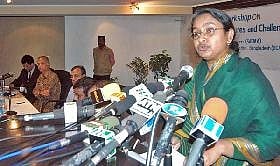
SAARC region 'least integrated': Dipu Moni
The SAARC region, home to 1.3 billion people, or a fifth of the world's population, is still one of the least integrated regions in world, said foreign minister Dipu Moni on Saturday.
bdnews24.com News Service
bdnews24.com
Published :
06 Jun 2009, 02:48 PM
Updated :
12 Aug 2022, 01:14 PM
Dhaka, June 06 (bdnews24.com)—The SAARC region, home to 1.3 billion people, or a fifth of the world's population, is still one of the least integrated regions in world, said foreign minister Dipu Moni on Saturday.
Voicing support for the South Asian Free Trade Agreement, however, she said the regional deal has increased Bangladesh's exports to SAARC countries.
"A widely held perception of SAFTA is that it has not been able to live up to its expectations. That is not entirely fair," the minister said on Saturday.
In the case of Bangladesh, her regional exports under SAFTA has grown from less than $100 million in 2000-2001 to about $370 million in 2006-2007, she told a workshop on Achievements, Failures and Challenges of the South Asian Association for Regional Cooperation (SAARC).
"But, the potential for intra-regional expansion is much greater," she added.
The foreign minister said the high level of protectionism was still a major obstacle to intra-regional trade growth.
SAFTA, signed at the Islamabad summit in 2004, only came into force on Jan 1, 2006, for promotion of free trade under SAARC comprising Afghanistan, Bangladesh, Bhutan, India, Maldives, Nepal, Pakistan and Sri Lanka.
One of the criticisms of SAFTA is that its effectiveness is undermined by lengthy 'negative lists' that include major export products as protectionist measures by member countries.
For instance, Bangladesh's key export items, ready-made garments and textiles, are included in India's negative list.
Greater market access through reduction of negative lists, elimination of trade barriers and other facilities are required to maximise free trade gains, said Dipu Moni.
"Considering that 60 percent of global trade is generated through regional trading arrangements, intra-regional trade in SAARC is only about 5 percent of the global trade," the foreign minister said.
According SAFTA, non-LDC members like India and Pakistan must waive import duties for products not included in their negative lists within seven years. Least Developed Countries like Bangladesh have 10 years to do the same.
The measures are aimed at increasing the volume of regional trade.
The foreign minister said creation of the SAARC Development Fund, setting up of a South Asian University and establishment of the SAARC Food Bank are some of the achievements of the regional body created in 1985 in Dhaka.
Foreign secretary Md Touhid Hossain said a poor level of trust among the members states stood in the way of SAARC's success in integrating the region.
"The level of trust is not adequate. And I think media can play an important role to build trust among peoples of the region," he said.
He said a common South Asian television channel could work in this regard.
South Asian Free Media Association (SAFMA) and the Diplomatic Correspondents Association (DCAB) jointly organised the workshop at the BRAC Centre Inn.
Prof Kazi Imtiaz Hossain, a director general at the foreign ministry, SAFMA secretary-general Zahiduzzaman Faruque, DCAB president Masud Karim and diplomats and journalists were among the speakers.
SAFMA president Reazuddin Ahmed presided over the workshop and senior journalist Zaglul Ahmed Chowdhury presented the keynote paper.
bdnews24.com/krc/rah/2058h