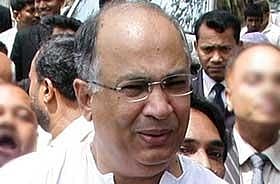
S Q Chy can't speak for self: ICT
The BNP MP cannot engage a lawyer and also advocate his case in the court, rules the tribunal
bdnews24.com News Service
bdnews24.com
Published :
04 Apr 2012, 03:42 PM
Updated :
09 Aug 2022, 03:37 PM
Dhaka, Apr 4 (bdnews24.com) — The war crimes tribunal ended up hearing BNP MP Salauddin Quader Chowhdury speak about his right to defend himself as soon as the tribunal called for bringing up the petitions.
The six-time MP had filed as many as eight petitions to the International Crimes Tribunal – 1, set up on Mar 25, 2010 to deal with crimes against humanity during the 1971 Liberation War.
The petitions will be heard on Apr 12.
Chowdhury's counsel Fakhrul Islam stood up to place the petitions that included an application for release on the grounds of arbitrary detention and transfer of the case to the Collaborators Act.
The petitions also include supply of legible copies of all documents provided by the defence, transcript of arguments and submissions before the court.
He also filed an application that the rules of procedure framed by the court were inadequate to conduct the case.
Chowdhury began with the release petition on the grounds of arbitrary detention, which the Chittagong MP said he would place personally.
But the tribunal head, Justice Nizamul Huq, shook his head indicating that it would not be allowed.
Also a former prime ministerial adviser in parliamentary affairs when BNP chief Khaleda Zia was in office, Chowdhury said, "But it is my right to defend myself."
Justice Huq said, "Not when you have engaged a lawyer."
Chowdhury then explained that according to the regulations of the bar council, he had to engage his counsels on the basis of their appearance at court and not for a case as a whole. "I have not engaged a counsel for today's hearing, nor have I instructed him."
Justice Huq said his hands were tied by the law.
S Q Chowdhury came back saying, "But that is exactly what I want to point out to you."
He said, "I want to conduct my own hearing but you are denying me the right and such denials could lead people to question the neutrality of this tribunal."
Justice Huq told Chowdhury, "You may think so, but that hardly matters."
Chowdhury then referred to section 17.2 of the International Crimes (Tribunal) Act of 1973 saying that, he also had some contribution of formulating laws suggesting that he knew what he was talking about.
The BNP MP then read out the section he was referring to, "An accused person shall have the right to conduct his own defence before the Tribunal or to have the assistance of counsel."
By this time it was clear that the tribunal would hear out Chowdhury's submissions who proceeded to say this option was the prerogative of the accused because the heading of that section reads "right of accused person during trial".
He said it was entirely up to the accused person whether to take assistance of the counsel or to plead the case by himself replying to prosecutor Zead-Al-Malum's contention that the 'or' in the cited provision meant that the accused could choose one or the other option but not both alternately.
When Chowdhury seemed to be digressing, Justice Huq said that he would be allowed his right to submit but nothing else.
To this, SQ Chowdhury said that he only meant to assist the court. "I will help."
Justice Huq said, "You are not helping."
Everyone, including the judges, laughed at the manner in which Chowdhury replied saying, "That is very unkind sir. You are being very unkind."
At one point Justice Huq told the BNP leader, that as much as the judges enjoyed his deliberations he must come to the point.
At one point of the arguments going back and forth, even Chowdhury's wife stood up to address the court. However, SQ Chowdhury did not let her go on for too long and asked her take her seat soon after she had begun to speak.
Chowdhury said that the right provided to the accused was not a matter of kindness or consideration but had to be granted. He said that the option of representing oneself or engaging a lawyer depended entirely on him.
Justice Huq then gave the order stating that while it was true that the accused could represent himself/herself, the provisions mentioned an 'or'. "This meant", the judge said, "that the accused could resort to either but not both together. If that were the intention then it would have said 'and' instead of the 'or'."
Justice Huq then said that the court had the papers of appointing counsels by S Q Chowdhury. The order said that Chowdhury would not be allowed to represent himself with that appointment operative.
Thus, as far as that petition was concerned, it was rejected.
bdnews24.com/ta/sk/2050h