'Political stability key to FDI'
A UNESCAP officials says instability signals investors to look for another destination
bdnews24.com News Service
bdnews24.com
Published :
21 Sep 2011, 01:31 PM
Updated :
10 Aug 2022, 05:29 PM
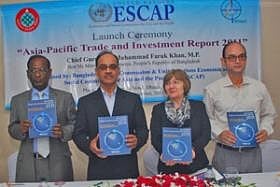
Dhaka, Sep 21 (bdnews24.com) – Presenting a trade and investment report of Asia and the Pacific, a UN official said political instability could chase away foreign direct investment from a country.
Mia Mikic launched the report on Wednesday, just a day before BNP's scheduled country-wide general strike.
The report predicts Bangladesh's export to grow at 15 percent in 2011 and 2012, which is higher than the average of several other countries in the region.
But the report shows that the foreign direct investment has been rather low in Bangladesh in the last five years. Three-fourths of all FDI in East and South-East Asia went to the five 'giants' –China, Hong Kong, Russia, India and Singapore.
The coordinator of the Asia-Pacific Research and Training Network (ARTNeT) of UNESCAP, Mikic did not explain clearly the reason of low FDI inflow in Bangladesh, but said political stability is an 'important factor'.
"Bangladesh government should not allow political instability."
She said political instability grows in one country sends 'signals to investors to look for another country'.
"FDI not only declined, but also disappeared from Nepal due to political instability," Mikic said.
However, commerce minister Muhammad Faruk Khan said his government is 'very much sincere' about political stability.
"Our prime minister is very responsible and democratic. We don't want political conflict," he said while speaking as the chief guest.
The minister said working together is the 'strength' of Bangladesh as he portrayed a rosy picture of trade and exports in his speech.
With the theme 'Post-crisis trade and investment opportunities' the UN's regional development arm ESCAP's report identifies challenges and opportunities for trade and investment in the region.
The report concludes that with strengthened regional cooperation and the right policies, the region will be able to continue its 'strong trade-and investment-led' growth.
It shows only 15 percent of Bangladesh's exports went to Asia-Pacific countries, while 63 percent of its imports came from the region.
The report identifies areas of opportunity in trade and investment for regional economies such as intraregional trade and investment, trade in services and trade and investment in climate-smart goods and technologies.
It offers three key sets of policy actions – strategies to reduce trade costs, small and medium enterprise export opportunities and mutually reinforcing multilateral and regional cooperation – to turn those opportunities into reality.
Mikic said Bangladesh has made 'big' improvement in reducing time to complete trade procedures, but a lot of work remains.
"Time to complete trade procedures were reduced by almost 40 percent – 40 days to 28 days – from 2005 to 2010."
"But cost to complete trade procedures decreased only by 1.6 percent during the same period."
She said trade costs of Asian developing countries with each other are much higher than with far-away countries like European Union and USA.
She also said in the present context climate-smart goods and technologies opened up new business opportunities.
"We consider 64 goods to be climate-smart. Trade potential is estimated to be $30 billion."
The report, however, says the export projection runs downside risks because of slow recovery of the global economy, rising oil and food prices and high inflation in most countries.
bdnews24.com/nih/ta/1922h