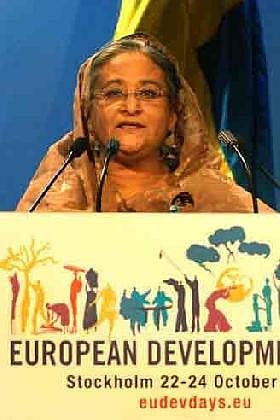
PM stresses urgent need for viable climate fund
Prime minister Sheikh Hasina, addressing a development conference in Stockholm on Saturday, stressed the urgency for worldwide action on climate change, seeking a "realistic" fund for Bangladesh and other vulnerable countries to viably face the fallout of global warming. bdnews24.com's Maruf Mallick reports from the Swedish capital
bdnews24.com News Service
bdnews24.com
Published :
24 Oct 2009, 11:35 AM
Updated :
12 Aug 2022, 01:58 PM
Maruf Mallick
bdnews24.com correspondent, reporting from Stockholm
Stockholm, Oct 24(bdnews24.com) – Prime minister Sheikh Hasina, addressing a development conference in Stockholm on Saturday, stressed the urgency for worldwide action on climate change, seeking a "realistic" fund for Bangladesh and other vulnerable countries to viably face the fallout of global warming.
She made the plea while delivering her address at the plenary session of the concluding day of the European Development Days 2009 summit in the Swedish capital.
Sheikh Hasina said Bangladesh and other countries most at risk to climate change impacts are anxiously looking forward to Copenhagen where the outcome must uphold the core principle of common but differentiated share of responsibilities for assured, adequate and easily accessible funding for adaptation.
The Least Developed Countries deserve special attention for their economic and climate plight, she said pointing out that Bangladesh and other developing countries deserve technical and financial support to face the challenges of climate change.
She called for the establishment of a realistic global fund to face the challenges of climate change.
The fund should be operational from 2010 onwards up to 2020 in the first phase and then extended beyond, Hasina said.
Every year, a substantial part of this fund should be kept aside for adaptation needs of the developing countries with maximum share going to the low lying coastal countries, LDCs and the small island nations, Hasina suggested.
Delay would only increase cost of adaptation and mitigation, she pointed out.
"As a global community, our destiny is now one. Climate Change is our common threat calling for common action. With no scope for a second chance, let us reject all self-centred discords and instead, embrace one another's responsibility, burden, prosperity and live in harmony."
But climate change mitigation must not impose constraints on measures taken for alleviating energy poverty, the prime minister said.
Describing the situation of Bangladesh and its neighbouring countries, Hasina said, "Today, we are distressed with the plight of our people caused by the adverse impact of climate change and global warming."
Though the emission of green house gas from our country is negligible, Bangladesh has been seriously affected by its fallout because of its topography as a low-lying country at the foot of the Himalayas.
South Asia, including Bangladesh, is prone to colossal tidal surges along the southern seaboard. Of late, Bangladesh has been subject to high level of monsoon rainfall, causing damaging landslides and widespread river erosions.
In dry season, lack of rain has been causing desertification in the north, and shrinking water flow in the rivers, resulting in salinity intrusion in the southern districts, she pointed out.
The international strategy for disaster reduction has thus placed Bangladesh as most vulnerable to floods, tsunami and cyclones.
The prime minister referred to scientific findings that indicate sea level rise up to one meter due to global warming which would inundate a fourth of Bangladesh, including the world's largest mangove forest, the Sundarbans, which is a UNESCO world heritage site.
Rapid melting of the Himalayan glaciers by as much as 23 meters annually is affecting over two billion people of south Asia, China and Indo-China.
This would leave some 40 million people in Bangladesh without livelihood and 20 million displaced by the year 2050. "Such a situation would swell our cities, causing social disorders, infrastructural crises and increased poverty".
Bangladesh is a resilient nation adapting to climate change. Some 14,000 cyclone shelters have been constructed while many more are the offing, she said.
She said Bangladesh has also adopted plans to change agricultural practices, develop crop varieties attuned to climate change, cover 20 percent of land area with forest by 2015 and protect bio-dibversity.
The prime minister said Bangladesh is preparing a strategic energy plan for following a low carbon path to development. This includes forestry, as well as developing a green belt through afforestation to create a large carbon sink, clean coal technology, nuclear power and renewable energy. Already 60,000 solar home systems have been installed.
"I would like to mention our government's concern over food security, which would clearly be affected by climate change. We have successfully adopted an agricultural programme that already made Bangladesh self-sufficient in food," said Hasina.
bdnews24.com/mrf/ec/1742h