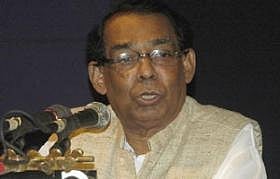
Parliament is sovereign: Suranjit
Amid controversy whether Bangladesh's parliament is sovereign, AL leader Suranjit Sengupta says it is not a rubber-stamp parliament.
bdnews24.com News Service
bdnews24.com
Published :
04 Jan 2011, 02:35 PM
Updated :
10 Aug 2022, 04:09 PM
Dhaka, Jan 4 (bdnews24.com) — Bangladesh's parliament is sovereign, says the parliamentary committee chairman on law ministry, a day after top judges commented that it was not.
"It's not a rubber-stamp parliament," Suranjit Sengupta told a press briefing at the parliament building on Tuesday.
On Monday, top judges from the High Court Division and Appellate Division at a full court meeting, chaired by chief justice A B M Khairul Haque, said they believed Bangladesh's parliament is not sovereign. And so the court is not bound to answer to the parliamentary standing committee.
The judges also agreed that the parliamentary committee's summons on the Supreme Court registrar to appear before it amounted to interference in the independence of the judiciary.
Suranjit on Dec 20 said the law ministry was working to enact a law to make any government official to appear before the parliamentary committee mandatory.
Regarding the judges' meeting on Monday, he said, "No such statement was delivered on behalf of the court."
The Awami League leader also said the decision taken in the meeting was not a judicial judgment as no certified statement on the meeting was issued.
"The media created the confusion by publishing reports based on information given by anonymous source," he added.
Sengupta said the press brief was arranged to remove the confusion.
He said the reports, published in the media stating that the parliamentary watchdog 'summoned' the Supreme Court registrar, were wrong.
"We did not summon him. We just invited him and he responded spontaneously," he added.
The registrar communicated to the parliamentary committee to speak about increase of the judges' pay-scale.
He also said, "The people own all power of the peoples' republic in line with the constitution.
The parliament members are representatives, who are elected by the people, he said, "The parliament elects the president, prime minister and speaker. The president appoints the chief justice. And so we can say that the parliament appoints all."
"The president appoints other judges following recommendations by the prime minister," he added.
bdnews24.com/arr/ost/am/1839h