


Published : 14 Dec 2021, 10:20 AM
Updated : 08 Apr 2022, 01:25 PM


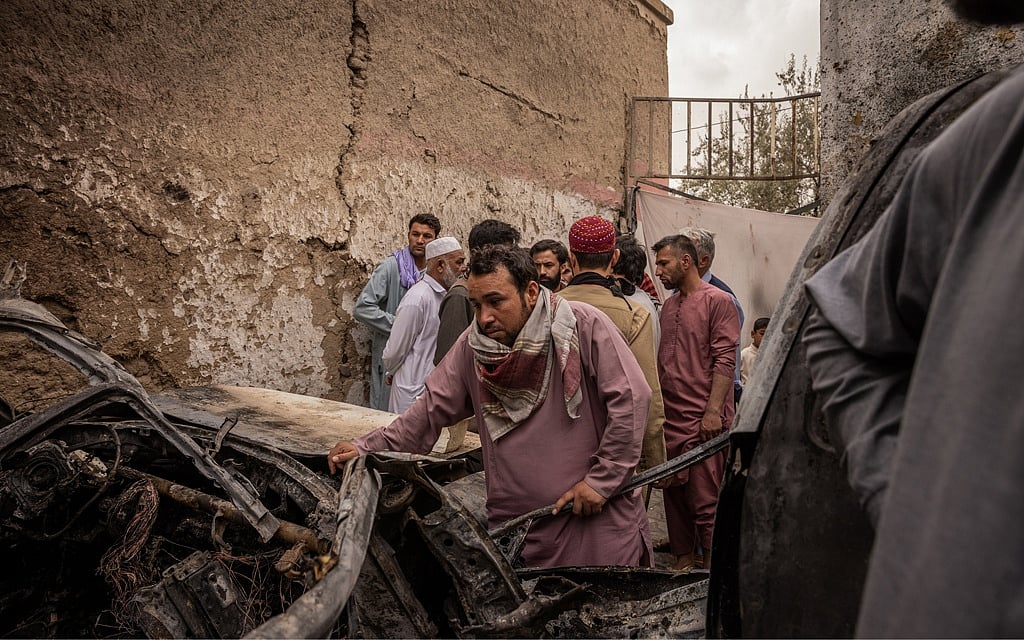
The Pentagon acknowledged in September that the last US drone strike before US troops withdrew from Afghanistan the previous month was a tragic mistake that killed the civilians, including seven children, after initially saying it had been necessary to prevent an Islamic State group attack on troops.
A subsequent high-level investigation into the episode found no violations of law but stopped short of fully exonerating those involved, saying such decisions should be left up to commanders.
Defence Secretary Lloyd Austin, who had left the final word on any administrative action, such as reprimands or demotions, to two senior commanders, approved their recommendation not to punish anyone. The two officers, Gen Kenneth F McKenzie Jr, the head of the military’s Central Command, and Gen. Richard D Clarke, the head of the Special Operations Command, found no grounds for penalising any of the military personnel involved in the strike, said John Kirby, the Pentagon’s chief spokesperson.
“What we saw here was a breakdown in process and execution in procedural events, not the result of negligence, not the result of misconduct, not the result of poor leadership,” Kirby told reporters.
“So I do not anticipate there being issues of personal accountability to be had with respect to the Aug 29 airstrike,” Kirby said.
The Pentagon had not acknowledged the mistaken strike until a week after a Times investigation of video evidence challenged assertions by the military that it had struck a vehicle carrying explosives meant for Hamid Karzai International Airport in Kabul.
In two decades of war against shadowy enemies like al-Qaida and the Islamic State group, the US military has killed hundreds, if not thousands, of civilians by accident in war zones like Iraq, Afghanistan, Syria and Somalia. And while the military from time to time accepts responsibility for an errant airstrike or a ground raid that harms civilians, rarely does it hold specific people accountable.
The most prominent recent exception to this trend was in 2016, when the Pentagon disciplined at least a dozen military personnel for their roles in an airstrike in October 2015 on a Doctors Without Borders hospital in Kunduz, Afghanistan, that killed 42 people. But none faced criminal charges.
Critics of the Kabul strike pointed to the incongruity of acknowledging the mistake but not finding anyone accountable for wrongdoing.
“This decision is shocking,” said Steven Kwon, founder and president of Nutrition & Education International, the California-based aid organization that employed Zemari Ahmadi, the driver of a white Toyota sedan that was struck by the US drone. “How can our military wrongly take the lives of 10 precious Afghan people and hold no one accountable in any way?”
Public scrutiny into military strikes against adversaries like the Islamic State group and al-Qaida that also killed civilians is intensifying. Austin last month ordered a new high-level investigation into a US airstrike in Syria in 2019 that killed dozens of women and children, and that military officials had tried to conceal.
On Sunday, an investigation by The Times revealed that the kinds of deaths in the Syrian strike were not isolated. The Times found that a top-secret American strike cell launched tens of thousands of bombs and missiles against the Islamic State group in Syria, but in the process of pounding a vicious foe, the commandos sidestepped safeguards and repeatedly killed civilians.
The higher-level inquiry into the Kabul strike by the Air Force’s inspector general, Lt Gen Sami D Said, blamed a series of erroneous assumptions, made over the course of eight hours as US officials tracked a white Toyota Corolla through the Afghan capital, for causing what he called “confirmation bias,” leading to the attack.
Said, in releasing his findings last month, found no criminal wrongdoing, but he said any other errors warranting disciplinary action would be up to senior commanders. “You should not perceive the fact that I didn’t call any individual out with accountability,” Said told reporters. “That just does not mean that the chain of command won’t.” But it did not.
The general’s investigation made several recommendations for fixing the process through which strikes are ordered, including new measures to cut down the risk of confirmation bias and reviewing the prestrike procedures used to assess the presence of civilians. Pentagon officials say they are incorporating those measures into a broader strategy to prevent civilian harm on the battlefield.
Gen Mark Milley, chairman of the Joint Chiefs of Staff, initially called the Kabul drone attack a “righteous strike,” but almost everything senior defence officials asserted in the hours, days and weeks after it turned out to be false. The explosives the military claimed were loaded in the trunk of a white sedan struck by the drone’s Hellfire missile were probably water bottles. A secondary explosion in the courtyard in the densely populated Kabul neighborhood where the attack took place was probably a propane or gas tank, military officials said.
Ahmadi, the driver of the white sedan that was struck by the US drone, had no ties to the Islamic State group, officials said.
McKenzie, head of the Central Command, said in a news conference in September that the strike was carried out “in the profound belief” that the Islamic State group was about to launch another attack on the airport. Three days earlier, a suicide bomber at the Kabul airport killed about 170 civilians and 13 US troops.
Since then, the Pentagon has offered unspecified condolence payments to the family of those killed in the drone strike. The Pentagon has also said it is working with the State Department to help surviving members of the family relocate to the United States, but negotiations appear to have bogged down in recent weeks.
“I’ve been beseeching the US government to evacuate directly impacted family members and NEI employees for months because their security situation is so dire,” Kwon said, referring to employees of Nutrition & Education International, where Ahmadi worked.
Kirby said Monday that Austin wanted to resolve the situation “as soon as possible.”
Top Defence Department officials were acting quickly “to get the identifying information that we need to help move family members out of Afghanistan as expeditiously as we can, and, of course, to better and safely affect the ex gratia payments,” Kirby said.
Congress has authorised the Pentagon to pay up to $3 million a year to compensate for property damage, personal injury or deaths related to the actions of US armed forces, as well as for “hero payments” to the family members of local allied forces, such as Afghan or Iraqi troops fighting al-Qaida or the Islamic State group.
Condolence payments for deaths caused by the US military have varied widely in recent years. In the 2019 fiscal year, for instance, the Pentagon offered 71 such payments — ranging from $131 to $35,000 — in Afghanistan and Iraq.
In the most recent example of one of these payments, the Pentagon has acknowledged that the military in Afghanistan paid $5,000 this year to a family there whose child was killed in an airstrike in January.
The Defence Department had notified Congress of this payment related to a civilian casualty but had not previously disclosed details of the strike.
In response to questions from The Times, Capt Bill Urban, a spokesperson for the Central Command, gave this account of what happened:
On Jan 8, Taliban forces attacked an Afghan security forces checkpoint in the Shindand district, near Herat. After Afghan troops requested US help, a US drone identified five Taliban fighters armed with small arms and rocket-propelled grenades. Two of the fighters broke away, repositioned and fired grenades at checkpoint.
American troops ordered a strike against the Taliban fighters firing the grenades. The drone operator scanned the target area, and after determining it was free of civilians, launched the strike against the Taliban fighters.
However, five seconds before the weapon hit the fighters, the drone operator saw a child approaching the target. Within two seconds, the drone operator tried to abort the strike and veer the weapon away. That failed, and the potential civilian casualty was reported immediately.
An investigation began Jan 9 and confirmed that while a child had been killed in the airstrike, the decision to conduct it was made properly, in accordance with the existing rules of engagement.
“We deeply regret the loss of innocent life associated with this strike and continue to strive to avoid such loss in the future,” Urban said in a response to questions from The Times about the strike.
© 2021 The New York Times Company













