Published : 12 Jan 2016, 03:00 AM
Updated : 11 Apr 2022, 09:34 PM


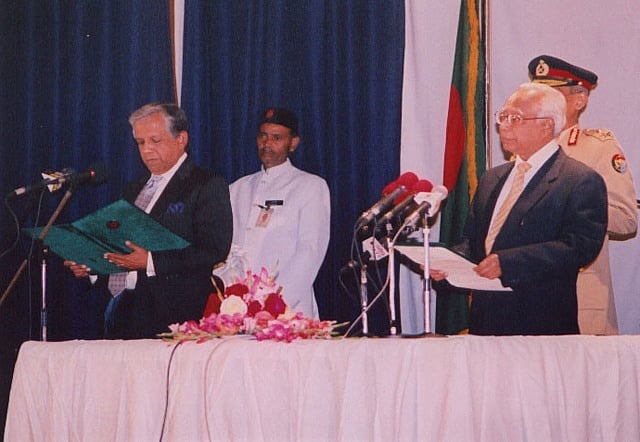
The military-backed caretaker government of Fakhruddin Ahmed came to the power on Jan 11, 2007, after toppling the Iajuddin Ahmed-led polls-time government.
Awami League chief Prime Minister Sheikh Hasina and BNP chief Khaleda Zia were among the top politicians to be arrested for corruption.
All political activities were banned under the state of emergency.
Freedom of expression was curbed.
The two major parties have always organised programmes to mark the day in the past few years.
But this year, the parties did not organise any such programme.
Both the major parties blame each other for the unacceptable change in power.
Politicians and members of the so-called civil society use the term ‘1/11’ to warn against threats to democracy.
Many term the attempt to eliminate Hasina and Khaleda from Bangladeshi politics during the Fakhruddin regime as the ‘Minus 2 Formula’.
Prime Minister Hasina has warned against such attempts several times.
“It is evident that the people who tried to implement the ‘Minus 2 Formula’ are still active. They want to hit us again,” she said.
On the other hand, BNP Chairperson Khaleda claims that the people who wanted to implement the ‘Minus 2 Formula’ actually wanted to destroy the BNP.
She blames the then army chief Gen Moeen Uddin Ahmed for the attempt.
“Moeen wanted to be like Ziaur Rahman by standing on the ruins of the BNP. Some black sheep from the BNP also joined them,” she said.
She has also promised that the BNP will try Fakhruddin and Moeen once the party comes to power again.
BNP leader Moudud Ahmed has asked Hasina why they have not been put on trial.
After coming to power in 2009, Awami league revoked the caretaker government system for general elections, and passed a law to punish anyone who takes power illegally.
But the BNP still demands the revival of the caretaker government system, and boycotted the elections on Jan 5, 2014, because the demand was not met.
What happened on Jan 1, 2007
On the evening of 1/11, amidst rumours and tension across the country, senior BNP and Awami League leaders met representatives from the United States, Britain, Australia, Japan and the European Commission at the residence of the Canadian High Commissioner.
Earlier the same day, President and Chief Advisor Iajuddin Ahmed had himself met the chiefs of the law-enforcing agencies. Later he met the chiefs of the Bangladesh Army, Navy and the Air Force at Bangabhaban.
After this meeting, the then army chief Moeen U Ahmed held another round of discussions with the chiefs of the air force, navy, police, Rapid Action Battalion, BDR (now BGB) and all the other law enforcing bodies including detective branches.
The president called the other advisers to Bangabhaban where the President himself resigned as the Chief Advisor. The other advisors also followed suit.
Soon after, a notification from the President’s office announced a state of emergency ‘for the sake of the country’s economy and for the security of the people’.
The order was put into effect that very evening and a curfew was imposed on all cities in Bangladesh.
In a late-night speech, the President announced that he had stepped down as Chief Advisor so that a general election could be held with the participation of all political parties.
The next day, Fakhruddin Ahmed declared himself the chief of the ‘caretaker government’.
The ‘one eleven’ event proved to be uncomfortable for all leading political parties. Over the next two years, Bangladesh witnessed numerous ‘ups and downs’ in the political arena.
Several top leaders and businessmen were arrested for corruption, and at one point, Sheikh Hasina and Khaeda Zia were also put under arrest for the same reason.
Later, sustained movements forced the ‘caretaker government’ to release them and to hold elections.
The army-backed government faced the toughest challenge from students. A massive all-out protest started from Dhaka University after a student was harassed by a soldier in 2007. Later, the protests spread throughout Bangladesh.
Many students and teachers of Dhaka and Rajshahi University were arrested.
After the 2009 elections, the Parliamentary Committee on the Education Ministry of the newly-formed Awami League-led government investigated the 'caretaker government'.
The probe report stated that the then chief and the army chief of the 'caretaker government’ were at fault, and recommended that they be brought to justice.