'Jamaat spawned vigilantes'
Moontassir Mamun repeats a previous statement that Ghulam Azam's party men were the main source of manpower for vigilante militia groups during the Liberation War.
bdnews24.com News Service
bdnews24.com
Published :
25 Sep 2012, 02:31 PM
Updated :
09 Aug 2022, 04:17 PM
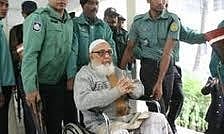
Dhaka, Sep 25 (bdnews24.com)�A prosecution witness against former Jamaat-e-Islam chief Ghulam Azam on Tuesday repeated a previous statement that Azam's party men were the main source of manpower for vigilante militia groups during the Liberation War in 1971.
Researcher and Dhaka University history professor Moontassiruddin Khan Mamun, better known Moontassir Mamun, also said during cross-examination he did not agree with the defence suggestion that the vigilante groups like Al Badr, Al Shams and Razakar were not separate entities but the former two were branches of the latter.
The three-judge International Crimes Tribunal -1, set up to try crimes against humanity during the 1971 War of Independence, indicted the Jamaat guru for seven war crimes including incitement, conspiracy, planning and abetment.
Ghulam Azam, as head of Jamaat, is said to have played a pivotal role behind founding the vigilante groups, responsible for widespread atrocities across Bangladesh in their bid to thwart pro-liberation efforts and eliminate liberation forces.
Senior defence counsel Mizanul Islam also suggested that Ghulam Azam's role during the war was 'entirely political', to which the history professor replied, "If loot, arson, plunder, rape and genocide are form 'political role' then I would say your suggestion is correct."
However, the first witness against Ghulam Azam, who said he had interviewed Pakistani Generals like Rao Farman Ali and Amir Abdullah Khan Niazi, besides others, could not confirm whether Niazi had made certain statements during the interview that Mamun had conducted.
While his initial reaction to almost each of these questions was his hallmark "I can't answer that without looking at the relevant documents", the professor changed his answers once the full question was recorded by the court.
Citing from his writings, the defence counsel asked him whether Niazi had told him that the Razakar, Al Badr and Al Shams were under his command and no one else's.
Mamun had initially said he would have to go through the interview of the man who led the Pakistani Army in Bangladesh in 1971 when answering the question. Then he said that the defence counsel was taking things out of context.
The witness also said Niazi was considered a clown even in Pakistan where no one really took him seriously. "And it does not prove that his statement was true since his statements must be weighed against the larger context of that time."
The counsel then referred to another answer where Niazi had told him that the vigilante groups were not in any way part of Jamaat. "I hate politicians and I don't even let them enter the Cantonment. Why would I then ask for a political party to help me?" Niazi had told Mamun.
The history professor repeated his answer and then added, "But the Jamaat historian Salim Mansoor stated the exact opposite."
Thus, the witness reasoned, the General's comments had to be analysed in light of the larger context.
The defence counsel then asked the witness whether the Jamaat had its own publisher. The professor said there was Jamaat-e-Taleba in Pakistan but was not sure about the pronunciation. "And in Bangladesh the daily Sangram is known as the party's mouthpiece."
Mizanul Islam then went on to suggest that no pro-Jamaat publication had published any such statement that the professor was referring to. It was duly denied by the professor.
Soon before wrapping up the cross-examination with contradictions, the defence counsel suggested that the professor was only giving false testimony to further his personal interests. The counsel also suggested that Mamun was only tainting Ghulam Azam driven by his own political ideology.
Mamun disagreed with the former suggestion, but the latter he said only after considerable subterfuge involving the court, prosecution and defence, "I cannot answer the question until you define my political ideology."
When the defence counsel suggested to Mamun that his claim of Jamaat men being the predominant force in manning vigilante groups, the professor disagreed but he failed to give specifics and said, "The Jamaat leaders never gave out exact numbers."
This ired the defence counsel who insisted that the professor should provide his own information and data to substantiate a claim he was making instead of shirking away from it citing lack of information from Jamaat.
This in turn sent prosecutor Zead-Al-Malum on his feet and objecting, "The witness is free to answer as he sees it. The answers will not necessarily be what the defence counsel desires."
Tribunal Chairman, Justice Mohammad Nizamul Huq asked him, "But can't he even tell the court that he is not satisfied with the answer?"
The answer, however, remained and the defence counsel relented as the court agreed to record its objection with the answer.
Malum stood up to repeat for the umpteenth time, "We object to the objection."
The tribunal chair said, "We shall memorise it that every defence objection was objected to by the prosecution."
Malum insisted that his objection be recorded, which the tribunal chair dismissed and asked the prosecutor to sit down.
bdnews24.com/ta/bd/1939h