


Published : 27 Aug 2012, 12:18 PM
Updated : 24 Apr 2022, 03:19 PM


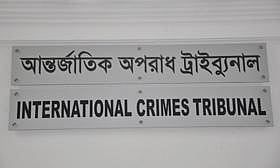
The second war crimes tribunal of Bangladesh on Monday rejected a petition seeking removal of all three judges, saying that it was "devoid of any merit".
The International Crimes Tribunal-2, set up to expedite war crimes trials, said, "We firmly hold that the petition is not maintainable and devoid of any merit, and is thereby rejected."
The application stated that the tribunal's independence and impartiality could be reasonably questioned by the average person because it had met Shahriar Kabir, a long time activist calling for the conviction of many of the Jamaat-e-Islami leaders who are currently behind bars for alleged war crimes.
Moving the petition for over two hours, Jamaat's chief defence counsel at the war crimes tribunals Abdur Razzaq based his arguments on Shahriar Kabir's statements as reported in the media and what kind of a signal it might send out to the average bystander.
Razzaq said Shahriar Kabir, who led a platform against killers and collaborators of the 1971 Liberation War, had publicly branded those on trial as war criminals and called for their conviction. Moreover, Razzaq said Kabir was the first prosecution witness in the war crimes case against Jamaat Secretary General Ali Ahsan Mohammad Mujaheed.
Mujaheed was a leader of Jamaat's student wing Islami Chhatra Sangha and succeeded Nizami, the current Jamaat chief, as its head in 1971. According to the prosecution, all Sangha members went on to join the Al Badr vigilante militia, which actively cooperated with the Pakistani Army to thwart liberation efforts and is alleged to be responsible for widespread atrocities during the war.
APPEARANCE OF BIAS
Abdur Razzaq brought a number of press reports to the tribunal's attention on Shahriar Kabir's comments to the media. Kabir had visited the tribunal and reportedly met with the second tribunal's judges on Aug 12.
The reports stated that Kabir, along with members of other activist organisations, called for the trial of war criminals. They branded the defendant of the case, Mujaheed, as a 'leading war criminal'. The reports also had Kabir saying that he expected at least 10 war crimes trials to conclude by 2013.
Razzaq also referred to reports that Shahriar Kabir and his companions had flouted security procedures which meant that he had been shown leniency.
Taken together, the chief defence counsel for Jamaat said the tribunal's meeting with such a person, an activist as well as a witness of the case, sent out a negative signal about the tribunal.
Razzaq said he was the last person to say that judges were biased. "But it could reasonably raise an appearance of bias."
The senior lawyer said Shahriar Kabir's statements after a meeting with the judges could actually lead the 'average bystander' to doubt the tribunal's impartiality and independence.
"A meeting," Razzaq said suggesting it was secret, "that was not disclosed to the public nor its proceedings announced officially."
But Razzaq said there was no need for the tribunal to go into any such controversy. He said the tribunal's judges would have 'felt embarrassed' to hear a case over far more trivial issues than that at hand.
The defence counsel said the judges should decide not to hear the case and pleaded that the tribunal pass an order removing all three judges from Mujaheed's case.
REBUTTAL
Prosecutor Syed Haider Ali opposed the application and said none of the reports sent any such message that raised a question of reasonable bias against the tribunal.
He took the tribunal through the reports, which he said was an individual's comments to the media about certain inadequacies of the tribunal's infrastructure.
The thrust of Kabir's statements, at least according to the prosecutor, revolved around pushing for sufficient logistics for the tribunal so that at least 10 trials come to an end by 2013, when the tenure of the current government is also expected to expire.
"He said he hoped that the trials would conclude by 2013. It is merely an individual expressing his desire. Anyone can do so without giving rise to concerns of bias."
Haider Ali continued that perhaps Shahriar Kabir had not followed the security procedures as he should have. "But there are some of the accused persons who are given even more of a VIP treatment. Because that is the kind of people who come here."
"There is no harm in treating a VIP like one."
Haider Ali said no such message as that made out by the defence had gone out to the public by way of the reports.
He then said the witness of a case was not a party to the case. "Where does it say in the code of conduct that a witness is a party to a case?"
The prosecutor said that the tribunal's meeting with Shahriar Kabir, a witness in a case, was inconsequential.
He said, referring to a judgement of a similar application at the first war crimes tribunal, the judges must be presumed to be impartial. "The presumption of impartiality is absolute and it must be presumed that the judges are acting impartially."
"If there is no allegation of bias then such an application should not even be heard," said Haider Ali.
To wrap up his arguments, the prosecutor pointed out that the relevant law did not have any such provision whereby the judges could pass such an order and furthermore, a similar application had been disposed of at the first tribunal earlier.
ORDER
The tribunal gave the order after the lunch recess. Tribunal chairman Justice A T M Fazle Kabir briefly summarised the arguments of both the defence and the prosecution.
He then went on that the tribunal felt there should be a few words about what had really happened given the questions raised by the defence.
Justice Kabir then described what had happened on Aug 12 in his order. The deputy register had sought permission saying that martyrs' family members (families of those killed during the 1971 Liberation War) wanted to meet the tribunal members.
The permission had come through the deputy registrar of the tribunal and the judges had not met anyone in the capacity of an institution or an activist.
He presented his findings and discussed inadequacies and the tribunal advised him to take up his concerns with the appropriate authorities.
But merely meeting individuals from martyrs' families did not constitute a disqualification of the judges, said Justice Kabir.
Furthermore, the defence petition was based on certain misconception since there was evidently a lack of knowledge about what had gone on between at the said meeting, which Justice Kabir said was not desirable.
The court said judges' impartiality could not be questioned in such a manner but had to be convincingly demonstrated. Allegation of conflict of interest should have been considered more seriously.
Currently the entire Jamaat leadership is in jail on war crimes charges. Among them are Jamaat guru Ghulam Azam, former party chief during the Liberation War, the current Jamaat chief Motiur Rahman Nizami, who headed Jamaat's student wing during the war, currently the Jamaat number two Ali Ahsan Mohammad Mujaheed, who succeeded Nizami in 1971, party's assistant secretaries general Abdul Quader Molla and Mohammad Kamaruzzaman, and its executive council member Delwar Hossain Sayedee.
The Islamist organisation's financier, Mir Quasem Ali, was arrested on Jun 17 for war crimes charges while investigations continue against him. A T M Azharul Islam, the party's acting secretary general was arrested on Aug 22 and sent to jail to facilitate investigations into alleged war crimes.







