


Published : 14 May 2013, 05:46 AM
Updated : 09 Aug 2022, 10:39 AM


The three-judge tribunal, led by Justice ATM Fazle Kabir, also set June 6 for hearing to frame charges against him.
Hrishikesh Saha stood for prosecution while advocate Saifur Rahman argued for Yusuf.
The tribunal in its order said Yusuf should not be granted bail if his crimes and political position are taken into consideration.
It also ordered the defence to submit the witness list on June 6 for the hearing.
Yusuf’s lawyers on Monday had pleaded for his bail on ground of his old age, 87, and ailment. They said he should get bail considering his physical condition.
They also complained that police had arrested his client before orders reached them. “This is unfair,” Saifur Rahman had said.
Opposing their argument, Hrishikesh Saha said, “AKM Yusuf was a top Jamaat-e-Islami leader in 1971 and formed the Razakars. He is still one of the top leaders of Jamaat.”
“Though his ailment is mentioned, yet he is active in politics and an executive council member of Jamaat. That’s why it will not be right to grant him bail taking his ailment into account,” Saha said.
Around Sunday noon, the tribunal took the prosecution’s charges against Yusuf into cognisance and ordered he be arrested and produced in court by May 26.
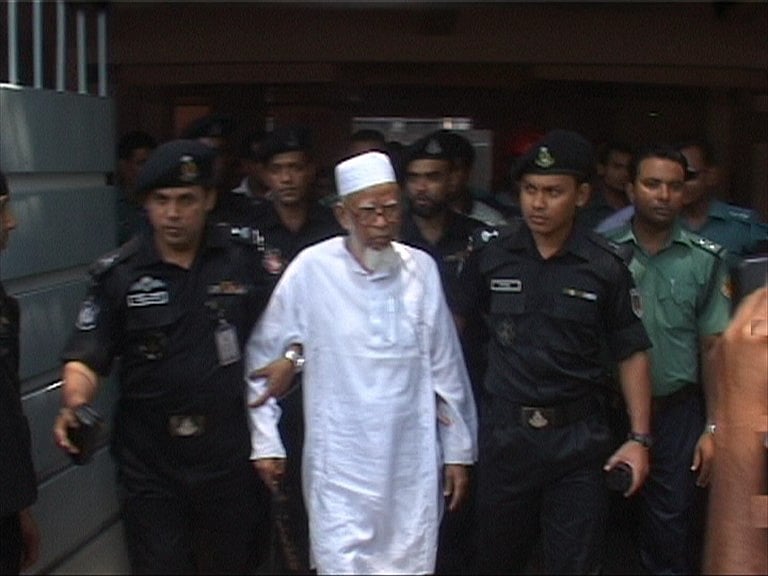
Immediately afterwards, Rapid Action Battelion (RAB) nabbed the Jamaat leader from his residence ‘Golap Villa’ in Dhaka's Dhanmondi.
Yusuf was taken to the tribunal after 4pm and the judge sent him to Dhaka Central Jail thereafter.
The prosecution had submitted the charges at the ICT registrar’s office on May 5.
On Apr 22, a probe panel of the prosecution filed a report accusing Yusuf of involvement in crimes against humanity on 15 counts, including mass murder, rape, arson and loot, during Bangladesh’s Liberation War.
Probe coordinator Hannan Khan had said they found evidence that the Razakars under Yusuf's command were involved in killing almost 700 people. There were also evidence against Yusuf of looting and setting fire to 300 houses, 400 shops and of forcibly converting 200 Hindus, he added.
Yusuf was a member of the so-called Malek Cabinet, a dummy government formed by Pakistan during the Liberation War. He was also Jamaat’s acting chief for some time.
Investigation Officer Helal Uddin said that Yusuf was the one who coined the term ‘Razakar’ for the support forces raised to collaborate with Pakistan during that time.
Investigation regarding the matter began on Jan 22 last year.
That revealed that Yousuf, Jamaat’s head of Khulna region and a former MP, had trained 96 Jamaat activists as Razakars in Khulna’s paramilitary camps. He also led all the anti-liberation war forces including the infamous Peace Committee, Razakars, Al Badr and Al Shams in the region.
The vigilante militia group Razakar — which has become synonymous with ‘collaborator’ in Bengali — supported the war effort of the Pakistani military junta during the 1971 Liberation War and committed widespread crimes against humanity.
The charges against Yusuf mentioned that he was in a superior position with command responsibility and assisted the Pakistani forces by giving directives and suggestions.
The investigation officials said Yusuf was both directly and indirectly involved in genocide, murder, rape, loot and arson that took place in different parts of Khulna during the war.
After the war, Yousuf was sentenced to life imprisonment under the 1972 Collaborator’s Order but was released from jail on Dec 5, 1973 after the then government announced general pardon.










