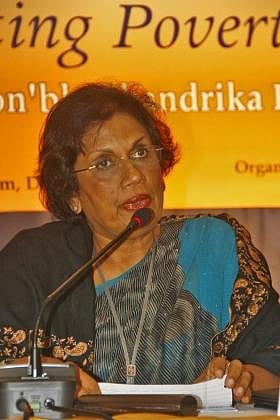
Inclusive society 'can cut inequities'
'Free and full' participation of all citizens in a democratic state can ensure 'sustainable' development, a former Sri Lankan president has said.
bdnews24.com News Service
bdnews24.com
Published :
25 Aug 2011, 04:38 PM
Updated :
10 Aug 2022, 05:20 PM
Dhaka, Aug 25 (bdnews24.com)—'Free and full' participation of all citizens in a democratic state can ensure 'sustainable' development, a former Sri Lankan president has said.
Otherwise, Chandrika Bandarnaike Kumaratunga said, 'government would soon deteriorate into dictatorship or anarchy and development into a farce.'
Lecturing on democracy and development in the capital on Thursday, the first female president of the South Asian Island nation pushed the idea of 'inclusive' society where development and its benefits are 'equitably distributed to all' and emphasised the link between development and good governance.
She portrayed the regional politics and economic development and shed light on the political situation of her own country where, she said, intimidation and killings of political opponents have become 'common' now.
But she observed the South Asian countries have the commonalities to 'work together.'
Kumaratunga said inequities in social, economic, political, and cultural aspects trigger violence and conflict, impeding the development process of a country.
"Development does not only imply building physical or economic and social infrastructure, it requires good governance and demands equitable and inclusive approach."
She said corruption in governance doubles the 'negative consequences.'
"In a nation where all citizens and communities feel satisfied that they are equal partners, sharing equally political rights, economic, social and cultural benefits, there will prevail political stability and economic prosperity."
She called it a 'cohesive and inclusive' society.
Studies of many countries reveal there is a significant rise in the probability of conflict in countries with considerable economic and social inequality, increasing by three times when they exist between different ethnic groups, according to her.
"Another study of Indonesia confirms a definite relationship between the occurrence of violent ethnic conflict and comparative economic and social deprivation of marginalized communities.
"Low levels of economic development are also seen to give rise to religious polarisation."
She said cultural inequalities have also engendered political instability, even conflicts of extreme violence while political inequality is another 'major cause of conflict.'
"There exists much evidence to demonstrate that inclusive government reduces probability of political instability and violent conflict, when power is shared and there exists less political inequality."
The nature of the state has also been found to impinge upon conflict.
.
The dismal failure of all Sri Lankan governments to resolve the problem of discrimination of the minorities led to the birth of five armed groups led by the LTTE, fighting for a separate State of Eelam.
"No credible alternative was offered by any government until my government did so in 1994."
She said religion mixed with politics is also not 'good.'
"Religious patronised politics in Pakistan gave rise to extremism while it is different in Bangladesh."
As some businessmen asked whether democracy needs to be redefined in South Asian countries, prime minister's advisor Gowher Rizvi said there is no wrong with democracy.
"Democracy fails when people lose trust.
"And it happens (loss of trust) when the government does not deliver."
He also emphasised on equitable distribution of resources as stressed by the former Sri Lankan president.
"But we need a comprehensive policy of social protection to protect democracy, as we noticed democracy's ability to distribute wealth has been stalled and inequity has started to widen."
Replying to a question of the opposition BNP lawmaker Moudud Ahmed on how Sri Lanka's elected government behaves toward the opposition since in Bangladesh intimidation on opposition is widely practiced, the president from Nov 1994 to Nov 2005 quipped: "We don't put them (opposition) into jail now, we buy them. If it does not work, we intimidate them and then kill them."
"But we didn't have that practice earlier."
"Our politics was liberal from the country's birth in 1948 to 1964 or 65, then it begun to rot little by little."
"I tried to stop this, but now you see 24 journalists were killed, three members of the parliament were killed and many others badly attacked," she said criticising the rule of the incumbent president Mahinda Rajapaksa.
Private research organision the Centre for Policy Dialouge organised the interactive dialogue.
bdnews24.com/nih/bd/2213h