ICT order on 'no grilling' plea Thursday
The prosecution petitioned for having depositions of 46 witnesses given to the investigation officer accepted as evidence against Sayedee. Tanim Ahmed reports
bdnews24.com News Service
bdnews24.com
Published :
28 Mar 2012, 08:47 AM
Updated :
09 Aug 2022, 03:35 PM
Dhaka, Mar 28 (bdnes24.com) — The war crimes tribunal will issue an order on Thursday in response to the prosecution's petition for having depositions of 46 witnesses given to the investigation officer accepted as evidence in a case against Jamaat-e-Islami leader Delwar Hossain Sayedee.
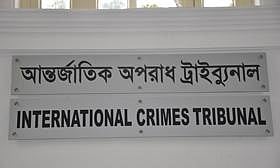
The International Crimes Tribunal, set up to deal with crimes against humanity during the 1971 Liberation War, on Wednesday heard senior defence counsel Abdur Razzaq counter the prosecution's petition.
The tribunal indicted Jamaat executive council member Sayedee on 20 counts of war crimes on Oct 3, 2011.
The senior defence counsel had his junior, Tanvir Ahmed Al-Amin, place the written reply before the court before beginning his arguments.
Abdur Razzaq, who represents the entire Jamaat leadership at the tribunal, six of whom are currently behind bars for war crimes charges, began by questioning the credibility of the investigation officer.
Razzaq pointed to a few instances where two or more depositions were "verbatim" copies of each other. "How is that even possible?!"
Razzaq argued that since the investigation officer was obviously fabricating these depositions, the prosecution's petition also based on the same person's report could not be acceptable.
Tribunal chairman, Justice Nizamul Huq then asked whether anomalies in one case warranted rejection of another report from the same source. "Can we say that since someone has got it wrong before, he has gotten it wrong this time too?"
"That is exactly my submission, your lordship," Razzaq replied.
The senior defence counsel also argued that it was not being possible for the prosecution to bring in witnesses because the witnesses were not willing to lie at the behest of the prosecution.
Razzaq claimed that since the prosecution had built a false case against Sayedee, but failed to find witnesses who would go along with their scheme, they have now resorted to this measure.
The legal provision that the prosecution had referred to was section 19.2 of the International Crimes (Tribunal) Act of 1973, which states that the court may accept depositions of people who were dead or in case of witnesses that would cause the court unreasonable expense or delay.
Razzaq's contention was that the prosecution had not been able to show that convincingly. He pointed out none of the witnesses were dead. "The witness testimonies began only in Decemeber 2011, and this March. This is hardly unreasonable delay. What is the need for expediting the case?"
As regards the witnesses who are supposedly sick or have become missing or as the prosecution put it, or have fled to India, Razzaq said there was no proof of that either.
Instead, he alleged that it was the prosecution who had arranged for the 'non-cooperating' witnesses to go elsewhere so that it could petition the court for this provision.
Razzaq said these depositions could not be taken in as evidence since that would seriously prejudice the defence and impede a fair trial.
The counsel referred to a few reports of the daily Naya Diganta and quoted potential witnesses claiming that they had been confined and tortured by the prosecution upon refusal to testify at the tribunal that suits the prosecution's case.
Razzaq said this was actually the main the reason that the witnesses could not be 'found'.
However, the tribunal reacted to the reports since this was a breach of the rules and broached upon a matter that was pending at the court.
Both the tribunal chairman and member A K M Zaheer Ahmed were aghast that the reporter had spoken to a witness and reported on it.
Justice Huq said the tribunal had been quite tolerant thus far issuing just one order and few warnings. "We had said in that order in our humble way how we would like to see the press and it is not that there cannot be any criticism."
He said, "We had hoped that the order would be enough. But that has not happened. There must be a limit to what you can do as a journalist."
When the tribunal said it would not take the paper's breach of conduct lightly, the senior counsel said that in such a case the tribunal would also have to initiate measures against a number of other publications.
Syed Haider Ali countered the defence arguments saying that his application was quite within the legal remits. He said he had stated his reasons and cited the legal provisions that clearly allowed what he was petitioning for.
The tribunal said it would give an order on Thursday.
FIRST CASE TO TRIAL
Sayedee's is the first case to proceed to the trial stage at the tribunal. The prosecution on Sept 4 last year proposed framing of charges against him on 31 counts for crimes against humanity and genocide.
On Oct 3 the same year, the tribunal indicted Sayedee on 20 counts including murder, rape, arson and loot.
The tribunal also sent Jamaat's former chief Ghulam Azam to jail on Jan 11. His indictment hearing began on Feb 15.
Besides Sayedee, Jamaat chief Matiur Rahman Nizami, secretary general Ali Ahsan Mohammad Mujaheed and assistant secretaries general Mohammad Kamaruzzaman and Abdul Quader Molla, and Bangladesh Nationalist Party's standing committee member and MP Salauddin Quader Chowdhury have been detained on war crimes charges.
The tribunal granted conditional bail to former BNP lawmaker and minister Abdul Alim on Mar 31 last year. The bail was extended on Mar 27 and Alim has been asked to submit a full medical report on Apr 22 when the prosecution has been ordered to place its formal charges against the BNP leader.
bdnews24.com/ta/bd/1420h