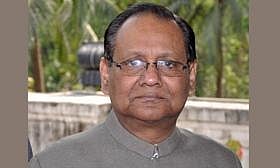
ICT judge Zaheer Ahmed bows out
The first war crimes tribunal member resigns on health grounds.
bdnews24.com News Service
bdnews24.com
Published :
28 Aug 2012, 08:52 AM
Updated :
09 Aug 2022, 04:11 PM
Tanim Ahmed
Dhaka, Aug 28 (bdnews24.com)— A member of the first war crimes tribunal of Bangladesh has resigned citing illness.
Judge AKM Zaheer Ahmed, who was present in the first session until 1pm, remained absent during the second half when the court convened after lunch.
He has been visiting the hospital for traction on a daily basis. Throughout Ramadan, when court hours had been advanced by half an hour, the judge would join around 11pm after visiting the hospital.
He had much trouble climbing steps and would take off his shoes before getting on the raised platform walking with much caution to his seat.
LAST DAY
Judge Zaheer's seat was conveniently the nearest to the judges' exit and he would be the last to enter and leave the court.
The judge had to climb two flights of steep stairs at the tribunal, housed in the Old High Court building, which once served as the chambers of the Chief Justice.
A few minutes to lunch recess, Judge Zaheer, seated to the left of the tribunal Chairman, was seen looking up and down across the courtroom, what later turned out to be his parting look. He also appeared to be smiling to himself just before the court rose.
He had the habit of greeting the court, not with a bow like his two colleagues, but by raising his hand up to just about his nose in the typical gesture of a 'Salaam'.
On Tuesday, his 'Salaam' appeared to linger slightly more than usual before he turned to leave behind the two other judges.
Speaking to bdnews24.com, Judge Zaheer said he was rather ill. "I have not been keeping well at all."
When asked about his retirement, the judge replied that he had already retired in 2010 as a Sessions Judge. "But yes, I expect to be spending much leisure now."
When asked if he would be writing a book on his experience at the tribunal, he said, "Well, I have only resigned today. And I have not really thought about it. But we will see about that."
Judge Zaheer Ahmed was appointed to the tribunal on Mar 25, 2010 along with Chairman Justice Mohammad Nizamul Huq and Justice A T M Fazle Kabir.
Almost two years later, Justice Kabir was appointed Chairman of the second tribunal on Mar 22, 2010 which was set up to expedite war crimes trials.
THE INTERPRETER
A former district judge of Satkhira and Comilla, Judge Zaheer Ahmed, of late, had taken upon himself the responsibility of an 'interpreter of sorts'.
He would explain complicated questions of the defence counsels put to the prosecution witnesses and dictate the answers for the benefit of the court stenographer.
There have only been prosecution witnesses so far at the first war crimes tribunal. The first defence witness is scheduled to be produced at the court in Jamaat-e-Islami leader Delwar Hossain Sayedee's case on Wednesday.
The only judge to be appointed at the tribunal from the lower courts, Judge Zaheer Ahmed would often come with, what he would call, 'minor queries' that turned out to be rather daunting for some lawyers.
He would typically engage with the lawyers in serious discussions as well as small talk, often making quips.
Naturally referring to Sayedee's case, which is the most advanced in both the tribunals, defence lawyer Mizanul Islam noted that the judge had been there from the beginning. His resignation at such a 'late stage' would somewhat encumber the proceedings.
A senior defence counsel leading Sayedee's trial, as well as those of other Jamaat leaders at the first tribunal, Islam said, "A new judge would have to become conversant with the evidence."
He said, "I don't know why he resigned but I wish him well. Lawyers develop a kind of relationship with the judges through long professional association and I had a similar experience here too."
Ahsanul Huq, the chief counsel for BNP MP Salauddin Quader Chowdhury, said, he would miss Judge Zaheer Ahmed "a lot". When asked why, he said, "Because he was a good man and very judicious."
Jamaat's chief defence counsel Abdur Razzaq said he was "surprised" that the Zaheer Ahmed had to leave "without any rhyme or reason".
He said this move would "not serve the course of justice" as the judge had been "level-headed and impartial".
"It was he who put difficult questions to the prosecutors." Razzaq went on to refer to one such instant in Jamaat acting Secretary General A T M Azharul Islam's bail when the judge had picked up on the Jamaat counsel's point questioning how Azharul Islam could destabilise the country while he was in jail, as the prosecution had claimed.
"The prosecutor could not answer the question." Abdur Razzaq said, "It is unfortunate that he had to go."
The counsel said that the tribunal had to earn the respect of everybody and appointment to the tribunal should be on a professional basis.
VOICE OF DISSENT
The outgoing judge had also been the only one to set an example of dissent when the tribunal passed orders on a 2-1 majority. On Mar 13, the tribunal rejected a number of petitions filed by the six-time MP from Chittagong, Salauddin Quader Chowdhury.
These included a second discharge petition (with additional grounds) on behalf of the BNP MP, which was rejected.
Judge Zaheer Ahmed added his dissent after the order stating that in his opinion the order for discharge petition should have been given in the presence of the accused. "The petitioner has the right to know why his petition is being rejected."
He said that he did not think a discharge petition was at all necessary and that the order should have been put on hold while the other orders could well be given out.
Again, on Mar 12, when none of the defence counsels had shown up to place two application or argue against the indictment of Jamaat guru Ghulam Azam, Justice Huq and Justice Fazle Kabir agreed that the two applications stood rejected. However, as regards the indictment hearing, the case was adjourned until the next day.
Judge Zaheer had taken serious exception to all this. He was visibly annoyed with the all-out absence of the defence counsels. The judge went on to add his dissent to the order saying that the tribunal's order opened up a can of worms.
While he noted that the adjournment decision had been a result of majority decision, the judge also stated that this opened the door for the prosecution to resort to similar action if they are not prepared to argue a case and set a bad precedent for future.
That day the defence had not shown up on account of the main opposition BNP's grand rally, which coupled with the government clampdown brought Dhaka to a virtual standstill.
bdnews24.com/ta/jr/bd/2116h