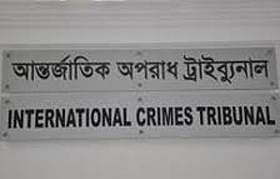
Hearing on Jamaat leaders' discharge pleas put off
The defence argues that the prosecution is politically motivated Updates
bdnews24.com News Service
bdnews24.com
Published :
16 Apr 2012, 12:01 PM
Updated :
09 Aug 2022, 03:40 PM
Dhaka, Apr 16 (bdnews24.com) — The war crimes tribunal on Monday deferred hearing cases of two Jamaat-e-Islami leaders to Apr 24.
Senior counsel Abdur Razzaq, representing the party's entire leadership at the tribunal, began his arguments in support of discharge petitions for Jamaat chief Matiur Rahman Nizami and his number two, party's secretary general Ali Ahsan Mohammad Mujaheed.
The International Crimes Tribunal-1 was set up on Mar 25, 2010 to deal with crimes against humanity during the 1971 Liberation War.
The tribunal was expected to hear common arguments in four cases but since the cases of two Jamaat assistant secretaries general were transferred to the newly-formed second tribunal, the first tribunal would not hear them any further.
Razzaq argued that the prosecution was politically motivated and thus the cases were malafide. "The Awami League considers Jamaat as a balancing factor and that is the reason behind these cases."
He said that if the tribunal found the cases to be malafide then it needed not go any further and could dismiss the charges immediately. That is why his first stance was to say that the cases were lodged with a political purpose.
Razzaq then submitted that the law was enacted in 1973 with the sole intent of trying 195 identified war criminals who were Pakistani officers, not citizens of Bangladesh. "My clients could perhaps be tried under the Collaborators Order but not this law."
Citing the examples of seven other war crimes tribunals including Nuremberg, Tokyo, Rwanda, former Yugoslavia and Sierra Leone, Razzaq said there was an inordinate delay of 40 years that the prosecution did not explain. "It was not that I (speaking for his clients) was abroad or had been away from the country. I was right here in Bangladesh and there was no hint of such trials before."
Razzaq also cited previous instances when the ruling Awami League had waged anti-government campaigns together with Jamaat but was now after the party.
He then began with specific arguments relating to the case against Nizami in which the prosecution proposes 15 charges against the Jamaat chief.
Mujaheed's case will be taken up after Razzaq is done with Nizami's case on Apr 24.
'HATE SPEECH AT MOST'
The prosecution had charged Nizami for incitement, provocation and creating panic through his speeches.
Razzaq said these speeches could not come anywhere near crimes against humanity going through quoted parts line by line and explaining what Nizami had meant.
He said that Nizami, chief of Jamaat's student wing the Islami Chhatra Sangha in 1971, was only a student then and it would be natural for him to make impassioned statements. "But those are merely political statements and nothing more."
"Supporting Pakistan certainly cannot be a crime."
He mentioned that murder, rape, arson, abduction, confinement, torture and so forth constituted crimes against humanity. "But the speeches, hate speech, as our foreign friends call them, do not constitute war crimes."
The senior counsel kept repeating 'war crimes' and although tribunal member Judge A K M Zaheer Ahmed corrected him, suggesting the more technically correct terms saying, "You mean crimes against humanity."
Razzaq accepted the correction but reverted to the more colloquial usage soon after.
He also submitted that there were no specifics in the allegations pointing to the lack of 'cause and effect'. He said, "The prosecution fails to establish that the speeches led to certain atrocities."
The defence counsel said there was not a single instance where the prosecution had been able to show a direct causal effect of Nizami's speeches.
As for command responsibility under Section 4.2 of the 1973 Act, Razzaq said, "The prosecution has not even tried to establish his command role."
He said Nizami was a mere student and wondered how he could have commanded so many people to commit the alleged atrocities.
JAMAAT CHIEF IN ICT
Matiur Rahman Nizami, headed Jamaat's student wing, that used to be called Islami Chhatra Sangha, in 1971.
The Islamist party's student cadres are said to have been instrumental in mobilising several fronts like Razakars, Al Badr and Al Shams that actively engaged against the freedom fighters to thwart the liberation forces.
These fronts were notorious for ruthlessly trying to subdue resistance against Pakistani occupation forces and full-fledged collaboration with the Pakistani Army.
The tribunal took charges into cognisance against Nizami on Jan 9 and set the indictment hearing to start from Feb 12.
On Dec 11, the prosecution brought formal charges at the tribunal against Nizami, secretary-general Ali Ahsan Mohammed Mujaheed and assistant secretary-general Mohammad Kamaruzzaman.
Indictment hearing of Mujaheed will follow Nizami's on Apr 24.
bdnews24.com/ta/nir/2039h