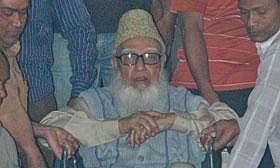
Hearing begins on charge against Azam
Tribunal says ruling on second bail petition for Jamaat's ex-chief on Feb 23, disposes of four other petitions Full story
bdnews24.com News Service
bdnews24.com
Published :
15 Feb 2012, 09:06 AM
Updated :
09 Aug 2022, 03:25 PM
Dhaka, Jan 11 (bdnews24.com) — The war crimes tribunal began hearing the formal charge against Jamaat-e-Islami guru Ghulam Azam on Wednesday.
The International Crimes Tribunal, set up to try crimes against humanity during the 1971 Liberation War, will continue hearing the charges against former Jamaat chief through Thursday.
The court, however, ordered that the previously scheduled testimony of prosecution witnesses against the party's executive member Delwar Hossain Sayedee would be heard first.
Earlier, after hearing a second bail petition for Azam, 89, the tribunal said it wanted to address all points made by the counsels of both sides and would give its verdict on Feb 23.
The former Jamaat leader had filed several other petitions that were heard and disposed of by the court until lunch. One petition, praying for adjournment of the charge hearing, scheduled to begin on Wednesday, remained pending.
The tribunal had ruled that the adjournment petition would be heard after lunch when the court reconvened at 2:15pm. But upon seeing that none of the senior lawyers were present, tribunal chairman Justice Nizamul Huq asked the prosecution to begin with its formal charge against the 89-year old former Jamaat leader.
Even before the chief prosecutor could begin in earnest, M Tajul Islam, who generally argues the cases of all six Jamaat leaders, entered the courtroom and upon seeing that the prosecution was about to begin with the formal charges, brought to the court's attention that there was still an adjournment petition pending.
The tribunal chief said the petition would be duly heard. However, in the meantime, the court merely wanted to advance other formalities.
Tajul Islam, however, was not convinced. Tribunal member, Judge A K M Zaheer Ahmed intervened to point out that the defence was actually getting time as it would have prayed.
Zaheer Ahmed asked the prosecution whether the voluminous forma charge would be read out to the full to which prosecutor Zead-Al-Malum said they would.
The judge then addressed the defence counsellor telling him that reading out the entire document would take at least five to six hours. "That means this is not going to be finished today. Chances are it will take another full day. Then [the prosecution] might present certain other things like clippings and such following which they will present their arguments."
The judge said that the defence could merely go through the formalities and said that a copy of the formal charge had already been served upon the defence and all that was going on was that the prosecution was reading it out.
Both the tribunal chairman and the judge assured the defence counsel that his team would get ample time for preparation and did not have to worry about it.
The chief prosecutor, Ghulam Arieff Tipoo, took up the responsibility to begin with the hearing and refused to allow a junior lead the charge.
The Jamaat guru's senior counsel, Abdur Razzaq, who also represents the party's top leadership, six of whom are currently behind bars charged with crimes against humanity, arrived around 2:30pm and joined the proceedings with his opposite number of the prosecution in full flow.
Tipoo had begun with a background of Ghulam Azam followed by an elaborate historical context of what used to be East Pakistan leading up to the Liberation War.
The tribunal chairman asked Tipoo to stop briefly and explained to the senior defence lawyer what was happening. He told Razzaq that the prosecution had merely decided to advance the formalities of reading out the charge.
Razzaq said he still wanted to make a submission and pointed out that the tribunal had thus far disposed of all such petitions before commencing with the case proceedings. "There is no reason that your lordship should deviate from that course."
Nizamul Huq replied that the tribunal was concerned with whether the defence was getting enough time.
Razzaq: But the point is about procedure, my lord.
Justice Huq: If it is the adjournment you are worried about, that will be duly considered later. It is true that we are not going to give an order in that regard today.
Razzaq: But when we are asking for an adjournment, we are praying for adjournment of the proceedings for both the sides. And that is what has happened so far.
Huq: Yes, so far we have given such adjournments because Tajul Islam had argued very strongly but we are not inclined to do so further. But as of now, this petition remains pending.
Razzaq: Let me be clear about it then. I will have the chance to present this petition once they have placed this petition and before they begin with their arguments.
Tajul Islam asked, "But what is the point of adjournment if we still have to sit at the court room?"
Zaheer Ahmed was the only one who appeared to appreciate Tajul Islam's sentiments and proceeded to suggest a solution. "Why don't you have a junior sit with the copy of the formal charge and go through it, as it is being read out. Not the entire defence team really needs to be here when the charges are merely being read out."
Abdur Razzaq then sought permission from the tribunal to leave the courtroom which was granted, as Tipoo resumed. He was followed by Rana Das Gupta who continued to read the charges until 4pm. It is set to continue tomorrow.
Earlier, the court heard four petitions and disposed of them. The first related to 15 illegible pages among the volumes of documents that the prosecution had supplied to the defence.
The court ordered that legible copies be given to the defence team in two days, after prosecutor Saiful Islam stated that there were only five illegible pages and not 15, as the defence had claimed.
The court also directed the prosecution to compare copies of the documents and take necessary steps.
The prosecution was further directed to furnish defence with some of the missing documents, which were not provided but were mentioned in the seizure list.
Abdur Razzaq submitted that the defence had not received copies of CDs, which the prosecution said had already been submitted to the court.
Tribunal chairman Justice Huq ordered the defence to collect them from the court.
DEENCE SEEKS COPY OF ORIGINAL COMPLAINT
The fourth petition of the defence asked for a copy of the original complaint that the defence claimed had triggered the investigation and led to the case.
Razzaq told the court, "This is the seed of the banyan tree that set off the thousand-mile journey." He argued that the complaint was at the heart of the case, so the defence had a right to have a copy of it.
He also pointed out that such a copy had been given to the defence, incidentally to the same team of lawyers, in Jamaat executive council member Delwar Hossain Sayedee's case. Razzaq said the court must do justice and must be equal in every case.
The tribunal chief, however, said, "It could have been a mistake. What if that is the case?"
He pointed out that the prosecution was expected to give the defence all documents that it would rely upon.
Countering Razzaq's petition, prosecutor Rana Das Gupta took the tribunal through several provisions, which, he said, made it clear that the complaint was part of the case diary.
Das Gupta also said legal provisions explicitly prohibited furnishing the case diary to the defence.
Razzaq then asked the court whether the prosecution would not rely on that complaint, to which the tribunal chief replied that they would not. "In fact, they will be forbidden to rely upon that complaint," Justice Huq said.
The application was rejected and disposed of.
AZAM'S BAIL PETITION
The court then heard the long bail petition, placed by Imran Siddiq. After Abdur Razzaq argued his case, chief prosecutor Ghulam Arieff Tipoo countered, saying the grounds for bail had remained more or less the same, as a similar petition for the same person had been rejected the last time.
Contending that the bail should be rejected, Tipoo said Ghulam Azam had been effectively the "mastermind and springboard in steering the paraphernalia of Jamaat" and other associate organisations like the infamous peace committees and Razakars, Al Badr and Al Shams.
All these organisations, he said, collaborated with Pakistani occupation forces in 1971, and actively engaged in thwarting the liberation forces.
Razzaq had argued that the Azam's medical condition had deteriorated. The senior counsellor argued that his client was suffering from weight loss, and had in fact been afflicted with diarrhoea.
The counsel cited a number of new reports from mostly the Jamaat's mouthpiece, Sangram, and another likeminded daily newspaper, Naya Diganta, citing Ghulam Azam's wife and her pleas that her husband was extremely ill.
Razzaq said the accused needed to be given home-cooked food, and required better medical attention, which was not possible at the Bangabandhu Sheikh Mujib Medical University's prison cell.
Razzaq said that merely because this was a sensational case and his client is accused of having committed heinous crimes, "It was not a sufficient ground to deny bail."
He cited other cases pointing out, "Heinousness of the alleged crimes, as argued by the prosecution, was not a ground for refusal of bail."
Secondly, Razzaq continued, even when the facts point towards a prima facie case, which he argued the facts did not, the accused could be enlarged if the person in question were a woman, infirm or extremely ill.
Furthermore, the counsel argued that denial of bail had to be in public interest. He also said that the facts as presented by the prosecution did not point to the fact that his client was guilty and hence could be freed on bail.
Tribunal member Justice A T M Fazle Kabir asked Razzaq whether the defence had submitted any document, any report, or any record that substantiated his claim of Ghulam Azam's failing health.
Abdur Razzaq replied that the defence was not allowed to have any such reports about Ghulam Azam since he was effectively in jail. "Your lordships can, however, demand to see such reports."
Justice Kabir asked him whether the defence had submitted any material to convince the tribunal about what he was claiming.
Razzaq said that his client had been at the prison cell of the medical university from day he was sent to jail on Jan 11. "He has been kept at the hospital for the last one month and five days. That is an obvious proof that the man is ill."
Tipoo said that old age complications were an act of God and men could hardly do anything about that. The chief prosecutor said pleas from his wife, or such prayer that the accused needed assistance for his natural calls and would only accept the assistance of his wife, did not constitute sufficient grounds for enlarging the accused on bail.
When judge Zaheer Ahmed asked the chief prosecutor whether he had any counter arguments about the instances that Razzaq had cited, Tipoo dismissed them outright. "They have no bearing on this case since the nature of the crime is completely different from those that had been cited."
Tipoo said that the gravity of the case was far more than the ones that the defence counsellor had referred to. "This case is of an entirely different footing."
He submitted that the prayer for bail be rejected.
Ghulam Azam left the premises soon after the court broke for lunch. The hearing continued in his absence.
The former Jamaat chief had made a feeble attempt to address the court during one of his bail petitions. When Razzaq brought that to the court's attention, the tribunal chairman said, "But he addresses the court through you."
When Razzaq said his client had expressed a desire to address the court, Justice Huq told him that the court was not inclined to hear the accused directly.
On Dec 12, the prosecution brought a 52-point charter of charges against Azam and appealed for his arrest. Later, following the tribunal order, charges were re-arranged and presented to the tribunal on Jan 5.
Azam had allegedly led the infamous 'peace committees' and collaborated with the Pakistan Army during the Liberation War. He also spoke in favour of Pakistan to the Middle Eastern countries during the war, according to the prosecution.
He stayed in London for seven years after 1971 and returned to Bangladesh in 1978 during Ziaur Rahman's rule. Having led Jamaat for long, Azam retired from active politics in 1999.
bdnews24.com/ta/std/bd/