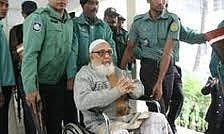
'Ghulam Azam was like Hitler'
Human rights activist and war-time nurse Sultana Kamal deposes against Jamaat-e-Islami guru for the fourth consecutive day Full story
bdnews24.com News Service
bdnews24.com
Published :
13 Sep 2012, 10:46 AM
Updated :
09 Aug 2022, 04:15 PM
Tanim Ahmed
Dhaka, Sep 13 (bdnews24.com)—Human rights activist Sultana Kamal on Thuesday drew an analogy between Jamaat-e-Islami guru Ghulam Azam and Adolf Hitler during her cross-examination by Azam's defence.
Appearing as the third defence witness at the first war crimes tribunal against the 89-year-old former Jamaat chief, Sultana Kamal was asked whether Ghulam Azam headed any of the wartime vigilante groups like Razakar, Al Badr or Al Shams.
The 63-year old wartime nurse told the tribunal that just as the German Chancellor, who led the Holocaust, was not officially at the helm of the Nazi Party, so was Ghulam Azam not directly linked with the vigilante groups. "Azam was not in charge officially," she said pointing out, "Motiur Rahman Nizami, who headed the infamous Al Badr was [Azam's] subordinate in Jamaat. As such Azam was a supra power."
Regarding the social front of the anti-liberation forces during the 1971 war, the witness conceded that Azam might not have been among the main leaders, "But he took it upon himself to organise and strengthen the Peace Committees and the Razakars."
She said Ghulam Azam was like the public face of these forces.
The three-judge International Crimes Tribunal-1, set up to try crimes against humanity during the War of Independence in 1971, indicted Ghulam Azam for complicity, incitement, planning and conspiracy of war crimes.
Azam, as the leader of Jamaat during the war, is also widely said to have acted as the springboard for vigilante militia groups like the Razakars, Al Badr and Al Shams which are alleged to have committed widespread atrocities during the war.
She asked, "How else then could Ghulam Azam boast of the Razakars being enough to annihilate the liberation forces on Dec 1, 1971 in Pakistan? He must have had strong control over those forces."
Sultana Kamal, daughter of the famous poet and activist Sufia Kamal, said during her long reply of the question that she believed Ghulam Azam and Hitler were comparable to each other.
Mohammed Kafil Uddin Chowdhury, Azam's defence counsel conducting the cross-examination for the day, as counsel Mizanul Islam was busy cross-examining another high profile witness at the second tribunal, protested that such a long statement need not have come in as an answer to his question, which he said was quite relevant.
The tribunal Chairman, Justice Mohammad Nizamul Huq, after recording the gist of Sultana Kamal's answer, over the audible mutters among the defence counsels, told Kafil Uddin that he should not ask such questions that allow the witness pass an opinion, which would naturally make his task more difficult.
The defence counsel then had the witness confirm that Hitler was at the helm of Germany before and during the World War II, and President Yahiya Khan was at the helm of Pakistan. The witness then also agreed that Tikka Khan was the Governor of the then East Pakistan but Ghulam Azam, the accused, was not in such a position of authority at that time.
Mizanul Islam was at hand after lunch and registered a slight protest saying the answers were rather long and making it difficult for the defence to wrap their part by the cut-off time.
He resumed the cross-examination suggesting that Sultana Kamal was distorting history, since she drew an analogy between Ghulam Azam and Hitler, although all books and historical records drew that analogy between Hitler and Pakistan's President, Yahiya Khan or East Pakistan Chief Martial Law Administrator General Tikka Khan.
The witness replied, "Then I am adding Ghulam Azam with them."
"And you are adding that from today?" asked Mizanul Islam to which Sultana Kamal, a lawyer by training, said, "I mention it today since the question did not come up before."
This was not, however, included in the records.
MILITARY-CIVILLIAN RELATIONSHIP
The second half of the proceedings saw much animated discussion over non-military influence in military activities going back and forth.
The defence had at first asked Sultana Kamal whether strategy and tactic of any mission would be either decided upon or approved by the regular military forces.
Sultana Kamal reminded the counsel that this was a theoretical question hinting that it may not apply to the context at hand. She said under normal circumstances, it was generally the case that military forces were in control.
Although prosecutor Syed Haider Ali protested to say that these questions were a matter of military policy and the witness was not in a position to answer such question, Justice Huq told him to sit down saying, "We have already spent much and we want to finish this by today."
The defence counsel after a few other questions then made a suggestion that opened the literal can of worms.
Mizanul Islam suggested that only civilian whose name is linked to the Operation Searchlight on March 25, 1971 was Zulfikar Ali Bhutto besides Yahiya Khan and Tikka Khan.
Bhutto, then the leader of Pakistan People's Party, went on to become the Pakistani Prime Minister.
Sultana Kamal agreed with the suggestion and quickly added that she wanted to remind the court of something and referred to the defence suggestion that the military did not always have control over the non-military forces.
"We clearly see here that non-military quarters may well have strong influence over military operations as is the case here," said the witness to much satisfaction of the conducting prosecutor Zead-Al-Malum.
He kept dipping his head to one side approvingly as the witness glanced at his direction while Malum looked eager to see how the defence counsel ventured from there.
The tribunal had also found it amusing and after recording the initial answer asked Mizanul Islam, "Should I have the rest noted down too? What do you say?"
The defence counsel said he had no objection but thought it was quite unnecessary.
But as the tribunal recorded the witness pointing out that there were indeed cases where non-military personnel had influence and control over military actions, the defence rose up in protest saying that his question was only regarding Operation Searchlight.
In the end, however, Sultana Kamal's point was recorded in the proceedings.
The defence counsel did not proceed any further with his questions and quickly switched to contradiction at a slight suggestion of the tribunal. The cross-examination was wrapped up in another hour after that.
bdnews24.com/ta/bd/1943h