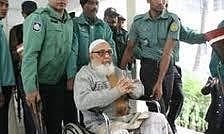
'Ghulam Azam symbol of enemy'
Human rights activist Sultana Kamal tells International Crimes Tribunal.
bdnews24.com News Service
bdnews24.com
Published :
10 Sep 2012, 08:23 AM
Updated :
09 Aug 2022, 04:14 PM
Dhaka, Sep 10 (bdnews24.com) — Human rights activist Sultana Kamal on Monday said Ghulam Azam had become the symbol of the enemy just like nation's founding father Bangabandhu Sheikh Mujibur Rahman symbolises the freedom struggle.
Appearing as the third prosecution witness of the war crimes case against the former Jamaat-e-Islaim chief, the 63-year old freedom fighter told the first war crimes tribunal that of the many names that they had heard — like Matiur Rahman Nizami, Ali Ahsan Mohammad Mujaheed and Abbas Ali Khan — Ghulam Azam's was the one most often repeated.
"It was like the war was between liberation forces and those led by Ghulam Azam."
The three-judge International Crimes Tribunal-1, set up to try crimes against humanity during the nine-month War of Independence, indicted Ghulam Azam on Apr 13, 2011 for incitement, planning, conspiracy and abetment to commit crimes against humanity during the war when he headed Jamaat.
A war time nurse at the Bangladesh Field Hospital in a place called Bisramganj in the Indian state of Tripura, Sultana Kamal said during her testimony that of the right-wing religion-based parties like the Pakistan Democratic Party, Muslim League and Jamaat, Ghulam Azam-led Jamaat featured most strongly.
Sultana Kamal, also daughter of the late poet and activist, Sufia Kamal, said the religion-based parties that had sided with Pakistan and against the liberation forces actively collaborated with the Pakistan Army. "They set up secret killing squads like the Al Badr and Al Shams."
Head of human rights organisation Ain of Salish Kendra, Sultana Kamal went through her experiences from just before the war broke out in March of 1971 and continued until she had crossed the border to India and joined a hospital to work as a nurse and tend to wounded freedom fighters.
Given her mother's involvement on the social and cultural front campaigning for democratic rights alongside the mainstream political movements of the late 1960's, Sultana Kamal said she always had a keen interest in politics. "We were always eager about the power handover after the elections."
The witness said her family lived on the same street in Dhammondi as that of Bangladesh's founding President Sheikh Mujibur Rahman. "On the evening of Mar 25, we could clearly see that Pakistani soldiers were setting up machine guns pointed at his house."
She also took the court through the course of events of that evening past midnight when the Pakistani Army descended on an unsuspecting civilian population and killed people at random in Dhaka as well as other district towns.
Sultana Kamal continued to recount from 1971 how her house gradually became a hub and a communication centre of sorts for pro-liberation forces.
However, at one point, the human rights activist, also a lawyer by training, said she had to flee Dhaka with her sister into India. There she went on to join the hospital and ended up tending to the wounded.
The witness said she was regularly in contact with freedom fighters and came to know of what was going on inside the country from guerrilla fighters returning from action and from the media.
Sultana Kamal's deposition will resume on Tuesday as the proceedings were adjourned before the lunch recess.
At the second tribunal, Awami League's Deputy Leader in Parliament, Syeda Sajeda Chowdhury's lawyer appealed for more time to file a reply to an application for holding her in contempt for certain remarks she had reportedly made at a public meeting.
Senior lawyer Abdul Baset Majumder prayed for a three-week adjournment of the hearing.
The three-judge International Crimes Tribunal-2 granted the prayer and scheduled the next hearing on Oct 1.
bdnews24.com/ta/bd/1720h