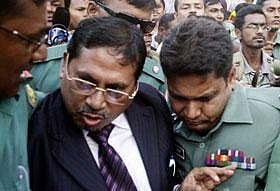
Camp guard links Kamaruzzaman with atrocities
The man recounts his experience at the gates of the camp where local Al Badr chief Mohammad Kamaruzzaman lived in 1971 Full report
bdnews24.com News Service
bdnews24.com
Published :
25 Jul 2012, 08:20 AM
Updated :
09 Aug 2022, 04:03 PM
Dhaka, Jul 25 (bdnews24.com) — The guard of an Al Badr camp in Sherpur linked Jamaat-e-Islami Assistant Secretary General Mohammad Kamaruzzaman with atrocities during the 1971 Liberation War.
Monwar Hossain Khan, currently an office assistant at a local school, used to work as the guard of the vigilante militia Al Badr mobilised mainly by Jamaat's student cadres from the Islami Chhatra Sangha.
Appearing as the second prosecution witness, the 63-year old man recounted his experience at the gates of the camp where the local Al Badr chief Mohammad Kamaruzzaman lived during the War of Independence.
Set up to expedite the trials of crimes against humanity during 1971, the International Crimes Tribunal-2 indicted the Jamaat leader on Jun 4 for seven war crimes charges.
Also known as Mohon Munshi, the witness described a number of incidents in his rustic Sherpuri dialect.
Clad in white kurta-shalwar and a white prayer cap, Monwar Hossain has a milky flowing beard to match. He leant on his black walking stick as he stood in the witness stand.
With no formal schooling, the near 20-year-old boy had taken to working in his grandfather tailor's shop. One of the vigilante camps in Sherpur fell on his way to the shop from home.
The animated witness said how he had been appointed as the camp guard before describing what he had seen at the camp.
Mohon Munshi had enrolled in a training programme for a paramilitary outfit, which he could not specify. But he said they trained for three hours every day for three months. However, there was no payment or benefit except for bread, which they got a month into the training.
This training, the witness had hoped, would get him into the paramilitary Ansars. "The training ended about 15-20 days before the Liberation War began."
About 17 or 18 days after Sheikh Mujib's speech, said the witness, there was news of people fleeing from Dhaka and other cities.
"It was around this time that Kamaruzzaman called the youths and elderly along with the local leaders one day and announced that they should invite the Pakistani Army from Jamalpur."
The next day, the Jamaat leader left early in the morning with 50-60 people. "They returned by 2pm."
It was around this time that Hindus prepared to leave Sherpur and go to India in 10-15 vehicles. They were blocked and their belongings looted where Kamaruzzaman was present. "He told Surendranath Saha, 'There is no point leaving like this. Why don't you come and we can talk about this?' And the two went to Suren Saha's house."
The witness said he was present at the scene but could not go to the meeting. "However, the next day Suren Saha's house was seen flying a Pakistani flag and it had been taken over by Kamaruzzaman."
It was at this house that the accused set up an Al Badr camp and the witness served as a guard.
Another house was forcibly taken over, which housed the local Peace Committee, said the witness.
Once the Pakistani Army arrived, Kamaruzzaman arranged for their camp to be set up at the Noi Ani Bari after which he became the head of Al Badr.
When the local vigilantes approached the witness and asked him to join them and train the recruits, since the local boys could not understand Urdu commands, Mohon Munshi's parents advised him to flee.
He eventually had to return after the Razakar and Al Badr men threatened to burn down their house and persecute his other brothers.
Mohammad Kamaruzzaman then told him that there was a space in his camp where he could stay at the foot of the stairs. "Sometimes I stayed at the camp (Suren Saha's house) and some other times I would return home."
Another time when the Sherpur civil surgeon, one Dr Askar, was brought to the camp, his wife came along too and requested that the man be released. But Kamran, one of Kamaruzzaman's aides, said nothing could be done. "He said that the commander, meaning Kamaruzzaman, would be back around 7-8pm, and only he could decide."
Once the Al Badr did return, the civil surgeon's wife had a long talk with him and then Kamaruzzaman finally agreed to let him go.
Another time when one Golam Mostafa had been caught, Kamaruzzaman called up a Pakistani officer, a Major Reaz and said his people had caught an Awami League 'seedling'. "Reaz had said that he should be kept there until the major came around after the evening prayers."
However, the Al Badr men had tied up Mostafa and beaten him so severely that he kept crying out loudly from the foot of the stairs which was officially the witness' guard post.
But soon afterwards Mohammad Kamaruzzaman left the camp and was closely followed by another aide Nasir, who dragged Mostafa out. "They returned about half an hour later without Mostafa."
"I heard Nasir say that the commander could now shoot really well. 'His aim has gotten much better,' said Nasir." The two had apparently shot the man.
Come evening, when the Pakistani officer arrived and inquired after the Awami 'seedling', Kamaruzzaman told him that Nasir had taken him away. "The Major became angry at this, and said, 'I told you to keep him here. Has Nasir become such a big guy that he does not need to heed orders?'"
When Nasir was pointed out to the Major, he hit him with the butt of a rifle and the man tumbled down the stairs.
Another time a Hindu man was forcibly converted by Kamaruzzaman at the orders of Major Reaz who found him to be quite brilliant. The Al Badr commander duly complied.
Once when the Major was injured, shot in the hand and leg, he was being taken to Dhaka by a helicopter accompanied by Kamaruzzaman's aide Kamran. The Jamaat assistant secretary general wrote a letter and handed it to Kamran saying, "Give it to our Sir."
When another asked who this 'sir' was, Kamran reminded him, "Don't you remember the telegram that came a few days from Ghulam Azam? He is our 'Sir'."
The witness remembered another time when Mohammad Kamaruzzaman left with a band of Razakar and Al Badr militia men for raiding a local village. "He said there was information that freedom fighters had come to the village."
The next morning, the witness said the Al Badr commander returned with a truckload of bodies. "He said there should be an announcement in the town saying that they had killed thousands of freedom fighter but brought a few to show the town's people."
The witness, who had been a guard for about four to five months — he could not remember exactly how long but said, "Not more than seven months".
Prosecutor Saiful Islam conducted the deposition and concluded it at 1pm. Mohammed Kafil Uddin Chowdhury began cross-examining the witness after lunch. He is set to resume on Thursday.
The prosecution submitted formal charges against Kamaruzzaman on Jan 15 and the tribunal took cognisance of offences on Jan 31.
The Jamaat leader's war crimes investigation began on July 21 in 2011 and he was subsequently shown arrested and in the custody of the tribunal on Aug 2 the same year.
bdnews24.com/ta/nir/2132h