Speaking at a rally at Dhaka University’s Curzon Hall, organised by the central Peace Committee, he had said that the dreams of Bengali Muslims would one day come to fruition if they remained with Pakistan.
Prosecutor Sultan Mahmud, going through the closing arguments of Ghulam Azam’s case at the war crimes tribunal, read out the newspaper clippings covering the Peace Committee’s celebration of Pakistan Independence Day. He explained to the tribunal, “He had in fact rightly identified the reasons for the Liberation War and yet chose to oppose it.”
The prosecutor exclaimed, “There is a limit to hypocrisy!”
The three-judge International Crimes Tribunal -1 of Bangladesh, set up to try crimes against humanity during 1971 Liberation War, indicted the former Jamaat chief for five war crimes charges including incitement, complicity and conspiracy.
The prosecutor has already summed up the case for charges of conspiracy and planning. He got through 25 out of 28 incitement counts levelled against Azam, who headed Jamaat’s East Pakistan unit during the Liberation War.
On Aug 14 that year, when the erstwhile East Pakistan was in the middle of the war to gain independence, Azam was trying to inspire his audience to act against the ‘enemies sitting at home’ and resisting them.
Reading out the news reports, Sultan Mahmud pointed out that Azam had actually touched off the main reasons of Liberation War like equality, economic emancipation, similar opportunities and so forth.
At the same gathering, Azam is also reported to have profusely praised the Peace Committee for assisting the Pakistani Army in its courageous actions to defend the country.
On another occasion, Prosecutor Sultan Mahmud told the judges, on Jul 16, 1971, Azam told a meeting of Rajshahi Peace Committee that there was no evidence of Hindus being true friends of Muslims.
Citing newspaper reports, Mahmud said that Jamaat leader had incited communal enmity saying that ‘Hindus were creating a rift between Muslim brothers on the basis of language’.
Azam had told his audience on that occasion that murder of Muslims had become a daily affair in India. Even while the larger neighbour had been cooperating with Bengalees with refuge and other support, Ghulam Azam told his followers that India was conspiring to break up Pakistan.
Ghulam Azam allegedly urged ‘all Muslims to discard the Bengali and non-Bengali mentality’.
“This,” said the prosecutor, “clearly shows the communal attitude of the accused.” He said that first defence witness had tried to establish Azam, his father, as a secular man.
On Aug 2 that same year, Azam spoke at the Dhaka University Gymnasium where he likened the ongoing ‘war situation’ to ‘Jihad’ and said that the war was not limited to weapons anymore, rather it had become ‘a war of ideals’.
The prosecutor said invoking the spirit of Jihad, which was fought between Muslims and the infidels, Azam had in fact incited further communal violence and was essentially directing his followers to eliminate those who sided with the liberation forces saying that they were not proper Muslims.
The formal charges state that on Aug 6 in Kushtia, Ghulam Azam had “declared that Sheikh Mujibur Rahman and the banned Awami League had entered into an alliance with India and had betrayed the common people of the region”.
“You went on to state that this betrayal had caused endless pain and sorrow for the people and future generations would not forgive them,” stated the indictment order, which the prosecutor backed up with newspaper reports of the time.
Speaking to the press at Lahore Airport on Aug 17, Azam apparently said that with India sending in ‘armed insurgents’ and helping the ‘miscreants’ the only path left open to Pakistan was reply in kind — with arms.
The prosecutor said this clearly amounted to incitement. “There is clear incitement throughout the entire speech.”
On Aug 23, 1971 Azam said that the true believers of Pakistan, the Muslims, were making sacrifices to protect the unity of their country from ‘separatists’.
On other occasions, Ghulam Azam ladled the Pakistani Armed forces with commendations for its actions and repeatedly asked his followers to assist them with all they had.
He also asked ‘Muslims’ not to shirk away from making all kinds of sacrifice to protect the integrity of Pakistan.
The prosecutor said, “By comparing Pakistan with Islam, Azam had turned those fighting for independence into infidels and instigated his subordinate forces into further violence against the genuinely patriotic liberation forces.”
<b>Jamaat Guru in ICT-1</b>
On Dec 12, 2011, the prosecution brought a 52-point charter of charges against Azam and appealed for his arrest. Later, following the tribunal order, charges were re-arranged and presented to the tribunal on Jan 5.
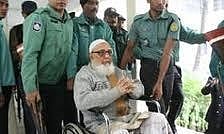
He was produced before the tribunal on Jan 11 and sent to jail the same day. Since that evening, the 89-year old former Carmichael College professor has been kept at the prison cell of the Bangabandhu Sheikh Mujib Medical University for better treatment considering his delicate health.
Ghulam Azam’s indictment hearing began on Feb 15 and the court charged him on May 13.
A former chief of Jamaat-e-Islami, arguably the largest Islamist organisation in the subcontinent, Azam is allegedly among the key people who pioneered anti-liberation efforts in 1971 colluding with the Pakistani military junta of that time.
He is widely perceived to have been among core group of right-wing supporters of the Pakistani Army, who came out strongly in support of a united Pakistan.
Ghulam Azam, then chief of Jamaat, was instrumental in setting up the infamous Peace Committee at the national level. The Razakars, an auxiliary force set up mainly to actively thwart the liberation forces, are said to have been mobilised through the Peace Committees across Bangladesh.
Among the most notorious vigilante militia are the Al Badr, whose membership is said to have been mainly dominated by the Jamaat's student wing called the Islami Chhatra Sangha at that time.
The Al Badr is alleged to have spearheaded execution of the intellectual elites of Bangladesh just days before the victory on Dec 16, 1971.
Azam also spoke in favour of Pakistan to the Middle Eastern countries during the war, according to the prosecution.
He stayed in London for seven years after 1971 and returned to Bangladesh in 1978 during BNP founder Ziaur Rahman's rule. Having led Jamaat for long, Azam retired from active politics in 1999.
His party remains a key ally of the main opposition BNP. Two Jamaat leaders, also behind bars for war crimes charges, have even served as ministers during the BNP's last tenure in government between 2001 and 2006, when Azam's party was part of the ruling coalition.
Azam was indicted on five charges including incitement, conspiracy and abetment.