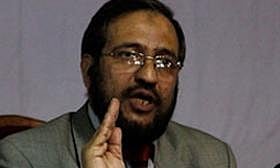
Azam's son gagged media
A second lieutenant in 1982, he controlled and monitored BTV news broadcast and programmes. Full report
bdnews24.com News Service
bdnews24.com
Published :
19 Nov 2012, 11:55 AM
Updated :
09 Aug 2022, 04:32 PM
Dhaka, Nov 19 (bdnews24.com)—Jamaat-e-Islami guru Ghulam Azam's son spoke about his role in gagging the media during a martial law regime at the first war crimes tribunal on Monday.
Abdullahil Amaan Azmi said he had been posted to look after the programmes of Bangladesh Television as a young second lieutenant in 1982.
An infantry officer of 30 years, the former Brigadier outlined his work in step-by-step detail for the benefit of the three-member International Crimes Tribunal-1, set up to try crimes against humanity during the 1971 Liberation War.
The tribunal indicted Azmi's father Azam, a former Jamaat chief, with five war crimes charges on May 13. His charges include conspiracy, abetment and incitement.
On the fourth day of his deposition, Azmi also touched upon Indo-Bangladesh relations in South Asia's geo-strategic context.
Media censorship
Azmi said that martial law regimes habitually censored and monitored the media strongly in a bid to ensure that the rulers are not cast in too negative a light that might fuel discontent among the public.
In this case, the ruler was the deposed military dictator former lieutenant general, Hussein Muhammad Ershad, later to become President. He was overthrown in a public uprising in 1990.
With this in mind, the witness said the military rulers typically controlled the media, especially as far as news was concerned.
Azmi said that at the state-owned television in the early 80's — private television stations surfaced more than a decade later — he would have to be physically present at all live programmes so that there was nothing strongly critical.
In case of drama or other entertainment programmes, the young second lieutenant would be present physically during recording only to make sure that the content was acceptable to the military rulers.
The programming officer, said Azmi, would bring to him a list of the day's schedule for approval every day. "If there was anything questionable, I would go down to the archives and have a look."
If the young army officer were not satisfied, he would order the necessary changes or refer it to his senior officer, said Azmi.
Only upon the young lieutenant's sign of approval would the national broadcasters air the programmes.
Around 20 years of age, Azmi was also charged with monitoring the daily news of Bangladesh Television. "The newscaster would bring the full news script to my office several hours before going on air."
Azmi would then go through the news from top to bottom. "And then I would sign the script on the top and at the bottom of every page as approval."
However, if he found something unacceptable, Azmi would either refer it up or try and effect the change. "Sometimes, when there was sensitive content, I would station myself at the [production control room] next to the newscaster from where the broadcast could be controlled."
As an example, the former Brigadier General, who served his initial years under a martial law regime where the army chief ruled supreme, Azmi said one radio newscaster had pronounced the name of Jessore area's chief martial law administrator wrongly.
RAM Golam Muktadir, was pronounced Ram (as in Gandhi's famous last words) Golam Muktadir, instead of pronouncing the alphabets separately. "That newscaster was suspended within hours. That is the extent of control we exercise."
This part of the session had been of much interest to those in attendance, especially to the media for getting such a candid confession from an insider. The tribunal also appeared to have been entertained.
"So the person was suspended because he had pronounced a name wrongly?" asked a tribunal member, to which Azmi nodded gravely.
Judging that the witness had reached the end of one part of his deposition, tribunal member Justice Jahangir Hossain said, "So you are deliberating on how good it is to have a martial law?"
"How strict it is," corrected Azmi stressing on 'strict'.
"Oh I see, I thought being a former military officer you would say [martial law] is rather good." It was evident from the judge's smile that he was only joking.
"I suppose it is best I refrain from making any comments," said Azmi, still very grave.
He then moved on to Indo-Bangladesh relationship and the regional context.
Indo-Bangladesh relations
Azmi said India's role in the subcontinent was of much concern from even before the partition in 1947.
He cited a number of instances where Indian leaders like Jawaharlal Nehru blatantly stated their resolve to take over smaller independent states like Hyderabad, which was eventually followed through.
Azmi also cited Nirad C Chaudhuri as stating that India had planned to take over, what was then, East Pakistan.
Jaiprakash Narayan, the Indian independence activist who famously led the opposition against Indira Gandhi in 1970, had apparently advocated for capturing East Pakistan, by military means if necessary, according to Azmi.
Azmi then went on to point towards Indian role in the subcontinent and its influence. He also spoke of Indian endeavours within the South Asian region specifying countries, which the tribunal expunged from the court records and instructed the media not to report on it.
The tribunal's deliberation had been preceded by Prosecutor Sultan Mahmud's intervention saying that if such statements, that he presumably found inflammatory, were accepted as court proceedings, "Then it would give out a wrong message."
"Who is he to comment on regional political history? On what authority does he speak on these matters?" wondered the prosecutor.
The tribunal Chairman, Justice Mohammad Nizamul Huq reassured him saying, "We are here and we are also thinking about it. Let him go on and we will record whatever we deem appropriate."
A senior defence counsel Mizanul Islam said he only had one small remark. "Is the Indo-Bangladesh relationship so light that it will be rocked by the strength of a single testimony?"
The tribunal then decided to take out the part of the deposition that had names of countries. Justice Huq said, "I believe the defence case is that Ghulam Azam had good reasons to back Pakistan and view Indian interest with apprehension. That case is still made by the comments that will remain on record."
Azmi said he would speak on the bilateral relations with India since 1971 and show how his father's apprehensions had come true.
Justice Huq told the defence counsel that the tribunal would not have a word of that. He said, "He can at best say that the Indian role had not been satisfactory, but that is hardly going to do any good."
Azmi is expected to resume his deposition in Tuesday's second session. The defence counsel reassured the tribunal that his witness would be done with the deposition within another half session and move on to submitting exhibits.
Azmi is still to speak on his father's life and politics.
Jamaat Guru in ICT-1
On Dec 12, 2011, the prosecution brought a 52-point charter of charges against Azam and appealed for his arrest. Later, following the tribunal order, charges were re-arranged and presented to the tribunal on Jan 5.
He was produced before the tribunal on Jan 11 and sent to jail the same day. Since that evening, the 89-year old former Carmichael College professor has been kept at the prison cell of the Bangabandhu Sheikh Mujib Medical University for better treatment considering his delicate health.
Ghulam Azam's indictment hearing began on Feb 15 and the court charged him on May 13.
A former chief of Jamaat-e-Islami, arguably the largest Islamist organisation in the subcontinent, Azam is allegedly among the key people who pioneered anti-liberation efforts in 1971 colluding with the Pakistani military junta of that time.
He is widely perceived to have been among core group of right-wing supporters of the Pakistani Army, who came out strongly in support of a united Pakistan.
Ghulam Azam, then chief of Jamaat, was instrumental in setting up the infamous Peace Committee at the national level. The Razakars, an auxiliary force set up mainly to actively thwart the liberation forces, are said to have been mobilised through the Peace Committees across Bangladesh.
Among the most notorious vigilante militia are the Al Badr, whose membership is said to have been mainly dominated by the Jamaat's student wing called the Islami Chhatra Sangha at that time.
The Al Badr is alleged to have spearheaded execution of the intellectual elites of Bangladesh just days before the victory on Dec 16, 1971.
Azam also spoke in favour of Pakistan to the Middle Eastern countries during the war, according to the prosecution.
He stayed in London for seven years after 1971 and returned to Bangladesh in 1978 during BNP founder Ziaur Rahman's rule. Having led Jamaat for long, Azam retired from active politics in 1999.
His party remains a key ally of the main opposition BNP. Two Jamaat leaders, also behind bars for war crimes charges, have even served as ministers during the BNP's last tenure in government between 2001 and 2006, when Azam's party was part of the ruling coalition.
Azam was indicted on five charges including incitement, conspiracy and abetment.
bdnews24.com/ta/bd/1921h